" transform="translate(5 2)" width="10px"/></svg>)

•
5 min read
Dyslexia Dictation Software: Skip the Keyboard (August 2026)
•
5 min read
Dyslexia Dictation Software: Skip the Keyboard (August 2026)
Most people think dictation software is a speed tool. For adults with dyslexia, the right dyslexia writing software is something more specific: it removes the part of writing that was never really about writing. The spelling, the error-checking, the second-guessing word choices mid-sentence. When you speak instead of type, that overhead disappears, and what you're left with is just the thinking. Getting there takes choosing a tool built for accuracy, beyond one that technically transcribes your voice.
TLDR:
Adults with dyslexia produce longer, more detailed written work with voice dictation because speaking removes the spelling encoding task entirely.
35% of dyslexic individuals face job performance difficulties tied to writing; voice dictation can cut that friction at the source.
Free tools like Apple Dictation and Google Docs Voice Typing run at 85-95% accuracy and 700ms+ latency, creating correction loops that recreate the original problem.
Dedicated tools reach 98%+ accuracy with ~200ms latency, plus filler removal and custom vocabulary that learns your specific terms over time.
The best dedicated tools offer 98%+ accuracy, ~200ms latency, cross-device vocabulary sync across Mac, Windows, and iOS, and a free unlimited plan with no word cap.
Why Typing Creates an Outsized Burden for Adults with Dyslexia

The ideas are there. Getting them onto the page is the problem.
For adults with dyslexia, the keyboard introduces a second cognitive task on top of writing: tracking spelling, second-guessing word choices, scanning for errors, and running constant mental corrections. That overhead hits before a single meaningful sentence lands. By the time the error-checking is done, the original thought is gone.
over 40 million U.S. adults have dyslexia. Most carry the gap quietly into their professional lives, avoiding written tasks or spending two or three times longer on emails than colleagues do. The cost shows up at work: 35% face dyslexia-related job performance difficulties directly tied to their condition.
The keyboard was never a neutral tool. For adults with dyslexia, it can function as a filter that strips out their best thinking before it reaches anyone else.
How Speech-to-Text Removes the Writing Bottleneck
Research consistently shows that people with dyslexia produce longer, more sophisticated written work when using voice dictation compared to typing or handwriting. The reason is structural, not motivational.
Typing forces two simultaneous tasks: forming the idea and encoding it into spelled words. For dyslexic adults, that second task pulls heavily on working memory. Research on speech to text for dyslexia shows the result is a constant interruption loop where the mental energy that should go toward thinking goes toward letter sequencing instead. Voice dictation collapses that loop. When you speak, the software handles spelling entirely. The word lands correctly on screen whether or not you know how to spell it.
That shift changes what writing feels like. The anxiety around spelling, which for many dyslexic adults operates as background noise throughout every sentence, disappears. What remains is just the thinking.
Features That Actually Matter for Dyslexia Writing Software
For dyslexic adults, the gap between a tool that helps and one that frustrates comes down to a handful of specific capabilities.
Transcription accuracy
Non-negotiable. Every uncorrected error sends you back into the loop the tool was supposed to eliminate. Look for best AI speech to text tools that hold 98%+ accuracy across natural speech, not just clean studio recordings.
Latency
A lag of 700ms or more disrupts your flow reliably. As voice dictation and flow state research shows, the pause breaks concentration at exactly the wrong moment. Sub-200ms latency keeps dictation feeling like thinking out loud.
Filler word removal
Speaking naturally means "um," "uh," and false starts. Automatic filler removal lets you speak at full conversational speed without a second editing pass.
Cross-application support
A tool locked to one browser forces constant window-switching. System-wide support, meaning the same hotkey works across email, Slack, documents, and every other text field, removes that friction entirely.
Custom vocabulary
Names, technical terms, and company-specific words misfire most. A tool that learns your corrections and stops repeating the same mistake is worth far more than one that requires manual fixes every time.
Dictation for Work: Emails, Notes, and Documents
For adults with dyslexia, app-locked dictation creates a specific problem: every window switch is an interruption that can break the train of thought you were trying to capture. System-wide dictation, where the same hotkey works in Gmail, Slack, Notion, Teams, Google Docs, or any other text field, removes that friction entirely. You speak wherever your cursor is. The text lands there.
Meeting notes taken directly into Notion or a Word doc while the conversation is still fresh
Email replies drafted by speaking, without touching the keyboard at all
Slack messages sent at the same speed you'd deliver them in person
Reports or forms filled out field by field using voice
Custom vocabulary matters here too. Generic dictation often misfires on colleague names, product names, and industry jargon. A tool that remembers your corrections and stops repeating the same mistakes is where the daily friction actually shrinks.
Dictation on iOS: What Works on Your Phone and Tablet
The iPhone keyboard has a built-in microphone. Tap it, speak, and text appears. For quick messages, that baseline works. For adults with dyslexia using voice as their primary writing method, the limitations surface fast: it struggles with names and technical terms, won't remove filler words, and doesn't learn from corrections, so the same misfires repeat indefinitely.
A dedicated voice keyboard replaces the system microphone with AI-powered accuracy, filler removal, and vocabulary learning, active across every app without switching windows.
What Cross-Device Continuity Actually Looks Like
Willow Voice offers a custom iOS keyboard that works directly in Mail, Notes, Messages, or any browser. Custom vocabulary syncs from your desktop setup, so the correction loop you've already reduced on Mac or Windows doesn't reappear when you pick up your phone.
Free Dictation Tools vs. Dedicated Software: Where the Tradeoffs Are
Free tools are genuinely capable starting points, but the best voice to text software goes well beyond what Apple Dictation, Windows 11 voice typing (Win + H), and Google Docs Voice Typing offer out of the box, cost nothing, and handle everyday vocabulary reasonably well. For occasional dictation, they can reduce keyboard time without any setup.
The tradeoffs become more visible when voice is your primary writing method.
Feature | Free Built-In Tools | Dedicated Software |
|---|---|---|
Accuracy | 85 to 95% on general speech | 98%+ with context awareness |
Filler word removal | No | Yes |
Custom vocabulary learning | No | Yes, improves over time |
Cross-app support | Varies; often app-limited | System-wide |
Latency | 700ms+ | ~200ms |
For adults with dyslexia, the accuracy gap carries more weight than it might for other users. Every misfire is a correction loop, which is exactly the burden voice dictation is supposed to remove. A tool running at 90% accuracy still forces regular error-checking. Whether that tradeoff is acceptable depends on how heavily you rely on dictation and how much time you can give to cleanup.
Getting Better Results from Voice Dictation
Most of the quality gap between a frustrating dictation experience and a fluid one comes down to setup, not the software itself.
Microphone
Built-in laptop mics pick up keyboard sounds, room reverb, and ambient noise at the same time. That background bleed reduces accuracy noticeably. A USB headset with a close-talk mic positioned an inch or two from your mouth, or wireless earbuds with a built-in mic like AirPods, removes most of that noise at the source. The hardware upgrade alone can close much of the accuracy gap before the software even processes a word.
Environment
A quieter room matters more than a better microphone. Fans, open windows, and background music all compete with your voice signal. If a dedicated quiet space is not available, facing away from noise sources and speaking slightly louder than conversational volume helps.
How to Speak
Speak at your natural pace instead of slowing down to enunciate. AI dictation tools are trained on natural speech patterns, so slowing down or over-enunciating often produces worse results. With automatic punctuation for dictation, you can stop saying "comma" and "period" manually. Voice commands like "delete that" or "scratch that" handle corrections without touching the keyboard.
Letting the Learning Loop Work
Most dedicated tools improve as they accumulate corrections. When a name or term misfires, correcting it once teaches the software. The second and third time that term appears, it lands clean. The correction loop shrinks over time, and that is where the real daily benefit accumulates for someone relying on voice as a primary input method.
Willow Voice for Adults with Dyslexia
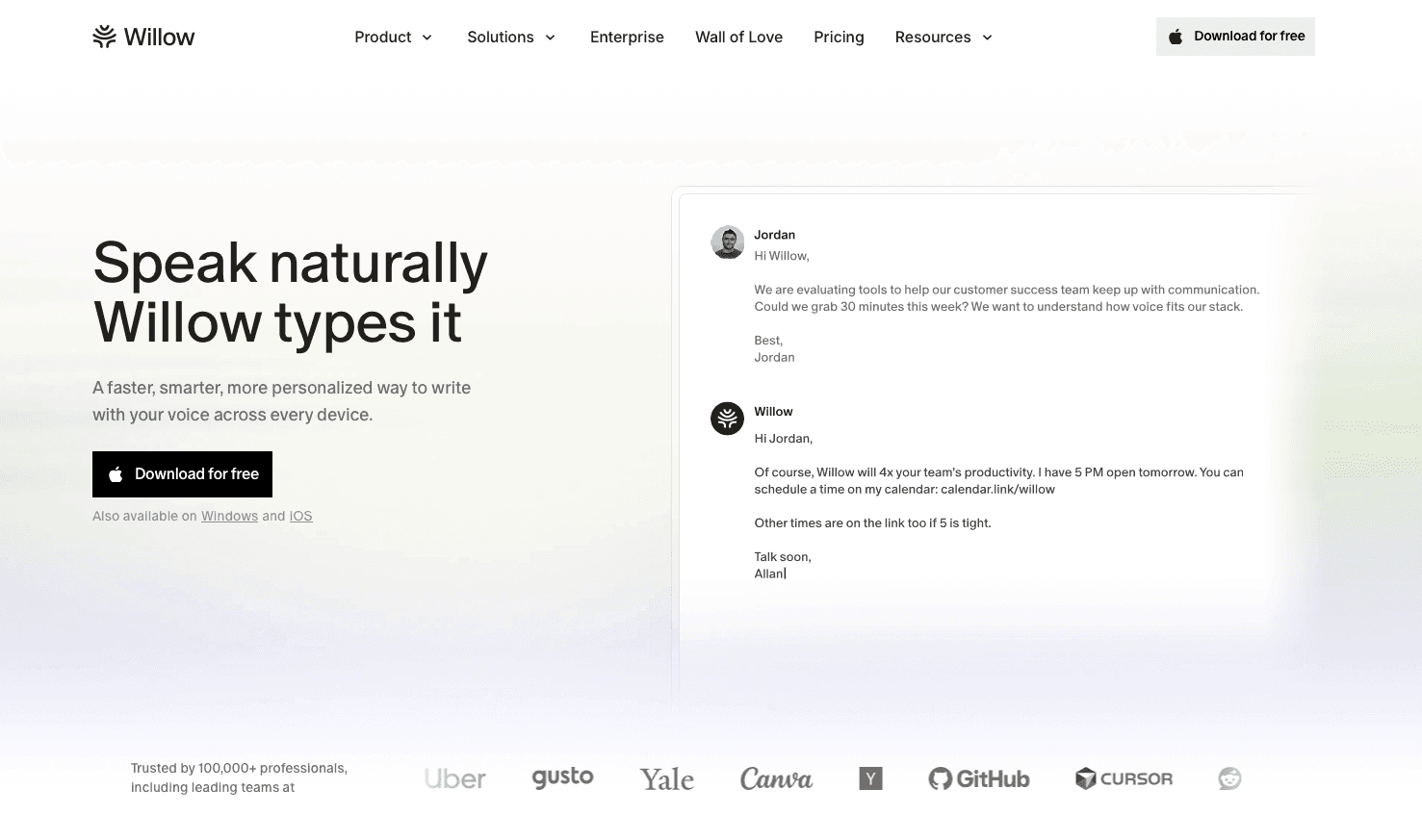
Willow Voice is built for anyone who finds typing a bottleneck, and that explicitly includes adults with dyslexia and others who benefit from voice dictation apps for neurodivergent users. The core case: 98%+ accuracy with 3x fewer errors than built-in dictation tools, ~200ms latency versus the 700ms+ you get from Apple Dictation or Windows 11 voice typing, and a comparison breakdown in reviews of the best voice dictation software for Mac. At ~200ms, dictation keeps pace with your thinking instead of interrupting it.
The Auto-Dictionary learns as you use it. Names, terminology, and company-specific words that misfire on day one correct themselves over time and stop repeating. For someone who relies heavily on voice input, that compounding improvement is where the daily friction genuinely shrinks.
Willow Scribe goes a step further. Activated with Fn + Control on Mac or Alt+Shift+Space on Windows, it generates complete written content from a voice prompt rather than transcribing word-for-word. Say "write a follow-up email to my manager about the project timeline" and get a full draft back. For adults with dyslexia who find a blank page difficult, that starting point matters.
Willow Voice runs on Mac, Windows, and iOS, with custom vocabulary syncing across all three. The free plan delivers unlimited AI dictation with no word cap and no credit card required. The Individual plan ($12 per month, billed annually) adds faster, more accurate dictation and unlimited Willow Scribe. For employers or teams supporting employees with dyslexia, the team plan ($10 per user per month, billed annually) adds shared custom dictionaries, admin controls, and team leaderboards, with SOC 2 Type II and HIPAA compliance included.
FAQs
What's the best dyslexia writing software for adults who need it to work across email, Slack, and documents, not limited to one app?
System-wide dictation tools that activate from any text field are the right fit. Apps locked to a single browser force constant window-switching, which breaks the train of thought voice input is meant to protect. Willow Voice works via a single hotkey across Gmail, Slack, Notion, Google Docs, and any other text field on Mac, Windows, and iOS, with vocabulary that syncs across all three devices.
What features should I look for in dictation software for adults with dyslexia?
Focus first on transcription accuracy above 98%, sub-200ms latency, automatic filler word removal, and system-wide cross-application support. Every uncorrected error sends you back into the correction loop voice input is supposed to remove, and latency above 700ms disrupts thought flow enough that dictation stops feeling natural. Custom vocabulary learning is where long-term daily friction actually shrinks.
Can I use Willow Voice on iOS as my primary writing tool for dyslexia?
Yes. Willow Voice provides a custom iOS keyboard that stays active across every app (Mail, Messages, Notes, browsers) without requiring you to switch applications to use voice input. The same custom vocabulary you've built on your Mac or Windows machine syncs automatically to iOS, so the correction loop you've already reduced on desktop doesn't reappear when you pick up your phone.
Final Thoughts on Using Speech-to-Text Software for Dyslexia
The ideas were never the problem. Getting them onto the page without the spelling loop interrupting every sentence has been the problem, and voice dictation cuts that friction at the root. Good dyslexia writing software holds 98%+ accuracy and learns your vocabulary over time, until it stops feeling like a workaround and starts feeling like the way writing was always supposed to work. Download Willow Voice and give it a real week across email, notes, and documents before you decide what writing looks like for you going forward.
Most people think dictation software is a speed tool. For adults with dyslexia, the right dyslexia writing software is something more specific: it removes the part of writing that was never really about writing. The spelling, the error-checking, the second-guessing word choices mid-sentence. When you speak instead of type, that overhead disappears, and what you're left with is just the thinking. Getting there takes choosing a tool built for accuracy, beyond one that technically transcribes your voice.
TLDR:
Adults with dyslexia produce longer, more detailed written work with voice dictation because speaking removes the spelling encoding task entirely.
35% of dyslexic individuals face job performance difficulties tied to writing; voice dictation can cut that friction at the source.
Free tools like Apple Dictation and Google Docs Voice Typing run at 85-95% accuracy and 700ms+ latency, creating correction loops that recreate the original problem.
Dedicated tools reach 98%+ accuracy with ~200ms latency, plus filler removal and custom vocabulary that learns your specific terms over time.
The best dedicated tools offer 98%+ accuracy, ~200ms latency, cross-device vocabulary sync across Mac, Windows, and iOS, and a free unlimited plan with no word cap.
Why Typing Creates an Outsized Burden for Adults with Dyslexia
The ideas are there. Getting them onto the page is the problem.
For adults with dyslexia, the keyboard introduces a second cognitive task on top of writing: tracking spelling, second-guessing word choices, scanning for errors, and running constant mental corrections. That overhead hits before a single meaningful sentence lands. By the time the error-checking is done, the original thought is gone.
over 40 million U.S. adults have dyslexia. Most carry the gap quietly into their professional lives, avoiding written tasks or spending two or three times longer on emails than colleagues do. The cost shows up at work: 35% face dyslexia-related job performance difficulties directly tied to their condition.
The keyboard was never a neutral tool. For adults with dyslexia, it can function as a filter that strips out their best thinking before it reaches anyone else.
How Speech-to-Text Removes the Writing Bottleneck
Research consistently shows that people with dyslexia produce longer, more sophisticated written work when using voice dictation compared to typing or handwriting. The reason is structural, not motivational.
Typing forces two simultaneous tasks: forming the idea and encoding it into spelled words. For dyslexic adults, that second task pulls heavily on working memory. Research on speech to text for dyslexia shows the result is a constant interruption loop where the mental energy that should go toward thinking goes toward letter sequencing instead. Voice dictation collapses that loop. When you speak, the software handles spelling entirely. The word lands correctly on screen whether or not you know how to spell it.
That shift changes what writing feels like. The anxiety around spelling, which for many dyslexic adults operates as background noise throughout every sentence, disappears. What remains is just the thinking.
Features That Actually Matter for Dyslexia Writing Software
For dyslexic adults, the gap between a tool that helps and one that frustrates comes down to a handful of specific capabilities.
Transcription accuracy
Non-negotiable. Every uncorrected error sends you back into the loop the tool was supposed to eliminate. Look for best AI speech to text tools that hold 98%+ accuracy across natural speech, not just clean studio recordings.
Latency
A lag of 700ms or more disrupts your flow reliably. As voice dictation and flow state research shows, the pause breaks concentration at exactly the wrong moment. Sub-200ms latency keeps dictation feeling like thinking out loud.
Filler word removal
Speaking naturally means "um," "uh," and false starts. Automatic filler removal lets you speak at full conversational speed without a second editing pass.
Cross-application support
A tool locked to one browser forces constant window-switching. System-wide support, meaning the same hotkey works across email, Slack, documents, and every other text field, removes that friction entirely.
Custom vocabulary
Names, technical terms, and company-specific words misfire most. A tool that learns your corrections and stops repeating the same mistake is worth far more than one that requires manual fixes every time.
Dictation for Work: Emails, Notes, and Documents
For adults with dyslexia, app-locked dictation creates a specific problem: every window switch is an interruption that can break the train of thought you were trying to capture. System-wide dictation, where the same hotkey works in Gmail, Slack, Notion, Teams, Google Docs, or any other text field, removes that friction entirely. You speak wherever your cursor is. The text lands there.
Meeting notes taken directly into Notion or a Word doc while the conversation is still fresh
Email replies drafted by speaking, without touching the keyboard at all
Slack messages sent at the same speed you'd deliver them in person
Reports or forms filled out field by field using voice
Custom vocabulary matters here too. Generic dictation often misfires on colleague names, product names, and industry jargon. A tool that remembers your corrections and stops repeating the same mistakes is where the daily friction actually shrinks.
Dictation on iOS: What Works on Your Phone and Tablet
The iPhone keyboard has a built-in microphone. Tap it, speak, and text appears. For quick messages, that baseline works. For adults with dyslexia using voice as their primary writing method, the limitations surface fast: it struggles with names and technical terms, won't remove filler words, and doesn't learn from corrections, so the same misfires repeat indefinitely.
A dedicated voice keyboard replaces the system microphone with AI-powered accuracy, filler removal, and vocabulary learning, active across every app without switching windows.
What Cross-Device Continuity Actually Looks Like
Willow Voice offers a custom iOS keyboard that works directly in Mail, Notes, Messages, or any browser. Custom vocabulary syncs from your desktop setup, so the correction loop you've already reduced on Mac or Windows doesn't reappear when you pick up your phone.
Free Dictation Tools vs. Dedicated Software: Where the Tradeoffs Are
Free tools are genuinely capable starting points, but the best voice to text software goes well beyond what Apple Dictation, Windows 11 voice typing (Win + H), and Google Docs Voice Typing offer out of the box, cost nothing, and handle everyday vocabulary reasonably well. For occasional dictation, they can reduce keyboard time without any setup.
The tradeoffs become more visible when voice is your primary writing method.
Feature | Free Built-In Tools | Dedicated Software |
|---|---|---|
Accuracy | 85 to 95% on general speech | 98%+ with context awareness |
Filler word removal | No | Yes |
Custom vocabulary learning | No | Yes, improves over time |
Cross-app support | Varies; often app-limited | System-wide |
Latency | 700ms+ | ~200ms |
For adults with dyslexia, the accuracy gap carries more weight than it might for other users. Every misfire is a correction loop, which is exactly the burden voice dictation is supposed to remove. A tool running at 90% accuracy still forces regular error-checking. Whether that tradeoff is acceptable depends on how heavily you rely on dictation and how much time you can give to cleanup.
Getting Better Results from Voice Dictation
Most of the quality gap between a frustrating dictation experience and a fluid one comes down to setup, not the software itself.
Microphone
Built-in laptop mics pick up keyboard sounds, room reverb, and ambient noise at the same time. That background bleed reduces accuracy noticeably. A USB headset with a close-talk mic positioned an inch or two from your mouth, or wireless earbuds with a built-in mic like AirPods, removes most of that noise at the source. The hardware upgrade alone can close much of the accuracy gap before the software even processes a word.
Environment
A quieter room matters more than a better microphone. Fans, open windows, and background music all compete with your voice signal. If a dedicated quiet space is not available, facing away from noise sources and speaking slightly louder than conversational volume helps.
How to Speak
Speak at your natural pace instead of slowing down to enunciate. AI dictation tools are trained on natural speech patterns, so slowing down or over-enunciating often produces worse results. With automatic punctuation for dictation, you can stop saying "comma" and "period" manually. Voice commands like "delete that" or "scratch that" handle corrections without touching the keyboard.
Letting the Learning Loop Work
Most dedicated tools improve as they accumulate corrections. When a name or term misfires, correcting it once teaches the software. The second and third time that term appears, it lands clean. The correction loop shrinks over time, and that is where the real daily benefit accumulates for someone relying on voice as a primary input method.
Willow Voice for Adults with Dyslexia
Willow Voice is built for anyone who finds typing a bottleneck, and that explicitly includes adults with dyslexia and others who benefit from voice dictation apps for neurodivergent users. The core case: 98%+ accuracy with 3x fewer errors than built-in dictation tools, ~200ms latency versus the 700ms+ you get from Apple Dictation or Windows 11 voice typing, and a comparison breakdown in reviews of the best voice dictation software for Mac. At ~200ms, dictation keeps pace with your thinking instead of interrupting it.
The Auto-Dictionary learns as you use it. Names, terminology, and company-specific words that misfire on day one correct themselves over time and stop repeating. For someone who relies heavily on voice input, that compounding improvement is where the daily friction genuinely shrinks.
Willow Scribe goes a step further. Activated with Fn + Control on Mac or Alt+Shift+Space on Windows, it generates complete written content from a voice prompt rather than transcribing word-for-word. Say "write a follow-up email to my manager about the project timeline" and get a full draft back. For adults with dyslexia who find a blank page difficult, that starting point matters.
Willow Voice runs on Mac, Windows, and iOS, with custom vocabulary syncing across all three. The free plan delivers unlimited AI dictation with no word cap and no credit card required. The Individual plan ($12 per month, billed annually) adds faster, more accurate dictation and unlimited Willow Scribe. For employers or teams supporting employees with dyslexia, the team plan ($10 per user per month, billed annually) adds shared custom dictionaries, admin controls, and team leaderboards, with SOC 2 Type II and HIPAA compliance included.
FAQs
What's the best dyslexia writing software for adults who need it to work across email, Slack, and documents, not limited to one app?
System-wide dictation tools that activate from any text field are the right fit. Apps locked to a single browser force constant window-switching, which breaks the train of thought voice input is meant to protect. Willow Voice works via a single hotkey across Gmail, Slack, Notion, Google Docs, and any other text field on Mac, Windows, and iOS, with vocabulary that syncs across all three devices.
What features should I look for in dictation software for adults with dyslexia?
Focus first on transcription accuracy above 98%, sub-200ms latency, automatic filler word removal, and system-wide cross-application support. Every uncorrected error sends you back into the correction loop voice input is supposed to remove, and latency above 700ms disrupts thought flow enough that dictation stops feeling natural. Custom vocabulary learning is where long-term daily friction actually shrinks.
Can I use Willow Voice on iOS as my primary writing tool for dyslexia?
Yes. Willow Voice provides a custom iOS keyboard that stays active across every app (Mail, Messages, Notes, browsers) without requiring you to switch applications to use voice input. The same custom vocabulary you've built on your Mac or Windows machine syncs automatically to iOS, so the correction loop you've already reduced on desktop doesn't reappear when you pick up your phone.
Final Thoughts on Using Speech-to-Text Software for Dyslexia
The ideas were never the problem. Getting them onto the page without the spelling loop interrupting every sentence has been the problem, and voice dictation cuts that friction at the root. Good dyslexia writing software holds 98%+ accuracy and learns your vocabulary over time, until it stops feeling like a workaround and starts feeling like the way writing was always supposed to work. Download Willow Voice and give it a real week across email, notes, and documents before you decide what writing looks like for you going forward.

Try Willow for free
Instant, accurate voice dictation. No card required.
Try Willow for free
Instant, accurate voice dictation. No card required.
Other stories you’ll love
Other stories you’ll love

Your keyboard is optional now
" transform="translate(5 5)" width="9.791000051498413px"/></svg>)

The voice-first interface for modern work.
© Willow Care, Inc. 2026. All rights reserved
Your keyboard is optional now
The voice-first interface for modern work.
© Willow Care, Inc. 2026. All rights reserved
Your keyboard is optional now
The voice-first interface for modern work.
© Willow Care, Inc. 2026. All rights reserved