" transform="translate(5 2)" width="10px"/></svg>)

•
5 min read
Best Voice Dictation Apps for ADHD Users in June 2026

•
5 min read
Best Voice Dictation Apps for ADHD Users in June 2026
To many people with ADHD, the distance between a thought and the words on a screen can feel impossibly wide, especially during a busy workday. Ideas race ahead while your fingers struggle to keep up, so by the time you finish typing a client update or a project brief, the original point may already be gone. Speech-to-text tools can close that gap by letting you speak in the same fast, expressive way you think, capturing ideas at 150 words per minute instead of typing at 40. However, most built-in dictation software on Mac or Windows still isn't designed to support neurodivergent professional workflows. That's why we tested today's leading speech-to-text tools to find which ones actually reduce friction instead of adding to it, and how modern tools can support a more intuitive, ADHD-friendly approach to workplace productivity.
TLDR:
Speech-to-text tools help ADHD users capture racing thoughts 3x faster than typing
Willow Voice delivers 98%+ accuracy and 3x fewer errors than built-in tools, with features like automatic filler-word removal and quiet-mode recording in shared spaces
Dragon Professional provides full computer control but requires extensive training time
Google Docs voice typing works free but only within Google's document editor
Modern cross-app dictation tools now work system-wide on Mac, Windows, and iOS with ~200ms processing speeds and customizable dictionaries
How Voice Dictation Changes the Writing Process
You have a clear idea in your head, but by the time you place your hands on the keyboard to draft a status update, the thought has scattered. The physical act of typing creates a bottleneck that forces your brain to slow down.
Modern speech-to-text tools remove that barrier. Instead of typing at 40 words per minute, you speak at 150 words per minute into any text field, from Slack and your CRM to clinical charting tools and IDEs like Cursor. Whether you are at a Windows workstation in the office, using a Mac at home, or reviewing notes on your phone, you press a hotkey, talk naturally, and watch the words appear on screen in real time. Voice dictation removes major friction from the daily workflow for professionals managing ADHD, dyslexia, or dysgraphia because it matches the natural speed of your mind.
What once required expensive software and training now works quietly in the background, helping you capture racing thoughts before they disappear.
How We Ranked Speech-to-Text Tools to Support ADHD alongside Neurodivergent Users
Tool | Pricing | Platforms | Latency | Key Strength |
|---|---|---|---|---|
Willow Voice | Pro: $12/mo; Business, Enterprise, and unlimited Free plans available | Mac, Windows, iOS | ~200ms | Context-aware, system-wide dictation |
Dragon Professional | $699 Upfront | Windows Only | Not published | Full hands-free PC navigation |
Google Docs Voice Typing | Free | Chrome Web Browser | 500-700ms | Native Google Workspace integration |
Windows Voice Access | Free (Included) | Windows 11 | Variable | Built-in Windows system control |
Apple Dictation | Free (Included) | Mac, iOS | 700ms+ | Frictionless Apple ecosystem usage |
Speechify | Free; Paid tiers | Mac, Windows, iOS, Android, Web | Variable | Text-to-speech reading capabilities |
Willow Voice
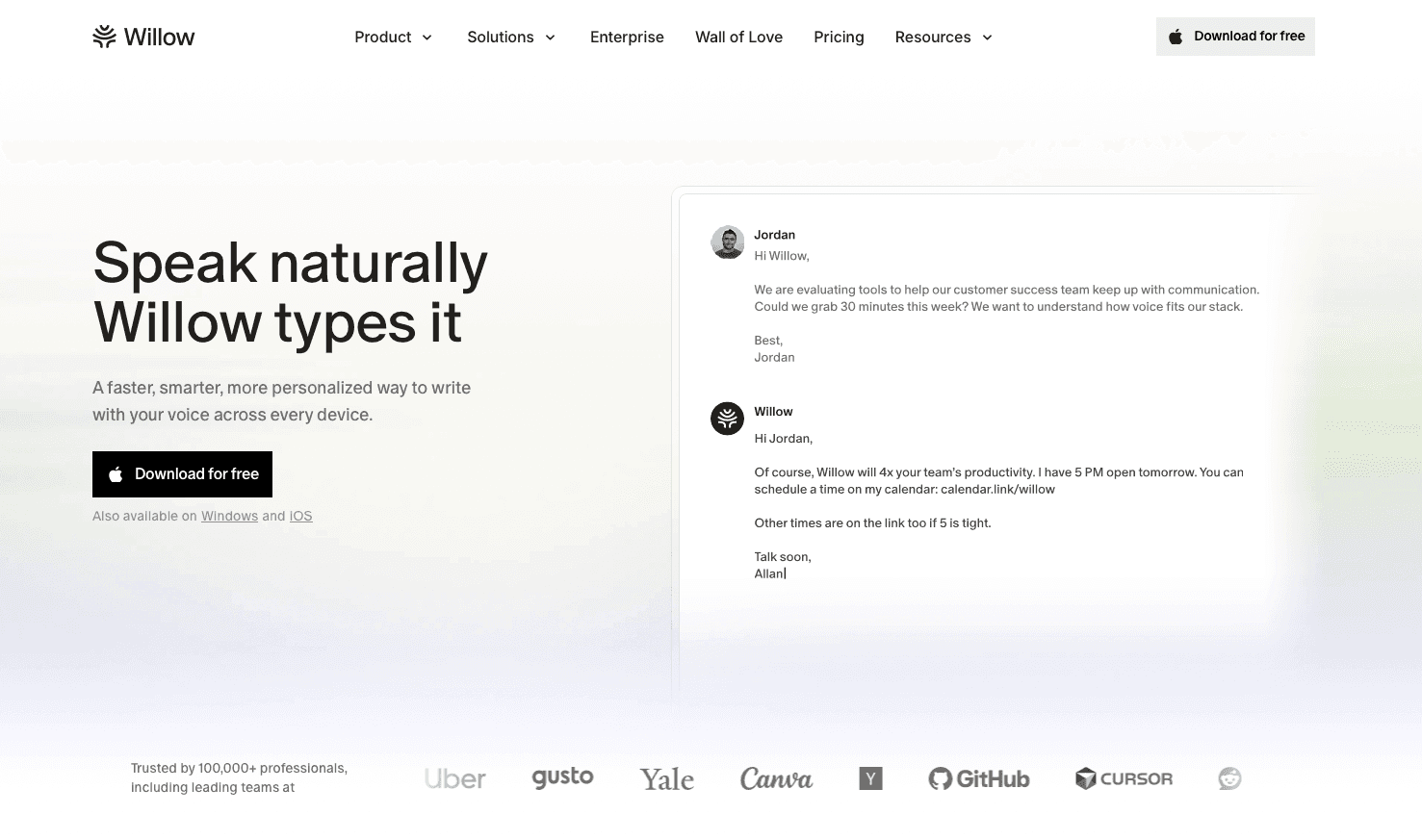
When ADHD scatters your thoughts across multiple tabs during a busy workday, a dictation tool needs to keep up across your entire technology stack. Willow Voice captures your words across your apps without forcing you to switch windows or break focus, whether you use Windows or Mac. The iOS custom voice keyboard extends this continuity to mobile, meaning your setup travels with you from a Windows desktop to an iPhone. Your text appears at ~200ms latency, delivering 98%+ accuracy and 3x fewer errors than built-in dictation on your computer.
To support different professional needs, Willow scales to match your workflow. For power users, developers prompting AI tools, and healthcare workers, the Pro plan is $12 per month and delivers faster, more accurate dictation along with unlimited access to Willow Scribe (activated with fn + Control on Mac and Alt+Shift+Space on Windows), which generates complete written content from voice prompts instead of transcribing word-for-word. Business and Enterprise plans are also available to support organizational rollouts. Finally, the Free plan provides genuinely unlimited free dictation with no word cap.
The context-aware AI uses context cues from your speech patterns and vocabulary to get technical terms and names right the first time. When you write an email to your manager, the AI keeps the tone formal, and when you message a friend in Slack, it switches to casual automatically.
Features That Support ADHD Workflows
If you need to capture racing thoughts quickly, filler word removal automatically strips out "um," "uh," and repeated words. This removes the need for extra editing passes that can derail your workday. Quiet mode lets you speak softly in open-plan offices or shared workspaces without losing transcription accuracy.
Sub-200ms processing latency instantly translates spoken words into text, keeping pace with rapid idea generation so you never lose your train of thought waiting for the screen to catch up.
Willow's Auto-Dictionary learns your vocabulary over time, picking up names, technical terms, and email contacts, so the more you use it, the more accurate it gets without any manual setup. This memory syncs automatically across Mac, Windows, and iOS, meaning the tool works consistently whether you're using Gmail, Notion, Cursor, iMessage, Google Docs, or any other application.
An optional offline mode supports fully private, local dictation on Mac and iOS when internet connectivity isn't available, or privacy is a top priority.
Enterprise and Team Deployment
Willow Voice is built for organizations as much as individuals, scaling from personal use to org-wide rollout. It features enterprise-grade security including SOC 2 Type II and HIPAA compliance, alongside a zero data retention architecture and centralized admin controls. Teams can deploy shared custom dictionaries and voice shortcuts across the entire organization, which is a structural necessity for mixed-device workforces. Whether your staff uses Windows desktops, Mac laptops, or iOS devices in the field, specialized terminology gets recognized consistently by everyone from day one without per-device setup. Team leaderboards give managers visibility into adoption and time saved across the group without manual tracking. These deployment capabilities separate Willow from consumer-only voice dictation alternatives that require each user to build their vocabulary from scratch.
Dragon Professional
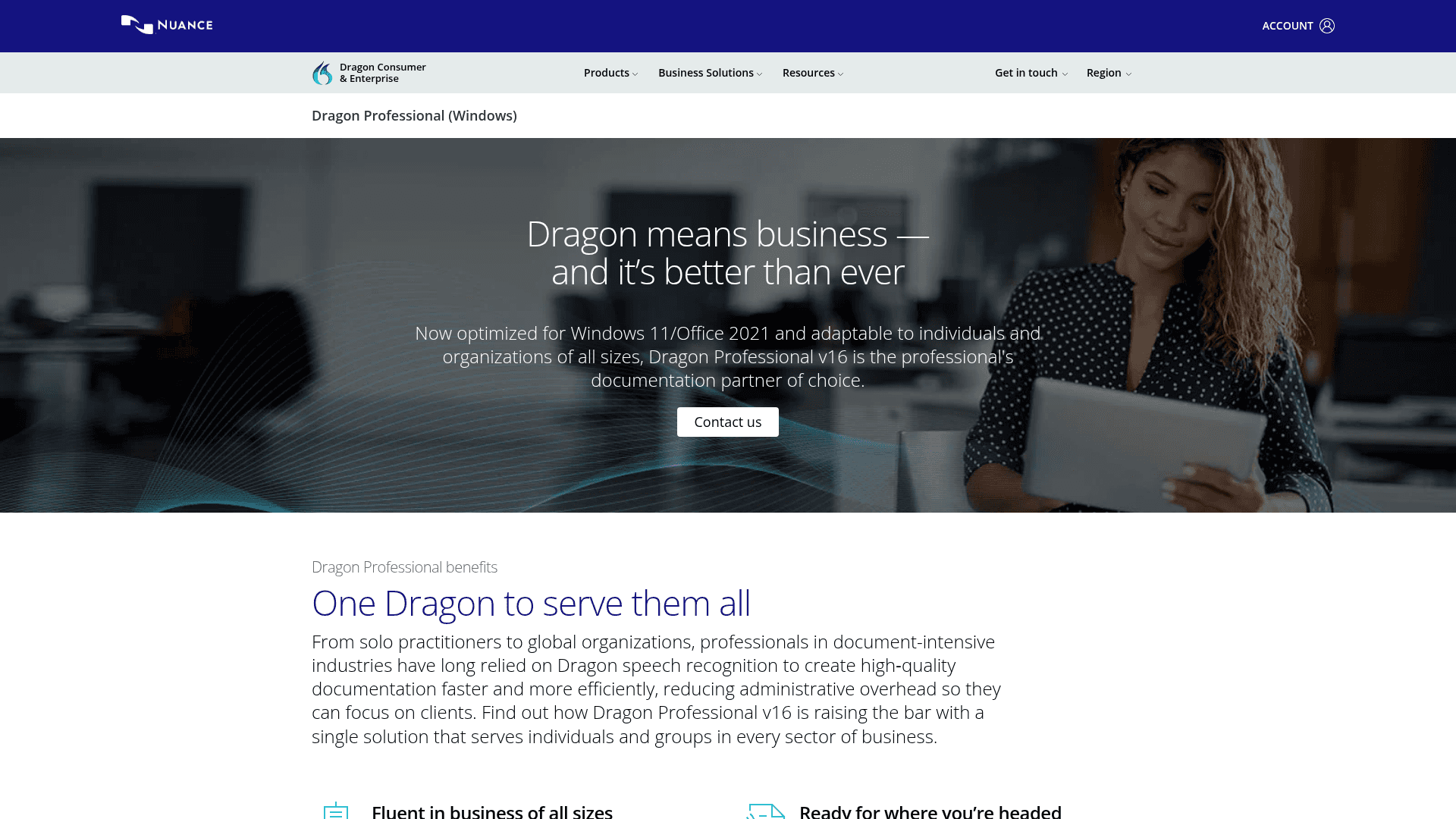
Dragon Professional offers an older, highly specialized approach for individuals who require complete hands-free operation due to physical accessibility needs. Instead of focusing on fast text generation for neurodivergent workflows, it provides full system control through complex voice commands, allowing users to open applications and format documents without touching a keyboard.
Dragon is built exclusively for Windows users (the Mac version was discontinued years ago). Because it relies on local acoustic models instead of modern AI, it requires upfront investment. You must spend time reading passages aloud to train the software to your specific voice, and manually add specialized vocabulary or acronyms one by one.
Since it offers literal transcription, it captures every verbal stumble or filler word you say. This can create extra editing work for ADHD users who process thoughts out loud. The software also requires a substantial upfront purchase (typically $699 for a perpetual license), creating a barrier for those wanting to test if voice dictation fits their workflow.
Despite the steep learning curve and lack of cross-platform support, educators and professionals continue to recommend it for older students or adults who have the patience to master its extensive command syntax for total PC control.
Google Docs Voice Typing
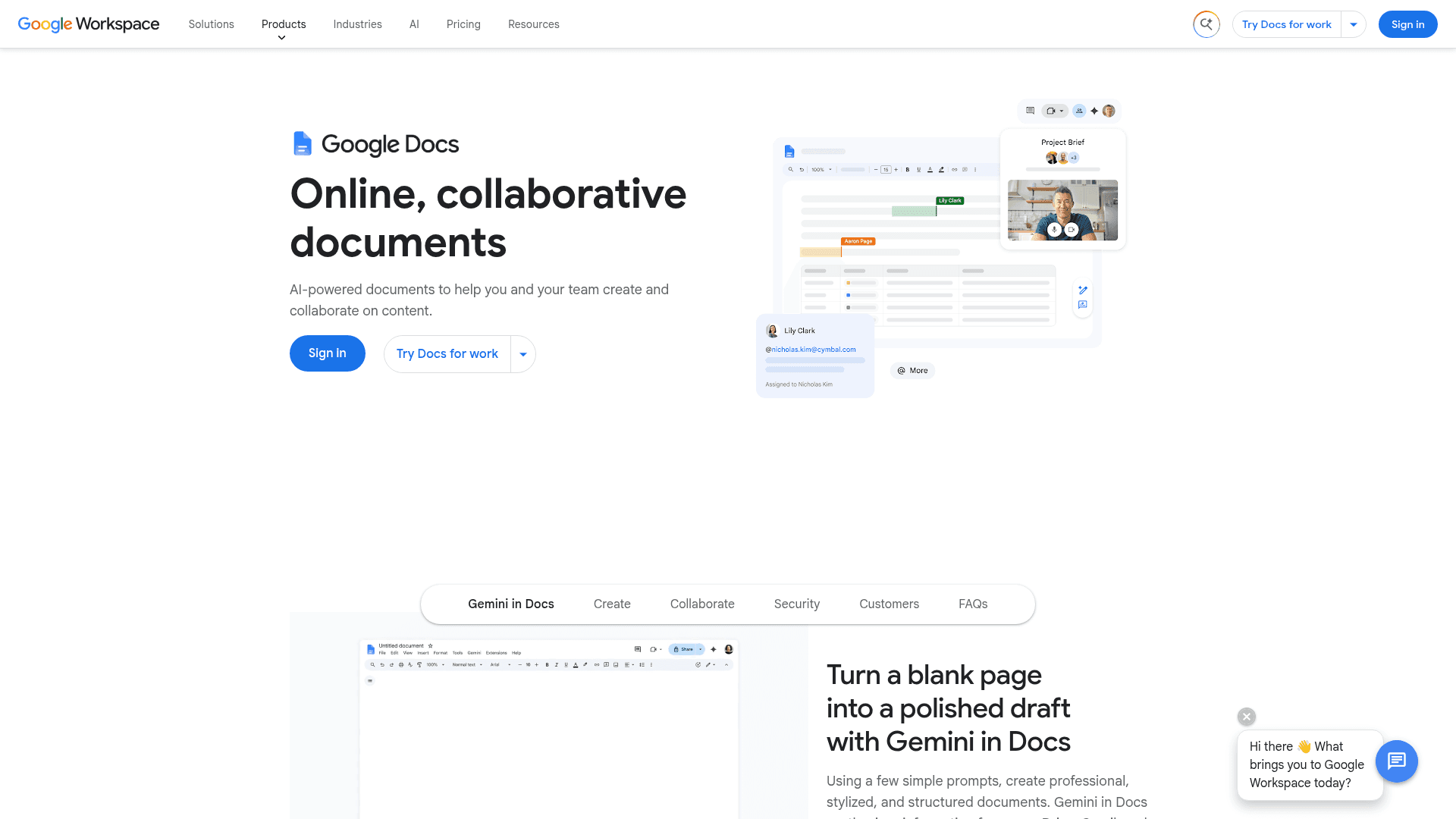
For users already embedded in Google Workspace, Google Docs Voice Typing offers a highly accessible, free transcription tool built right into the document editor. It transcribes speech in real time across more than 100 languages and dialects, and allows you to format or edit text using basic voice commands.
The primary limitation comes down to its browser-bound architecture.
Because the feature only operates inside Google Docs and Google Slides speaker notes while using Chrome, it cannot follow you across your workflow. For an ADHD user who needs to quickly draft an email, send a Slack message, or capture a thought in a different app, relying on this tool means constantly switching between different dictation methods depending on the context.
Windows Voice Access and Voice Typing
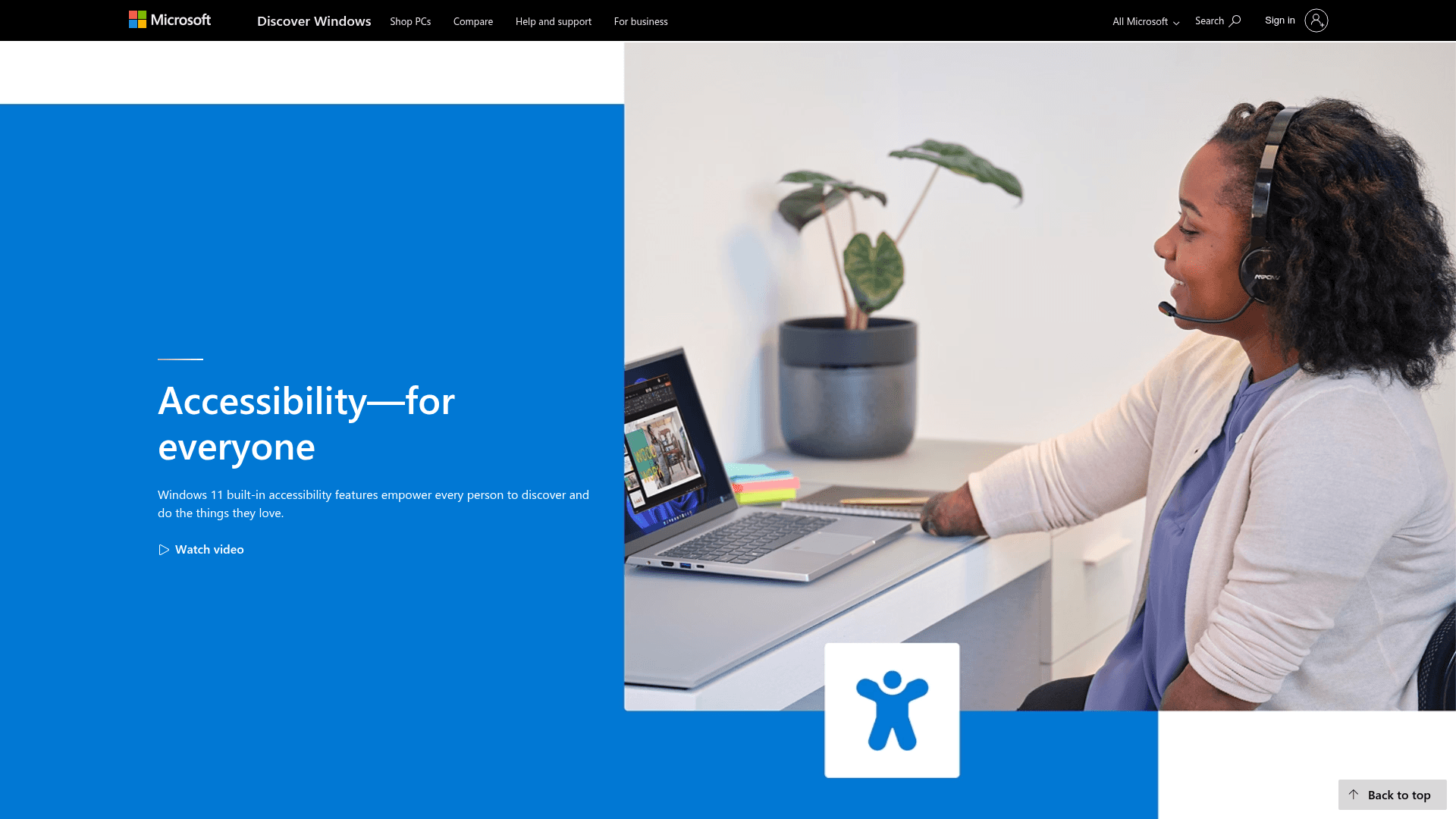
Windows users already have a capable dictation tool built directly into their operating system.
Windows 11 replaced legacy speech recognition with modern Voice Access and Voice Typing. This native integration provides a clear accessibility advantage, allowing you to control menus and draft text across Microsoft Word, Outlook, and Notepad without installing any external software.
The tradeoff comes from its underlying architecture. Because Voice Access relies on local OS-level processing, it transcribes speech word-for-word instead of understanding the context of your sentence. It struggles to recognize specialized vocabulary, and transcription quality often drops in noisy environments. For an ADHD user trying to capture ideas at the speed of thought, stopping to manually correct these literal transcription errors can easily break a fragile writing flow.
Apple Dictation
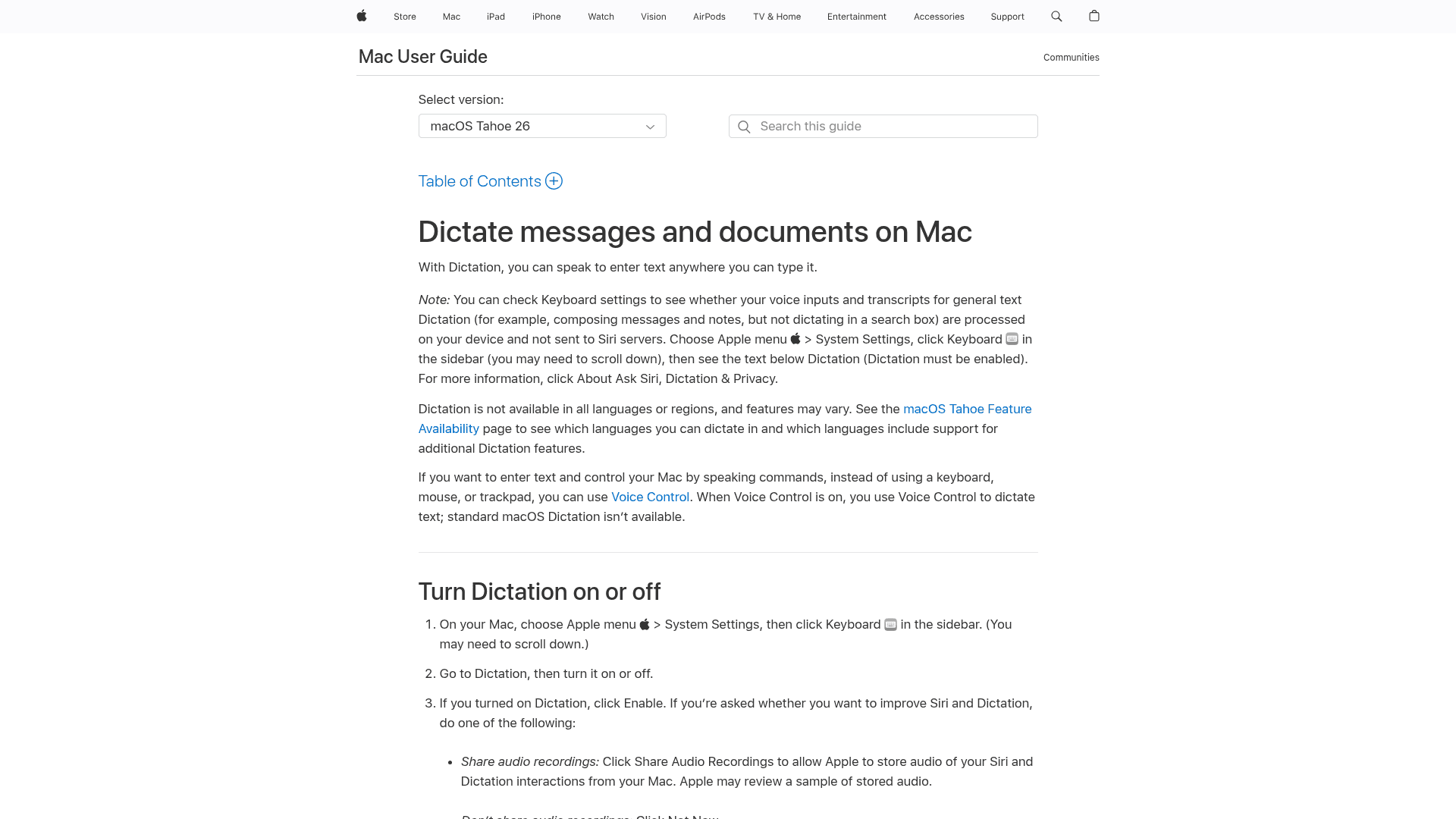
For Mac and iOS users, Apple Dictation offers the advantage of being completely frictionless.
Because it comes built into every iPhone, iPad, and Mac, you can press the Function key twice and immediately start speaking into Pages, Safari, or any text field. It requires zero setup and syncs automatically across your Apple ID, making it a capable starting point for basic, occasional speech-to-text needs at no extra cost.
But that general-purpose design comes with a distinct architectural tradeoff.
Apple Dictation relies on literal, word-for-word transcription without understanding the broader context of your sentences. It operates at a noticeable 700ms+ latency and lacks the ability to filter out verbal stumbles or learn custom vocabulary. For neurodivergent users who rely on writing momentum, stopping to manually correct misunderstood technical terms or filler words can quickly break a fragile train of thought.
Speechify
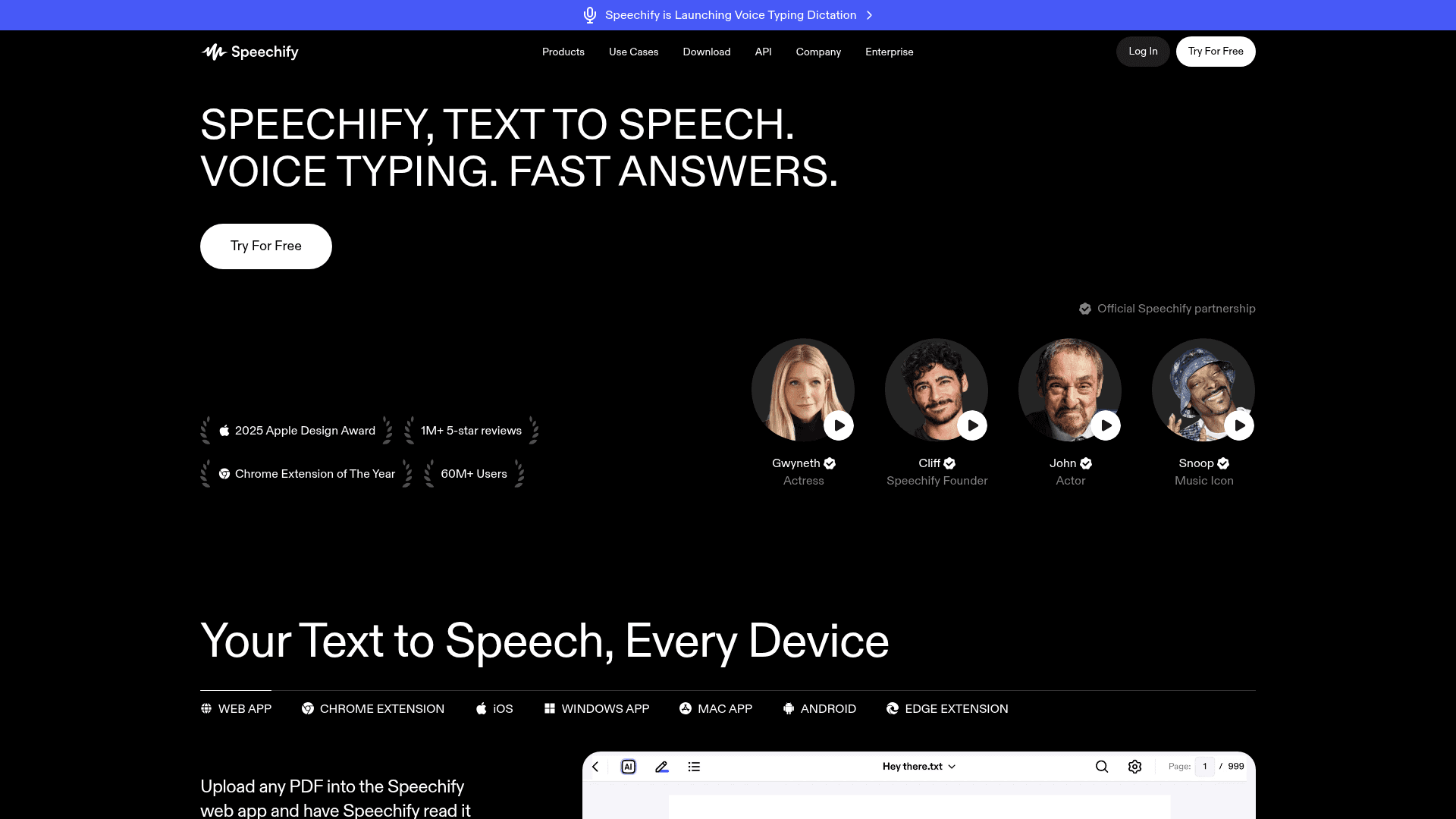
While most tools on this list focus on writing, Speechify approaches accessibility from the opposite direction.
The app is built to help users consume content through listening. It uses AI voices to read documents, articles, and PDFs aloud with adjustable speed controls. The multi-device compatibility across Mac, Windows, iOS, Android, and web browsers makes it a valuable utility for neurodivergent individuals who need to process heavy amounts of written information without burning out.
But that reading-first architecture creates a distinct tradeoff.
Because the platform is fundamentally designed for text-to-speech, its voice input capabilities take a secondary role. The dictation function lacks the sub-200ms processing speed and deep context-awareness found in dedicated speech-to-text tools. For ADHD users, it remains a valuable resource for comprehension, yet it is less optimized for capturing racing thoughts during intensive writing sessions.
Why Willow Voice Is a Leading Voice Dictation App for ADHD and Neurodivergent Users
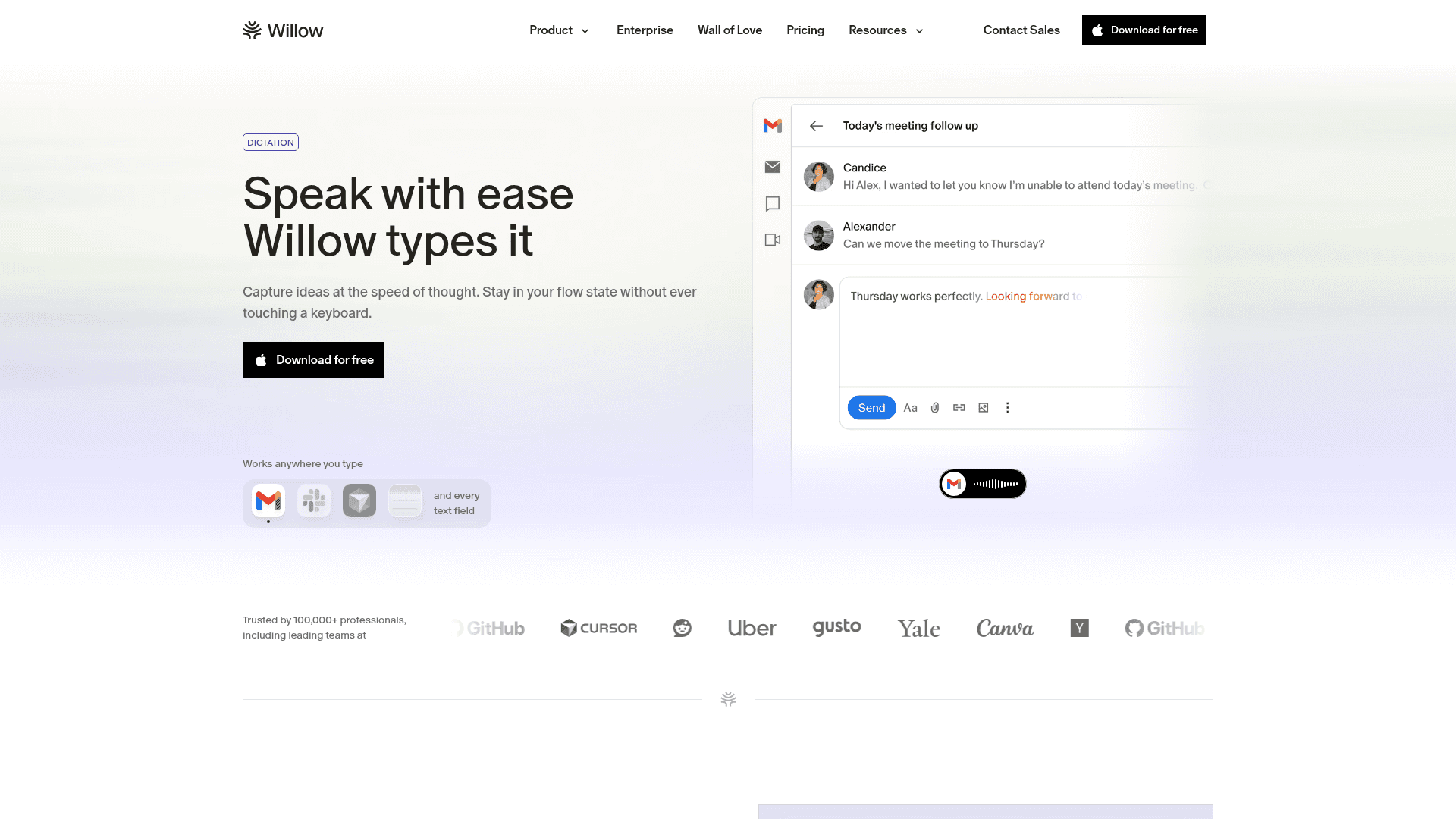
Speech recognition reduces cognitive load for individuals managing ADHD, dyslexia, or dysgraphia by removing the mechanical barrier of typing. When your mind operates at 150 words per minute, being forced to type at 40 words per minute creates a bottleneck that scatters ideas before they reach the screen.
Willow closes that gap by offering access to high-quality dictation that scales with your needs. The Pro plan delivers the absolute highest speed and precision for complex professional environments, such as prompting AI coding assistants and managing clinical documentation. Business and enterprise plans are also available. For everyday workflows, the Free plan provides genuinely unlimited, highly accurate dictation.
Instead of requiring you to speak into a separate app and copy text over, Willow captures your words system-wide with features expressly built to support neurodivergent workflows:
Filler word removal cleans up transcripts on the fly, saving you from extra editing passes that often derail writing momentum.
Quiet mode accurately captures soft speech or whispers, making it practical to speak in shared workspaces, libraries, or busy open-plan offices.
Sub-200ms processing latency instantly translates spoken words into text, keeping up with rapid idea generation.
Context-aware AI adjusts tone and formatting based on what you are writing, matching your style without manual mode switching.
Custom dictionaries automatically learn specialized vocabulary, technical terms, and proper names so they transcribe the first time correctly.
Because Willow Voice operates natively across Mac, Windows, and iOS, the experience remains identical across all your work tools, solving the deployment friction of mixed-device environments. You get the exact same 98%+ accuracy in a Slack message, a Google Doc, or a client email, letting your natural voice drive your workflow across your entire technology stack.
FAQs
How does voice dictation help with ADHD symptoms?
Voice dictation removes the physical barrier of typing, letting you capture racing thoughts at speaking speed (150 words per minute vs 40 when typing). By matching the natural speed of your mind, it lowers cognitive load. With Willow Voice, features like automatic filler word removal and sub-200 millisecond processing prevent those ideas from scattering before they reach the screen.
What's the difference between basic dictation and AI-powered tools?
Basic dictation transcribes literally and often misunderstands context. AI-powered tools like Willow Voice analyze your phrasing to get technical terms right, format text automatically, and adjust tone on the fly.
Can I use voice dictation in quiet environments like libraries?
Yes, modern apps like Willow include a Quiet Mode that accurately captures soft speech or whispers so you can work in shared spaces without disturbing others.
Do voice dictation apps work with specialized vocabulary and technical terms?
Advanced dictation tools like Willow Voice include custom dictionaries that actively learn your company names, industry jargon, and personal contacts. As a result, your specialized terminology is transcribed correctly, sparing you from constant manual edits.
Are there free voice dictation apps for ADHD?
Yes. Willow Voice offers an unlimited Free plan with no word cap and no credit card required. Built-in operating system tools like Apple Dictation and Windows Voice Access are also free, though they operate with higher latency (700ms+) and lack the filler word removal that helps neurodivergent users maintain a clean train of thought.
Does voice dictation help with task initiation and writer's block?
Yes. For many ADHD brains, the gap between thinking and typing creates severe friction, making it hard to start tasks. Speaking at 150 words per minute lowers the barrier to entry, allowing you to capture racing thoughts out loud before they vanish. Willow Voice captures these spoken thoughts system-wide, helping you bypass the blank page.
Is my dictation data private when using AI tools?
Tools built for professionals put data security first. Willow Voice is SOC 2 Type II and HIPAA compliant with a zero data retention architecture. For users who need strict local-only privacy, it also offers an Offline Mode on Mac and iOS, keeping your thoughts completely private.
Can I use voice dictation to write prompts for ChatGPT and Claude?
Yes. Speaking generates richer, more contextual prompts than typing. Because Willow Voice operates system-wide, you can speak complex instructions directly into AI tools at 150 words per minute, helping you articulate detailed ideas without losing focus on the keyboard.
Final Thoughts on Selecting Dictation Tools for Neurodivergent Workflows
The best voice dictation apps for professionals with ADHD are the ones that quietly adapt to your professional environment, keeping pace with rapid thought patterns to reduce the need for constant corrections during the workday. If you are looking to experience the difference an ADHD-friendly tool can make for your team's productivity, try Willow Voice for free and see how much faster your workflow can feel.
To many people with ADHD, the distance between a thought and the words on a screen can feel impossibly wide, especially during a busy workday. Ideas race ahead while your fingers struggle to keep up, so by the time you finish typing a client update or a project brief, the original point may already be gone. Speech-to-text tools can close that gap by letting you speak in the same fast, expressive way you think, capturing ideas at 150 words per minute instead of typing at 40. However, most built-in dictation software on Mac or Windows still isn't designed to support neurodivergent professional workflows. That's why we tested today's leading speech-to-text tools to find which ones actually reduce friction instead of adding to it, and how modern tools can support a more intuitive, ADHD-friendly approach to workplace productivity.
TLDR:
Speech-to-text tools help ADHD users capture racing thoughts 3x faster than typing
Willow Voice delivers 98%+ accuracy and 3x fewer errors than built-in tools, with features like automatic filler-word removal and quiet-mode recording in shared spaces
Dragon Professional provides full computer control but requires extensive training time
Google Docs voice typing works free but only within Google's document editor
Modern cross-app dictation tools now work system-wide on Mac, Windows, and iOS with ~200ms processing speeds and customizable dictionaries
How Voice Dictation Changes the Writing Process
You have a clear idea in your head, but by the time you place your hands on the keyboard to draft a status update, the thought has scattered. The physical act of typing creates a bottleneck that forces your brain to slow down.
Modern speech-to-text tools remove that barrier. Instead of typing at 40 words per minute, you speak at 150 words per minute into any text field, from Slack and your CRM to clinical charting tools and IDEs like Cursor. Whether you are at a Windows workstation in the office, using a Mac at home, or reviewing notes on your phone, you press a hotkey, talk naturally, and watch the words appear on screen in real time. Voice dictation removes major friction from the daily workflow for professionals managing ADHD, dyslexia, or dysgraphia because it matches the natural speed of your mind.
What once required expensive software and training now works quietly in the background, helping you capture racing thoughts before they disappear.
How We Ranked Speech-to-Text Tools to Support ADHD alongside Neurodivergent Users
Tool | Pricing | Platforms | Latency | Key Strength |
|---|---|---|---|---|
Willow Voice | Pro: $12/mo; Business, Enterprise, and unlimited Free plans available | Mac, Windows, iOS | ~200ms | Context-aware, system-wide dictation |
Dragon Professional | $699 Upfront | Windows Only | Not published | Full hands-free PC navigation |
Google Docs Voice Typing | Free | Chrome Web Browser | 500-700ms | Native Google Workspace integration |
Windows Voice Access | Free (Included) | Windows 11 | Variable | Built-in Windows system control |
Apple Dictation | Free (Included) | Mac, iOS | 700ms+ | Frictionless Apple ecosystem usage |
Speechify | Free; Paid tiers | Mac, Windows, iOS, Android, Web | Variable | Text-to-speech reading capabilities |
Willow Voice
When ADHD scatters your thoughts across multiple tabs during a busy workday, a dictation tool needs to keep up across your entire technology stack. Willow Voice captures your words across your apps without forcing you to switch windows or break focus, whether you use Windows or Mac. The iOS custom voice keyboard extends this continuity to mobile, meaning your setup travels with you from a Windows desktop to an iPhone. Your text appears at ~200ms latency, delivering 98%+ accuracy and 3x fewer errors than built-in dictation on your computer.
To support different professional needs, Willow scales to match your workflow. For power users, developers prompting AI tools, and healthcare workers, the Pro plan is $12 per month and delivers faster, more accurate dictation along with unlimited access to Willow Scribe (activated with fn + Control on Mac and Alt+Shift+Space on Windows), which generates complete written content from voice prompts instead of transcribing word-for-word. Business and Enterprise plans are also available to support organizational rollouts. Finally, the Free plan provides genuinely unlimited free dictation with no word cap.
The context-aware AI uses context cues from your speech patterns and vocabulary to get technical terms and names right the first time. When you write an email to your manager, the AI keeps the tone formal, and when you message a friend in Slack, it switches to casual automatically.
Features That Support ADHD Workflows
If you need to capture racing thoughts quickly, filler word removal automatically strips out "um," "uh," and repeated words. This removes the need for extra editing passes that can derail your workday. Quiet mode lets you speak softly in open-plan offices or shared workspaces without losing transcription accuracy.
Sub-200ms processing latency instantly translates spoken words into text, keeping pace with rapid idea generation so you never lose your train of thought waiting for the screen to catch up.
Willow's Auto-Dictionary learns your vocabulary over time, picking up names, technical terms, and email contacts, so the more you use it, the more accurate it gets without any manual setup. This memory syncs automatically across Mac, Windows, and iOS, meaning the tool works consistently whether you're using Gmail, Notion, Cursor, iMessage, Google Docs, or any other application.
An optional offline mode supports fully private, local dictation on Mac and iOS when internet connectivity isn't available, or privacy is a top priority.
Enterprise and Team Deployment
Willow Voice is built for organizations as much as individuals, scaling from personal use to org-wide rollout. It features enterprise-grade security including SOC 2 Type II and HIPAA compliance, alongside a zero data retention architecture and centralized admin controls. Teams can deploy shared custom dictionaries and voice shortcuts across the entire organization, which is a structural necessity for mixed-device workforces. Whether your staff uses Windows desktops, Mac laptops, or iOS devices in the field, specialized terminology gets recognized consistently by everyone from day one without per-device setup. Team leaderboards give managers visibility into adoption and time saved across the group without manual tracking. These deployment capabilities separate Willow from consumer-only voice dictation alternatives that require each user to build their vocabulary from scratch.
Dragon Professional
Dragon Professional offers an older, highly specialized approach for individuals who require complete hands-free operation due to physical accessibility needs. Instead of focusing on fast text generation for neurodivergent workflows, it provides full system control through complex voice commands, allowing users to open applications and format documents without touching a keyboard.
Dragon is built exclusively for Windows users (the Mac version was discontinued years ago). Because it relies on local acoustic models instead of modern AI, it requires upfront investment. You must spend time reading passages aloud to train the software to your specific voice, and manually add specialized vocabulary or acronyms one by one.
Since it offers literal transcription, it captures every verbal stumble or filler word you say. This can create extra editing work for ADHD users who process thoughts out loud. The software also requires a substantial upfront purchase (typically $699 for a perpetual license), creating a barrier for those wanting to test if voice dictation fits their workflow.
Despite the steep learning curve and lack of cross-platform support, educators and professionals continue to recommend it for older students or adults who have the patience to master its extensive command syntax for total PC control.
Google Docs Voice Typing
For users already embedded in Google Workspace, Google Docs Voice Typing offers a highly accessible, free transcription tool built right into the document editor. It transcribes speech in real time across more than 100 languages and dialects, and allows you to format or edit text using basic voice commands.
The primary limitation comes down to its browser-bound architecture.
Because the feature only operates inside Google Docs and Google Slides speaker notes while using Chrome, it cannot follow you across your workflow. For an ADHD user who needs to quickly draft an email, send a Slack message, or capture a thought in a different app, relying on this tool means constantly switching between different dictation methods depending on the context.
Windows Voice Access and Voice Typing
Windows users already have a capable dictation tool built directly into their operating system.
Windows 11 replaced legacy speech recognition with modern Voice Access and Voice Typing. This native integration provides a clear accessibility advantage, allowing you to control menus and draft text across Microsoft Word, Outlook, and Notepad without installing any external software.
The tradeoff comes from its underlying architecture. Because Voice Access relies on local OS-level processing, it transcribes speech word-for-word instead of understanding the context of your sentence. It struggles to recognize specialized vocabulary, and transcription quality often drops in noisy environments. For an ADHD user trying to capture ideas at the speed of thought, stopping to manually correct these literal transcription errors can easily break a fragile writing flow.
Apple Dictation
For Mac and iOS users, Apple Dictation offers the advantage of being completely frictionless.
Because it comes built into every iPhone, iPad, and Mac, you can press the Function key twice and immediately start speaking into Pages, Safari, or any text field. It requires zero setup and syncs automatically across your Apple ID, making it a capable starting point for basic, occasional speech-to-text needs at no extra cost.
But that general-purpose design comes with a distinct architectural tradeoff.
Apple Dictation relies on literal, word-for-word transcription without understanding the broader context of your sentences. It operates at a noticeable 700ms+ latency and lacks the ability to filter out verbal stumbles or learn custom vocabulary. For neurodivergent users who rely on writing momentum, stopping to manually correct misunderstood technical terms or filler words can quickly break a fragile train of thought.
Speechify
While most tools on this list focus on writing, Speechify approaches accessibility from the opposite direction.
The app is built to help users consume content through listening. It uses AI voices to read documents, articles, and PDFs aloud with adjustable speed controls. The multi-device compatibility across Mac, Windows, iOS, Android, and web browsers makes it a valuable utility for neurodivergent individuals who need to process heavy amounts of written information without burning out.
But that reading-first architecture creates a distinct tradeoff.
Because the platform is fundamentally designed for text-to-speech, its voice input capabilities take a secondary role. The dictation function lacks the sub-200ms processing speed and deep context-awareness found in dedicated speech-to-text tools. For ADHD users, it remains a valuable resource for comprehension, yet it is less optimized for capturing racing thoughts during intensive writing sessions.
Why Willow Voice Is a Leading Voice Dictation App for ADHD and Neurodivergent Users
Speech recognition reduces cognitive load for individuals managing ADHD, dyslexia, or dysgraphia by removing the mechanical barrier of typing. When your mind operates at 150 words per minute, being forced to type at 40 words per minute creates a bottleneck that scatters ideas before they reach the screen.
Willow closes that gap by offering access to high-quality dictation that scales with your needs. The Pro plan delivers the absolute highest speed and precision for complex professional environments, such as prompting AI coding assistants and managing clinical documentation. Business and enterprise plans are also available. For everyday workflows, the Free plan provides genuinely unlimited, highly accurate dictation.
Instead of requiring you to speak into a separate app and copy text over, Willow captures your words system-wide with features expressly built to support neurodivergent workflows:
Filler word removal cleans up transcripts on the fly, saving you from extra editing passes that often derail writing momentum.
Quiet mode accurately captures soft speech or whispers, making it practical to speak in shared workspaces, libraries, or busy open-plan offices.
Sub-200ms processing latency instantly translates spoken words into text, keeping up with rapid idea generation.
Context-aware AI adjusts tone and formatting based on what you are writing, matching your style without manual mode switching.
Custom dictionaries automatically learn specialized vocabulary, technical terms, and proper names so they transcribe the first time correctly.
Because Willow Voice operates natively across Mac, Windows, and iOS, the experience remains identical across all your work tools, solving the deployment friction of mixed-device environments. You get the exact same 98%+ accuracy in a Slack message, a Google Doc, or a client email, letting your natural voice drive your workflow across your entire technology stack.
FAQs
How does voice dictation help with ADHD symptoms?
Voice dictation removes the physical barrier of typing, letting you capture racing thoughts at speaking speed (150 words per minute vs 40 when typing). By matching the natural speed of your mind, it lowers cognitive load. With Willow Voice, features like automatic filler word removal and sub-200 millisecond processing prevent those ideas from scattering before they reach the screen.
What's the difference between basic dictation and AI-powered tools?
Basic dictation transcribes literally and often misunderstands context. AI-powered tools like Willow Voice analyze your phrasing to get technical terms right, format text automatically, and adjust tone on the fly.
Can I use voice dictation in quiet environments like libraries?
Yes, modern apps like Willow include a Quiet Mode that accurately captures soft speech or whispers so you can work in shared spaces without disturbing others.
Do voice dictation apps work with specialized vocabulary and technical terms?
Advanced dictation tools like Willow Voice include custom dictionaries that actively learn your company names, industry jargon, and personal contacts. As a result, your specialized terminology is transcribed correctly, sparing you from constant manual edits.
Are there free voice dictation apps for ADHD?
Yes. Willow Voice offers an unlimited Free plan with no word cap and no credit card required. Built-in operating system tools like Apple Dictation and Windows Voice Access are also free, though they operate with higher latency (700ms+) and lack the filler word removal that helps neurodivergent users maintain a clean train of thought.
Does voice dictation help with task initiation and writer's block?
Yes. For many ADHD brains, the gap between thinking and typing creates severe friction, making it hard to start tasks. Speaking at 150 words per minute lowers the barrier to entry, allowing you to capture racing thoughts out loud before they vanish. Willow Voice captures these spoken thoughts system-wide, helping you bypass the blank page.
Is my dictation data private when using AI tools?
Tools built for professionals put data security first. Willow Voice is SOC 2 Type II and HIPAA compliant with a zero data retention architecture. For users who need strict local-only privacy, it also offers an Offline Mode on Mac and iOS, keeping your thoughts completely private.
Can I use voice dictation to write prompts for ChatGPT and Claude?
Yes. Speaking generates richer, more contextual prompts than typing. Because Willow Voice operates system-wide, you can speak complex instructions directly into AI tools at 150 words per minute, helping you articulate detailed ideas without losing focus on the keyboard.
Final Thoughts on Selecting Dictation Tools for Neurodivergent Workflows
The best voice dictation apps for professionals with ADHD are the ones that quietly adapt to your professional environment, keeping pace with rapid thought patterns to reduce the need for constant corrections during the workday. If you are looking to experience the difference an ADHD-friendly tool can make for your team's productivity, try Willow Voice for free and see how much faster your workflow can feel.

Try Willow for free
Instant, accurate voice dictation. No card required.
Try Willow for free
Instant, accurate voice dictation. No card required.
Other stories you’ll love
Other stories you’ll love


Your keyboard is optional now
" transform="translate(5 5)" width="9.791000051498413px"/></svg>)

The voice-first interface for modern work.
© Willow Care, Inc. 2026. All rights reserved
Your keyboard is optional now
The voice-first interface for modern work.
© Willow Care, Inc. 2026. All rights reserved
Your keyboard is optional now
The voice-first interface for modern work.
© Willow Care, Inc. 2026. All rights reserved