" transform="translate(5 2)" width="10px"/></svg>)

•
5 min read
Cognitive Load and Voice Dictation: Neurodivergent Guide August 2026
•
5 min read
Cognitive Load and Voice Dictation: Neurodivergent Guide August 2026
You probably know the feeling of staring at a blank email while the idea you had thirty seconds ago quietly disappears. For neurodivergent professionals, that's not a focus problem, it's a working memory problem, and typing makes it worse by design. Understanding voice dictation cognitive load, what it is, and how speaking instead of typing removes the bottleneck at the source, is where this guide starts.
TLDR:
Typing imposes pure extraneous cognitive load (key-finding, cursor-tracking, spelling) before a single idea lands on the page.
For ADHD and dyslexia, that overhead lands on a working memory system already running near capacity, compounding the cost.
Voice dictation removes the motor translation layer entirely, leaving only the cognitive work that actually produces output.
A dictation tool only reduces load if accuracy stays at 98%+ and latency stays near 200ms; tools running at 700ms+ degrade working memory between sentences.
Purpose-built AI dictation tools designed around these thresholds include filler word removal and a learning dictionary for the correction-loop sensitivity neurodivergent users face.
Willow Voice is the voice dictation tool most directly matched to neurodivergent working memory constraints: 98%+ accuracy and ~200ms latency keep correction loops rare and the feedback loop tight enough that spoken thoughts arrive on screen before short-term memory loses them. At those thresholds, the extraneous cognitive load that typing imposes is removed instead of being redistributed to a different form of overhead. For users with ADHD and dyslexia, filler word removal, a learning Auto-Dictionary, and a system-wide hotkey on Mac (Fn), Windows (Alt+Space), and iOS take on the initiation friction and correction sensitivity that generic tools leave in place.
What Cognitive Load Actually Is (And Why It Matters for Writing)
Cognitive Load Theory, developed by psychologist John Sweller, holds that working memory has a hard capacity limit. Push too much through it at once, and performance degrades.
CLT breaks that load into three types. Intrinsic load is the inherent difficulty of the task itself, like organizing an argument or structuring a report. Extraneous load comes from the medium you're working in, the friction imposed by format, tools, or interface. Germane load is the productive kind: the mental effort that actually builds understanding and output.
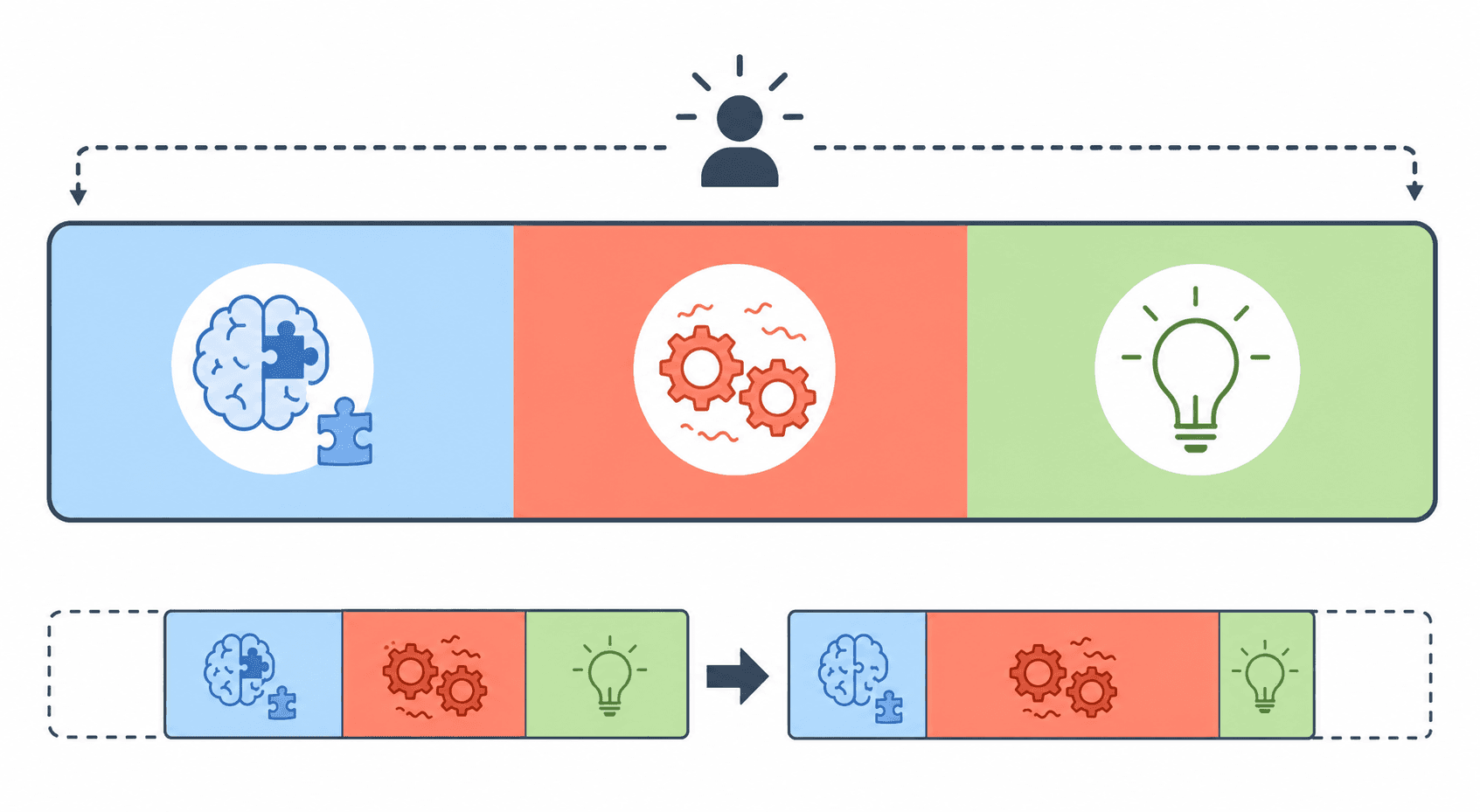
Typing introduces substantial extraneous load before a single idea gets captured. Your working memory is already managing the mechanics of the keyboard while simultaneously trying to hold your thoughts together. Less capacity remains for the work that matters.
Why Typing Imposes a Disproportionately High Extraneous Load
Typing looks simple from the outside. From inside working memory, it's a parallel processing nightmare: your brain is managing key-finding, cursor-tracking, and spelling monitoring while simultaneously holding the sentence in short-term memory.
None of that mechanical overhead produces cognitive benefit. Research writing and working memory research confirms that writing overloads working memory more than reading or listening does. The compositional thinking, the germane load where ideas actually form and connect, gets crowded out by the motor task sitting in front of it.
How Neurodivergent Brains Experience Cognitive Load Differently
Extraneous load is not equally costly for everyone. For neurodivergent professionals, the working memory overhead that typing imposes lands on a system that already has less available capacity. ADHD is most directly linked to this: a ADHD and working memory scoping review in the European Journal of Neuroscience found it affects 6.8 to 10.2% of the population, with working memory impairment as a core feature. Dyslexia adds phonological processing difficulty that makes spelling demands especially costly (see speech to text for dyslexia); dysgraphia impairs the motor act of writing directly; and ADHD and dyslexia co-occur in roughly 25 to 40% of cases. Anxiety about visible errors compounds the cost further, pulling from the same working memory pool before a single word is typed.
How Voice Dictation Reduces Extraneous Load
Speaking bypasses the motor translation layer that typing requires. The extraneous load that consumed a meaningful portion of working memory simply disappears.
What remains is intrinsic and germane load: the actual difficulty of the ideas and the cognitive work of building them. Voice dictation does not make thinking easier. It stops taxing working memory with overhead that was never contributing to the output.
This distinction has practical consequences. When typing, many professionals unconsciously compress their ideas to reduce the mechanical cost of getting them out: shorter sentences, simpler structures, fewer qualifications. Thoughts arrive more completely by voice because there is no incentive to abbreviate them.
Voice Dictation and Executive Function: What Changes for ADHD
For ADHD in particular, the friction often starts before any writing begins. Opening a blank email, deciding on tone, committing to a first sentence: each step costs executive function before a word lands.
Voice collapses that sequence. One keypress and you're already speaking, and output starts. This is why AI dictation tools for ADHD essay writing focus heavily on reducing initiation friction.
There are two other patterns worth naming here.
Filler word removal matters for ADHD verbal output, which tends to be non-linear, with restarts, tangents, and mid-thought corrections. A dictation tool that strips those artifacts automatically means the messiness of the thinking process doesn't contaminate the final text. You can think out loud without paying an editing penalty for it.
The "brain dump" pattern fits naturally for nonlinear thinkers. Separating the output phase from the editing phase removes the stall point that comes from trying to organize and compose at the same time; this pattern is also covered in voice dictation for writer's block.
Voice Dictation and the Spelling and Phonological Barrier in Dyslexia
Dyslexia is not a reading problem with a spelling side effect. The underlying mechanism is phonological processing: the brain's ability to map sounds to their written representations. When that mapping is effortful, translating a spoken thought into typed text requires explicit conversion at every word. Roughly 20% of the population has dyslexia symptoms; dysgraphia, which impairs the motor sequencing required to form letters, affects approximately 5 to 20% and almost always co-occurs with other conditions. Voice dictation removes both barriers. The user speaks; the tool handles phoneme-to-grapheme conversion and motor output entirely, and tools with automatic punctuation for dictation remove an additional layer of overhead for these users. The cognitive path from idea to text shortens to a single step.
There is also an anticipatory cost worth naming. Many professionals with dyslexia carry a background awareness of visible errors before they begin writing, and that background monitoring draws from the same working memory that should be going toward the content. A voice-first workflow removes that anticipatory load before the task starts, not after it ends.
Latency, Accuracy, and Why Both Matter for Cognitive Flow
Not all voice dictation tools reduce cognitive load. Some redistribute it by introducing new friction instead of removing existing overhead.
A tool that frequently misrecognizes words creates a correction loop: spot the error, stop, re-read, fix, try to recover the original thought. For neurodivergent users, that loop is particularly costly because re-entering a focused state takes longer, and the frustration itself consumes cognitive resources that were already scarce.
Latency creates a parallel problem. When there is a perceptible gap between speaking and seeing text appear, attention has nowhere to go. The thought being held in working memory starts to degrade during that pause, compounding re-engagement costs across every sentence for anyone who already finds prolonged focus effortful.
This makes accuracy and latency accessibility specifications, not convenience features. For professionals in workplace settings, whether drafting reports, responding to clients, or prompting AI tools, the same thresholds apply whether the device is a Windows workstation, a Mac, or an iPhone. Comparing AI dictation tools on these dimensions is critical. When assessing any dictation tool for neurodivergent use, both thresholds matter: accuracy high enough that corrections are rare, and latency low enough that output feels continuous with speech.
Criterion | Willow Voice | Built-in OS Dictation (Apple / Windows) |
|---|---|---|
Latency | ~200ms | 700ms+ |
Accuracy | 98%+ | Lower accuracy; errors compound across a session |
Filler word removal | Yes, automatic | No |
Learning loop | Yes; Auto-Dictionary adapts from corrections | No; corrections do not carry forward |
Custom vocabulary | Yes; preloadable before first session | Limited or not available |
Correction loop cost | Low; rare errors, short re-engagement | High; frequent misrecognitions trigger repeated re-engagement |
Among AI-powered dictation tools, Wispr Flow is a widely used alternative with Mac, Windows, and iOS support that handles general dictation reliably. At ~700ms latency and 90% accuracy, it clears a higher bar than built-in OS tools. Both figures still sit above the thresholds where re-engagement costs compound for neurodivergent users: 700ms is long enough for the next clause to partially dissolve in working memory between sentences, and at 90% accuracy, correction loops still interrupt output mode often enough to pull focus. That gap is why the table above frames accuracy and latency as accessibility specifications instead of convenience benchmarks.
How Willow Voice Is Designed for Neurodivergent Professionals
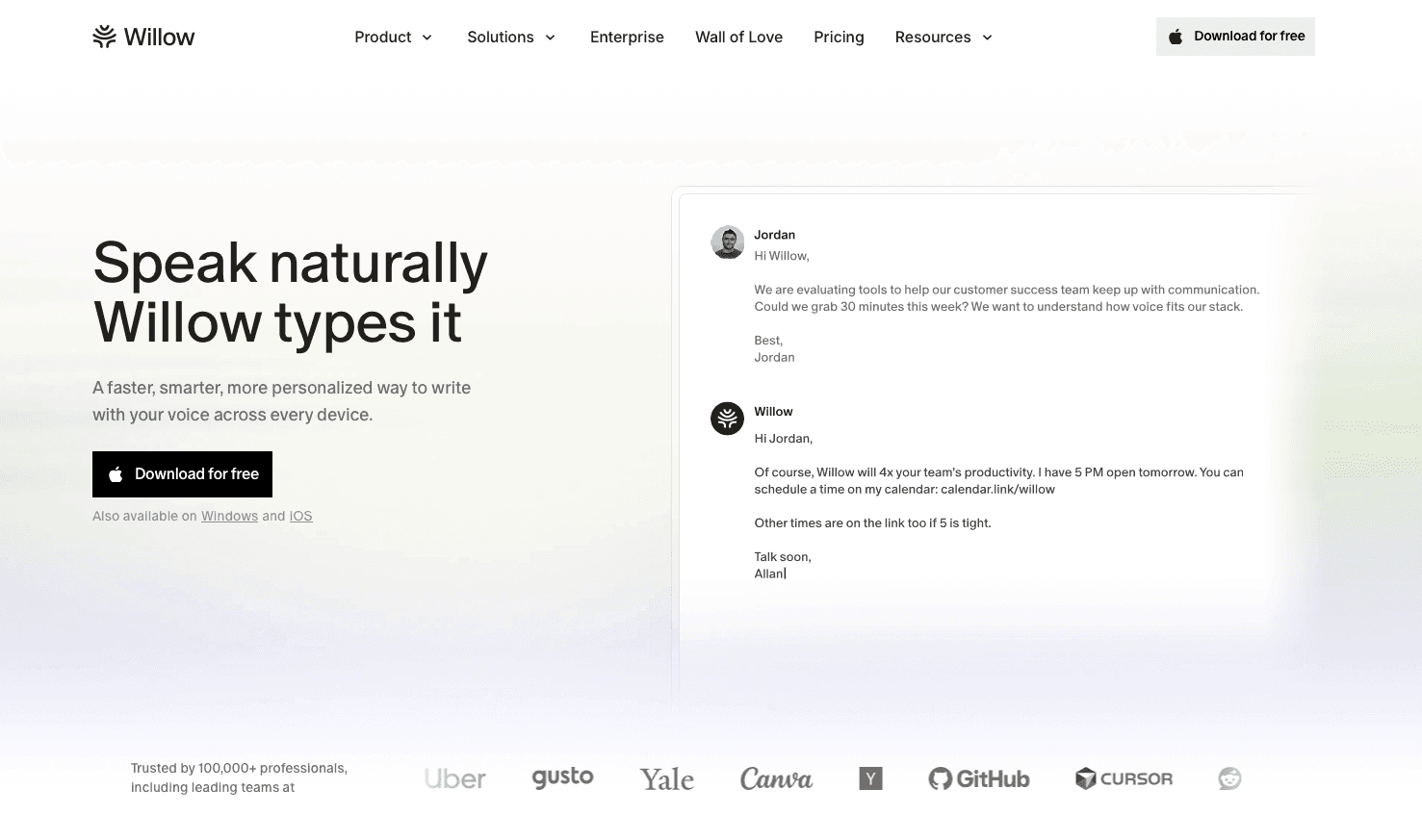
Willow Voice is built for Mac, Windows, and iOS around the failure modes that make generic dictation tools expensive for neurodivergent users. The ~200ms latency keeps spoken thoughts from degrading before text appears. The 98%+ accuracy rate, with 3x fewer errors than built-in OS dictation, cuts correction loops and re-engagement cycles per session. Filler word removal handles the nonlinear, restart-heavy speech common in ADHD output automatically. The Auto-Dictionary learns from corrections, so proper nouns and domain terms that misfire early stop misfiring after a handful of fixes, with no manual setup required.
Activation is a single hotkey from any application: Fn on Mac, Alt+Space on Windows, with vocabulary carrying to iOS via Willow's custom keyboard. The same gesture works in Gmail, Slack, Notion, or any text field, cutting the initiation friction that compounds for ADHD users across dozens of daily tasks. Willow offers a free unlimited plan with no word cap and no credit card required. The Individual plan is $12/month billed annually; Team plans at $10 per user per month include shared custom dictionaries and admin controls for employers building voice-first accommodation workflows. Willow is SOC 2 Type II and HIPAA compliant, used by over 100,000 professionals including teams at Uber, Reddit, and companies across 20% of the Fortune 500.
FAQs
How do I set up Willow Voice to minimize correction loops for neurodivergent workflows?
Load your custom vocabulary (proper nouns, product names, domain terms) before your first session, and use a USB headset or close-talk earbuds over a built-in laptop mic to keep accuracy high. Activate with Fn on Mac or Alt+Space on Windows, both reassignable to any key combination you prefer. Finally, use a dump-then-refine pattern: speak the full thought first, then review, so initiation and editing stay separate.
Can voice dictation be formally documented as a workplace accommodation for ADHD or dyslexia?
Yes: voice dictation qualifies as a reasonable accommodation under the ADA and can be documented through standard HR processes. A 2024 SHRM survey found only 35% of U.S. employers offer formal ADHD-specific accommodations compared to 78% for dyslexia, so professionals whose primary diagnosis is ADHD may need to initiate that conversation explicitly. This is not legal advice; accommodation rights vary by jurisdiction, employer size, and individual circumstance, and an HR team or employment attorney is the right resource.
What accuracy and latency thresholds should I look for in a voice dictation tool for neurodivergent use?
Two benchmarks matter: 98%+ accuracy and latency at or below ~200ms. At 98%+ accuracy, errors stay infrequent enough that you remain in output mode without toggling into proofreading mid-thought. At ~200ms, text appears fast enough that speaking and reading feel continuous; tools running at 700ms or higher create a gap long enough for the next clause to dissolve in working memory, compounding re-engagement costs across every sentence.
Final Thoughts on Cognitive Load, Voice Dictation, and Neurodivergent Workflows
Typing asks your brain to do two jobs at once, and for neurodivergent professionals, the second job costs more than most tools account for. Voice dictation cognitive load is the framework that explains why: remove the motor translation layer, and more of working memory goes toward actual output. Your thoughts arrive more completely, your initiation friction drops, and the correction loops that drain focus become the exception, not the norm. Download Willow Voice to see how a single workflow shift can change how much of your working day actually goes toward the work.
You probably know the feeling of staring at a blank email while the idea you had thirty seconds ago quietly disappears. For neurodivergent professionals, that's not a focus problem, it's a working memory problem, and typing makes it worse by design. Understanding voice dictation cognitive load, what it is, and how speaking instead of typing removes the bottleneck at the source, is where this guide starts.
TLDR:
Typing imposes pure extraneous cognitive load (key-finding, cursor-tracking, spelling) before a single idea lands on the page.
For ADHD and dyslexia, that overhead lands on a working memory system already running near capacity, compounding the cost.
Voice dictation removes the motor translation layer entirely, leaving only the cognitive work that actually produces output.
A dictation tool only reduces load if accuracy stays at 98%+ and latency stays near 200ms; tools running at 700ms+ degrade working memory between sentences.
Purpose-built AI dictation tools designed around these thresholds include filler word removal and a learning dictionary for the correction-loop sensitivity neurodivergent users face.
Willow Voice is the voice dictation tool most directly matched to neurodivergent working memory constraints: 98%+ accuracy and ~200ms latency keep correction loops rare and the feedback loop tight enough that spoken thoughts arrive on screen before short-term memory loses them. At those thresholds, the extraneous cognitive load that typing imposes is removed instead of being redistributed to a different form of overhead. For users with ADHD and dyslexia, filler word removal, a learning Auto-Dictionary, and a system-wide hotkey on Mac (Fn), Windows (Alt+Space), and iOS take on the initiation friction and correction sensitivity that generic tools leave in place.
What Cognitive Load Actually Is (And Why It Matters for Writing)
Cognitive Load Theory, developed by psychologist John Sweller, holds that working memory has a hard capacity limit. Push too much through it at once, and performance degrades.
CLT breaks that load into three types. Intrinsic load is the inherent difficulty of the task itself, like organizing an argument or structuring a report. Extraneous load comes from the medium you're working in, the friction imposed by format, tools, or interface. Germane load is the productive kind: the mental effort that actually builds understanding and output.
Typing introduces substantial extraneous load before a single idea gets captured. Your working memory is already managing the mechanics of the keyboard while simultaneously trying to hold your thoughts together. Less capacity remains for the work that matters.
Why Typing Imposes a Disproportionately High Extraneous Load
Typing looks simple from the outside. From inside working memory, it's a parallel processing nightmare: your brain is managing key-finding, cursor-tracking, and spelling monitoring while simultaneously holding the sentence in short-term memory.
None of that mechanical overhead produces cognitive benefit. Research writing and working memory research confirms that writing overloads working memory more than reading or listening does. The compositional thinking, the germane load where ideas actually form and connect, gets crowded out by the motor task sitting in front of it.
How Neurodivergent Brains Experience Cognitive Load Differently
Extraneous load is not equally costly for everyone. For neurodivergent professionals, the working memory overhead that typing imposes lands on a system that already has less available capacity. ADHD is most directly linked to this: a ADHD and working memory scoping review in the European Journal of Neuroscience found it affects 6.8 to 10.2% of the population, with working memory impairment as a core feature. Dyslexia adds phonological processing difficulty that makes spelling demands especially costly (see speech to text for dyslexia); dysgraphia impairs the motor act of writing directly; and ADHD and dyslexia co-occur in roughly 25 to 40% of cases. Anxiety about visible errors compounds the cost further, pulling from the same working memory pool before a single word is typed.
How Voice Dictation Reduces Extraneous Load
Speaking bypasses the motor translation layer that typing requires. The extraneous load that consumed a meaningful portion of working memory simply disappears.
What remains is intrinsic and germane load: the actual difficulty of the ideas and the cognitive work of building them. Voice dictation does not make thinking easier. It stops taxing working memory with overhead that was never contributing to the output.
This distinction has practical consequences. When typing, many professionals unconsciously compress their ideas to reduce the mechanical cost of getting them out: shorter sentences, simpler structures, fewer qualifications. Thoughts arrive more completely by voice because there is no incentive to abbreviate them.
Voice Dictation and Executive Function: What Changes for ADHD
For ADHD in particular, the friction often starts before any writing begins. Opening a blank email, deciding on tone, committing to a first sentence: each step costs executive function before a word lands.
Voice collapses that sequence. One keypress and you're already speaking, and output starts. This is why AI dictation tools for ADHD essay writing focus heavily on reducing initiation friction.
There are two other patterns worth naming here.
Filler word removal matters for ADHD verbal output, which tends to be non-linear, with restarts, tangents, and mid-thought corrections. A dictation tool that strips those artifacts automatically means the messiness of the thinking process doesn't contaminate the final text. You can think out loud without paying an editing penalty for it.
The "brain dump" pattern fits naturally for nonlinear thinkers. Separating the output phase from the editing phase removes the stall point that comes from trying to organize and compose at the same time; this pattern is also covered in voice dictation for writer's block.
Voice Dictation and the Spelling and Phonological Barrier in Dyslexia
Dyslexia is not a reading problem with a spelling side effect. The underlying mechanism is phonological processing: the brain's ability to map sounds to their written representations. When that mapping is effortful, translating a spoken thought into typed text requires explicit conversion at every word. Roughly 20% of the population has dyslexia symptoms; dysgraphia, which impairs the motor sequencing required to form letters, affects approximately 5 to 20% and almost always co-occurs with other conditions. Voice dictation removes both barriers. The user speaks; the tool handles phoneme-to-grapheme conversion and motor output entirely, and tools with automatic punctuation for dictation remove an additional layer of overhead for these users. The cognitive path from idea to text shortens to a single step.
There is also an anticipatory cost worth naming. Many professionals with dyslexia carry a background awareness of visible errors before they begin writing, and that background monitoring draws from the same working memory that should be going toward the content. A voice-first workflow removes that anticipatory load before the task starts, not after it ends.
Latency, Accuracy, and Why Both Matter for Cognitive Flow
Not all voice dictation tools reduce cognitive load. Some redistribute it by introducing new friction instead of removing existing overhead.
A tool that frequently misrecognizes words creates a correction loop: spot the error, stop, re-read, fix, try to recover the original thought. For neurodivergent users, that loop is particularly costly because re-entering a focused state takes longer, and the frustration itself consumes cognitive resources that were already scarce.
Latency creates a parallel problem. When there is a perceptible gap between speaking and seeing text appear, attention has nowhere to go. The thought being held in working memory starts to degrade during that pause, compounding re-engagement costs across every sentence for anyone who already finds prolonged focus effortful.
This makes accuracy and latency accessibility specifications, not convenience features. For professionals in workplace settings, whether drafting reports, responding to clients, or prompting AI tools, the same thresholds apply whether the device is a Windows workstation, a Mac, or an iPhone. Comparing AI dictation tools on these dimensions is critical. When assessing any dictation tool for neurodivergent use, both thresholds matter: accuracy high enough that corrections are rare, and latency low enough that output feels continuous with speech.
Criterion | Willow Voice | Built-in OS Dictation (Apple / Windows) |
|---|---|---|
Latency | ~200ms | 700ms+ |
Accuracy | 98%+ | Lower accuracy; errors compound across a session |
Filler word removal | Yes, automatic | No |
Learning loop | Yes; Auto-Dictionary adapts from corrections | No; corrections do not carry forward |
Custom vocabulary | Yes; preloadable before first session | Limited or not available |
Correction loop cost | Low; rare errors, short re-engagement | High; frequent misrecognitions trigger repeated re-engagement |
Among AI-powered dictation tools, Wispr Flow is a widely used alternative with Mac, Windows, and iOS support that handles general dictation reliably. At ~700ms latency and 90% accuracy, it clears a higher bar than built-in OS tools. Both figures still sit above the thresholds where re-engagement costs compound for neurodivergent users: 700ms is long enough for the next clause to partially dissolve in working memory between sentences, and at 90% accuracy, correction loops still interrupt output mode often enough to pull focus. That gap is why the table above frames accuracy and latency as accessibility specifications instead of convenience benchmarks.
How Willow Voice Is Designed for Neurodivergent Professionals
Willow Voice is built for Mac, Windows, and iOS around the failure modes that make generic dictation tools expensive for neurodivergent users. The ~200ms latency keeps spoken thoughts from degrading before text appears. The 98%+ accuracy rate, with 3x fewer errors than built-in OS dictation, cuts correction loops and re-engagement cycles per session. Filler word removal handles the nonlinear, restart-heavy speech common in ADHD output automatically. The Auto-Dictionary learns from corrections, so proper nouns and domain terms that misfire early stop misfiring after a handful of fixes, with no manual setup required.
Activation is a single hotkey from any application: Fn on Mac, Alt+Space on Windows, with vocabulary carrying to iOS via Willow's custom keyboard. The same gesture works in Gmail, Slack, Notion, or any text field, cutting the initiation friction that compounds for ADHD users across dozens of daily tasks. Willow offers a free unlimited plan with no word cap and no credit card required. The Individual plan is $12/month billed annually; Team plans at $10 per user per month include shared custom dictionaries and admin controls for employers building voice-first accommodation workflows. Willow is SOC 2 Type II and HIPAA compliant, used by over 100,000 professionals including teams at Uber, Reddit, and companies across 20% of the Fortune 500.
FAQs
How do I set up Willow Voice to minimize correction loops for neurodivergent workflows?
Load your custom vocabulary (proper nouns, product names, domain terms) before your first session, and use a USB headset or close-talk earbuds over a built-in laptop mic to keep accuracy high. Activate with Fn on Mac or Alt+Space on Windows, both reassignable to any key combination you prefer. Finally, use a dump-then-refine pattern: speak the full thought first, then review, so initiation and editing stay separate.
Can voice dictation be formally documented as a workplace accommodation for ADHD or dyslexia?
Yes: voice dictation qualifies as a reasonable accommodation under the ADA and can be documented through standard HR processes. A 2024 SHRM survey found only 35% of U.S. employers offer formal ADHD-specific accommodations compared to 78% for dyslexia, so professionals whose primary diagnosis is ADHD may need to initiate that conversation explicitly. This is not legal advice; accommodation rights vary by jurisdiction, employer size, and individual circumstance, and an HR team or employment attorney is the right resource.
What accuracy and latency thresholds should I look for in a voice dictation tool for neurodivergent use?
Two benchmarks matter: 98%+ accuracy and latency at or below ~200ms. At 98%+ accuracy, errors stay infrequent enough that you remain in output mode without toggling into proofreading mid-thought. At ~200ms, text appears fast enough that speaking and reading feel continuous; tools running at 700ms or higher create a gap long enough for the next clause to dissolve in working memory, compounding re-engagement costs across every sentence.
Final Thoughts on Cognitive Load, Voice Dictation, and Neurodivergent Workflows
Typing asks your brain to do two jobs at once, and for neurodivergent professionals, the second job costs more than most tools account for. Voice dictation cognitive load is the framework that explains why: remove the motor translation layer, and more of working memory goes toward actual output. Your thoughts arrive more completely, your initiation friction drops, and the correction loops that drain focus become the exception, not the norm. Download Willow Voice to see how a single workflow shift can change how much of your working day actually goes toward the work.

Try Willow for free
Instant, accurate voice dictation. No card required.
Try Willow for free
Instant, accurate voice dictation. No card required.
Other stories you’ll love
Other stories you’ll love

Your keyboard is optional now
" transform="translate(5 5)" width="9.791000051498413px"/></svg>)

The voice-first interface for modern work.
© Willow Care, Inc. 2026. All rights reserved
Your keyboard is optional now
The voice-first interface for modern work.
© Willow Care, Inc. 2026. All rights reserved
Your keyboard is optional now
The voice-first interface for modern work.
© Willow Care, Inc. 2026. All rights reserved