" transform="translate(5 2)" width="10px"/></svg>)

•
5 min read
9 Proven Ways to Improve Client Communication Skills in July 2026

•
5 min read
9 Proven Ways to Improve Client Communication Skills in July 2026
There's a version of client communication that feels like you're always one step behind: responding to confusion instead of preventing it, chasing approvals, smoothing over misunderstandings that never should have happened. Learning how to improve client communication skills, whether you're in a law firm, an agency, a healthcare practice, or a consulting firm, really comes down to a handful of repeatable behaviors.
TLDR:
Ineffective communication is associated with significant project losses, with organizations reporting an average of approximately $75 million at risk for every $1 billion invested in projects, per Project Management Institute research.
Set a written alignment document at the start of every engagement to close expectation gaps before they compound.
Match your channel to the message: async for updates and decisions, synchronous for anything where tone matters.
Send a written recap within an hour of every client meeting that names who owns each next step and when it is due.
Purpose-built voice dictation software runs natively on Windows, Mac, and iOS, captures client context at 150 WPM versus 40 WPM typing, with roughly 200ms latency, shared custom dictionaries, admin controls for team-wide deployment, and SOC 2 Type II and HIPAA compliance built in.
The Real Cost of Poor Client Communication
Research consistently shows that communication failures carry a measurable price tag. According to a study by the Project Management Institute, ineffective communication is associated with significant project losses, with organizations reporting an average of approximately $75 million at risk for every $1 billion invested in projects. For client-facing teams, those numbers compound quickly.
Beyond lost revenue, poor communication damages trust in ways that are difficult to recover from. Clients who feel ignored, misunderstood, or left waiting for updates are far more likely to disengage entirely. Studies from Salesforce Research find that 86% of customers say the experience a company provides matters as much as its products or services, and communication quality sits at the center of that experience.
For legal teams, the stakes rise further. According to the American Bar Association, communication failures are among the leading causes of client grievances and malpractice claims. Clear, consistent attorney-client communication is not a courtesy; it is a professional obligation.
What Effective Client Communication Looks Like
Effective client communication shares a few consistent traits:
It sets expectations before the client thinks to ask, not after confusion has already built up.
It matches the client's preferred channel and cadence instead of defaulting to whatever is easiest for the team. Async communication best practices can help define those norms clearly.
It delivers bad news early and directly, with context and a path forward, not delay and damage control.
It treats the client as someone with their own goals and pressures, never as an account number to manage.
Set Clear Expectations from the Start
Most mid-project friction has a predictable origin: two parties who assumed they agreed on something they never actually discussed. The kickoff or onboarding moment is the best opportunity to close that gap before assumptions harden into misunderstandings.
A short alignment document, shared at the start of any engagement, prevents most of the confusion that builds later. Cover the basics:
Who makes decisions on each side, and who gets looped in on what
Which channel fits which type of message (routine updates, urgent flags, billing questions)
Expected response windows from both parties
How scope changes get raised, reviewed, and approved
Choose the Right Communication Channels
Matching Channel to Purpose

Different communication needs call for different tools:
Use async written channels like email or shared docs for internal status updates and decisions that benefit from a paper trail.
Use synchronous channels like video calls for complex discussions, sensitive feedback, or moments where tone matters.
Use messaging tools for quick clarifications, not for anything requiring context or nuance. Knowing how to close threads and unblock your team keeps conversations from dragging.
Channel Type | Best For | Avoid When |
|---|---|---|
Email / shared docs (async) | Status updates, decisions, anything needing a paper trail | Tone is ambiguous or nuance is critical |
Video / phone call (sync) | Complex discussions, sensitive feedback, moments where tone matters | A quick factual update would suffice |
Messaging tools (chat) | Quick clarifications with simple yes/no answers | Context or nuance is required; threads drag without resolution |
Practice Active Listening in Every Client Interaction

Active listening means giving clients your full attention, something distinct from waiting for your turn to speak. When clients feel genuinely heard, they share more, trust faster, and push back less.
A few habits that make a measurable difference:
Reflect back what you heard before responding. A quick "So what you're saying is..." catches misalignments early and signals that you're tracking the detail, beyond the headline.
Resist the urge to fill silence. Pauses often precede the most useful information a client will share.
Take notes visibly during calls. It communicates investment and gives you an accurate record to reference later.
Be Clear and Concise in Every Message
Front-load every message by putting the key ask or update in the first sentence, then providing context for those who need it. Clients scan before they read, and anything buried past the second line often goes unread entirely.
Drop internal jargon. Shorthand obvious to your team reads as noise to someone outside it. If a client needs to decode your terminology before they can process your point, the message has already failed.
Respond Promptly and Follow Up Consistently
Slow response times are one of the fastest ways to erode client trust. Research from HubSpot shows that 90% of customers rate an "immediate" response as important or very important when they have a service question, and for most clients, immediate means within ten minutes.
A few habits that build this reputation:
Set internal response-time targets by channel, document them as a shared team standard, and communicate them to clients upfront, so expectations are calibrated before urgency strikes.
After key milestones, send a brief follow-up confirming next steps and inviting any outstanding questions, instead of waiting for the client to reach out.
Handle Difficult Conversations with Honesty and Empathy
Difficult conversations don't get easier by avoiding them. Whether you're delivering critical feedback, owning a missed deadline, or working through a disagreement over project direction, how you handle these moments shapes client trust more than almost anything else.
Acknowledge the client's perspective before defending your own. Saying "I understand this isn't what you expected" costs nothing and defuses tension fast.
Stay solution-focused. Once the problem is named, move toward what happens next instead of relitigating what went wrong.
Follow up in writing. After any difficult exchange, send a brief recap of what was discussed and agreed upon so nothing gets misremembered.
Empathy and honesty aren't opposites. The clearest, most direct communicators are often also the most trusted because clients know they won't be managed or misled.
Build Trust Through Transparency
Clients can tell when they're being kept in the loop versus when they're being managed. The difference usually comes down to one thing: whether you share information proactively, before they have to ask for it.
A few practical ways to build this habit:
Share progress updates on a set cadence even when there's nothing dramatic to report. Silence reads as avoidance.
When something goes wrong, lead with what happened, what caused it, and what you're doing about it, in that order.
Let clients know about constraints or tradeoffs early. A client who understands why a timeline shifted is far less frustrated than one who finds out after the fact.
Transparency also means being clear about scope. If a request falls outside what was agreed, say so directly.
Document Action Items and Shared Agreements
After every client meeting, agreements made in conversation tend to disappear. Someone remembers a slightly different version of what was decided, the follow-up email never arrives, or the action item gets buried in a thread nobody revisits. Customer success managers write follow-ups faster when they have a repeatable system for this.
The fix is straightforward: document decisions in writing before the meeting ends, share them with the client immediately, and keep them somewhere your whole team can reference.
What Good Post-Meeting Documentation Looks Like
A brief summary sent within an hour of a call should capture, and knowing how to write meeting follow-up emails that hit every required element makes this easier:
What was decided, stated plainly without jargon
Who owns each next step and when it is due
Any open questions that still need a response
The date of the next scheduled touchpoint
Keeping this to a single short document, not a long narrative, makes it easier for clients to confirm, correct, or flag a missing item.
How Willow Voice Accelerates Client Communication for Teams
Client communication bottlenecks rarely come from a lack of effort. They come from friction: the lag between a meeting and a follow-up, the note that never got written, the update that sat in someone's head instead of a shared doc.
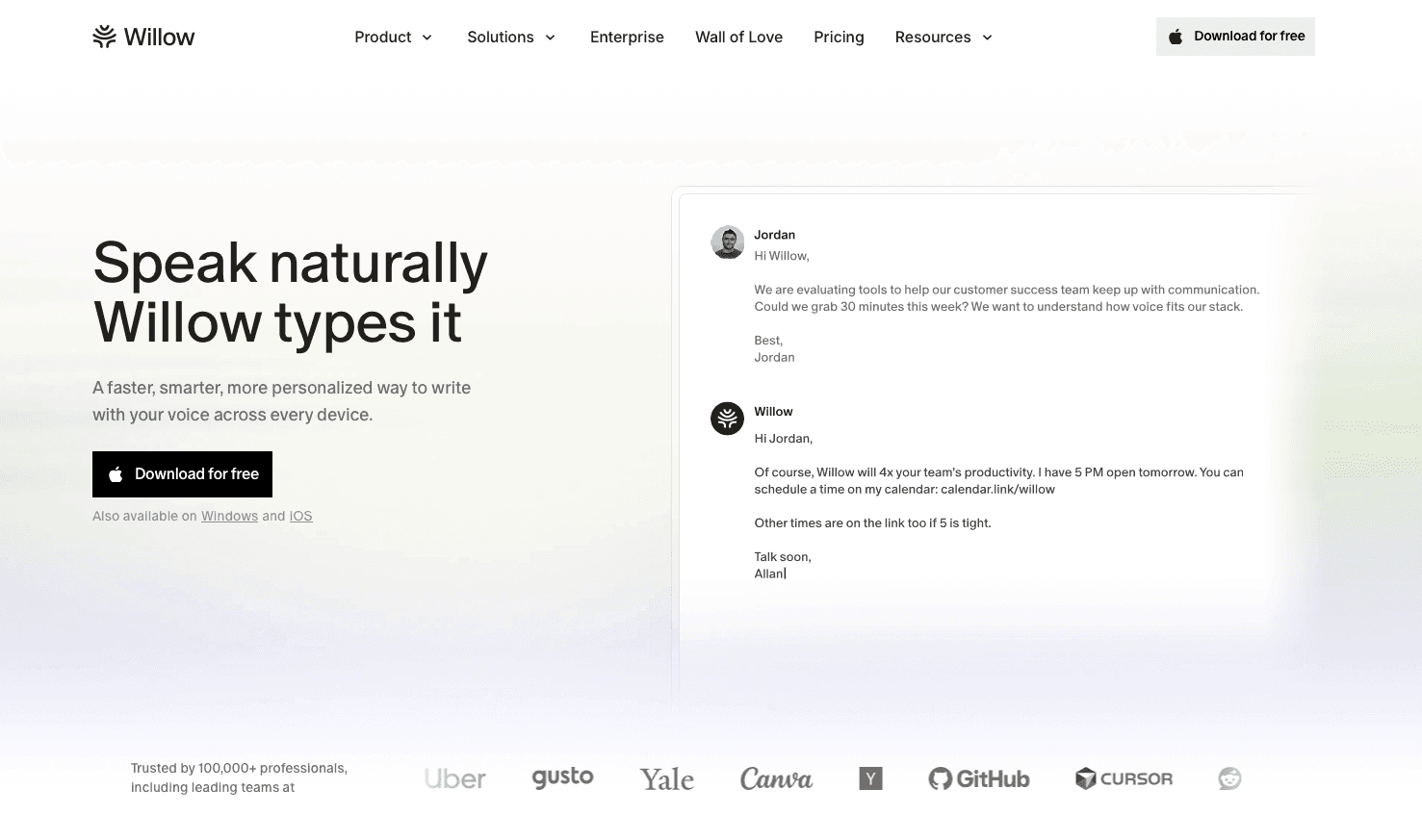
Willow Voice is built for teams where that friction compounds daily, whether members are at a Windows workstation, a Mac, or on iOS between calls. Client-facing professionals speak naturally and get accurate text back in roughly 200ms. Speaking at 150 WPM versus 40 WPM typing, a call recap that once took ten minutes to write gets captured in under three, and Willow Scribe can generate a complete follow-up email from a voice prompt without switching tools. Voice dictation for customer success teams shows how this plays out across daily documentation workflows.
Shared custom dictionaries and admin controls let teams standardize client names, project terminology, and internal shorthand across the org without per-user setup. Team leaderboards give managers visibility into adoption and time saved across the group. For mixed-device teams running Windows desktops alongside Mac laptops, Willow delivers the same dictation experience across Windows, Mac, and iOS. With SOC 2 Type II and HIPAA compliance built in, it scales from individual adoption to org-wide rollout and is trusted by teams at Uber, Reddit, and companies across 20% of the Fortune 500.
FAQs
What's the fastest way to fix communication in a relationship with clients before a small issue becomes a bigger one?
Handle expectation gaps in writing before they harden into disputes. A shared alignment document covering decision-makers, preferred channels, response windows, and scope-change protocols, created at the start of every engagement, closes the gap that causes most mid-project friction.
What does good post-meeting documentation look like for client communication?
A brief written recap sent within an hour of the call should name what was decided, who owns each next step, when it is due, any open questions, and the next scheduled touchpoint, all in a single short document, not a long narrative. Keeping it concise makes it easy for clients to confirm, correct, or flag a missing item without wading through prose.
How do I assess and improve client care and communication across a team without manual tracking?
Set clear channel norms and response-time standards in writing, then use tools that give managers visibility into adoption without extra overhead. Willow Voice includes team leaderboards that surface words dictated and time saved per team member, letting managers track whether communication habits are actually taking hold across the group.
Final Thoughts on Building Stronger Client Communication
The gap between clients who stay and clients who leave often traces back to communication quality, not work quality. Knowing how to improve client communication starts with the basics: setting clear expectations, choosing the right channel, and following up consistently. These are skills your team can build starting today, no major process change required. When you get these habits right, clients stop second-guessing the relationship and start trusting it. Willow Voice can help your team move faster from meeting to follow-up, on Windows, Mac, or iOS, so nothing falls through the cracks.
There's a version of client communication that feels like you're always one step behind: responding to confusion instead of preventing it, chasing approvals, smoothing over misunderstandings that never should have happened. Learning how to improve client communication skills, whether you're in a law firm, an agency, a healthcare practice, or a consulting firm, really comes down to a handful of repeatable behaviors.
TLDR:
Ineffective communication is associated with significant project losses, with organizations reporting an average of approximately $75 million at risk for every $1 billion invested in projects, per Project Management Institute research.
Set a written alignment document at the start of every engagement to close expectation gaps before they compound.
Match your channel to the message: async for updates and decisions, synchronous for anything where tone matters.
Send a written recap within an hour of every client meeting that names who owns each next step and when it is due.
Purpose-built voice dictation software runs natively on Windows, Mac, and iOS, captures client context at 150 WPM versus 40 WPM typing, with roughly 200ms latency, shared custom dictionaries, admin controls for team-wide deployment, and SOC 2 Type II and HIPAA compliance built in.
The Real Cost of Poor Client Communication
Research consistently shows that communication failures carry a measurable price tag. According to a study by the Project Management Institute, ineffective communication is associated with significant project losses, with organizations reporting an average of approximately $75 million at risk for every $1 billion invested in projects. For client-facing teams, those numbers compound quickly.
Beyond lost revenue, poor communication damages trust in ways that are difficult to recover from. Clients who feel ignored, misunderstood, or left waiting for updates are far more likely to disengage entirely. Studies from Salesforce Research find that 86% of customers say the experience a company provides matters as much as its products or services, and communication quality sits at the center of that experience.
For legal teams, the stakes rise further. According to the American Bar Association, communication failures are among the leading causes of client grievances and malpractice claims. Clear, consistent attorney-client communication is not a courtesy; it is a professional obligation.
What Effective Client Communication Looks Like
Effective client communication shares a few consistent traits:
It sets expectations before the client thinks to ask, not after confusion has already built up.
It matches the client's preferred channel and cadence instead of defaulting to whatever is easiest for the team. Async communication best practices can help define those norms clearly.
It delivers bad news early and directly, with context and a path forward, not delay and damage control.
It treats the client as someone with their own goals and pressures, never as an account number to manage.
Set Clear Expectations from the Start
Most mid-project friction has a predictable origin: two parties who assumed they agreed on something they never actually discussed. The kickoff or onboarding moment is the best opportunity to close that gap before assumptions harden into misunderstandings.
A short alignment document, shared at the start of any engagement, prevents most of the confusion that builds later. Cover the basics:
Who makes decisions on each side, and who gets looped in on what
Which channel fits which type of message (routine updates, urgent flags, billing questions)
Expected response windows from both parties
How scope changes get raised, reviewed, and approved
Choose the Right Communication Channels
Matching Channel to Purpose
Different communication needs call for different tools:
Use async written channels like email or shared docs for internal status updates and decisions that benefit from a paper trail.
Use synchronous channels like video calls for complex discussions, sensitive feedback, or moments where tone matters.
Use messaging tools for quick clarifications, not for anything requiring context or nuance. Knowing how to close threads and unblock your team keeps conversations from dragging.
Channel Type | Best For | Avoid When |
|---|---|---|
Email / shared docs (async) | Status updates, decisions, anything needing a paper trail | Tone is ambiguous or nuance is critical |
Video / phone call (sync) | Complex discussions, sensitive feedback, moments where tone matters | A quick factual update would suffice |
Messaging tools (chat) | Quick clarifications with simple yes/no answers | Context or nuance is required; threads drag without resolution |
Practice Active Listening in Every Client Interaction
Active listening means giving clients your full attention, something distinct from waiting for your turn to speak. When clients feel genuinely heard, they share more, trust faster, and push back less.
A few habits that make a measurable difference:
Reflect back what you heard before responding. A quick "So what you're saying is..." catches misalignments early and signals that you're tracking the detail, beyond the headline.
Resist the urge to fill silence. Pauses often precede the most useful information a client will share.
Take notes visibly during calls. It communicates investment and gives you an accurate record to reference later.
Be Clear and Concise in Every Message
Front-load every message by putting the key ask or update in the first sentence, then providing context for those who need it. Clients scan before they read, and anything buried past the second line often goes unread entirely.
Drop internal jargon. Shorthand obvious to your team reads as noise to someone outside it. If a client needs to decode your terminology before they can process your point, the message has already failed.
Respond Promptly and Follow Up Consistently
Slow response times are one of the fastest ways to erode client trust. Research from HubSpot shows that 90% of customers rate an "immediate" response as important or very important when they have a service question, and for most clients, immediate means within ten minutes.
A few habits that build this reputation:
Set internal response-time targets by channel, document them as a shared team standard, and communicate them to clients upfront, so expectations are calibrated before urgency strikes.
After key milestones, send a brief follow-up confirming next steps and inviting any outstanding questions, instead of waiting for the client to reach out.
Handle Difficult Conversations with Honesty and Empathy
Difficult conversations don't get easier by avoiding them. Whether you're delivering critical feedback, owning a missed deadline, or working through a disagreement over project direction, how you handle these moments shapes client trust more than almost anything else.
Acknowledge the client's perspective before defending your own. Saying "I understand this isn't what you expected" costs nothing and defuses tension fast.
Stay solution-focused. Once the problem is named, move toward what happens next instead of relitigating what went wrong.
Follow up in writing. After any difficult exchange, send a brief recap of what was discussed and agreed upon so nothing gets misremembered.
Empathy and honesty aren't opposites. The clearest, most direct communicators are often also the most trusted because clients know they won't be managed or misled.
Build Trust Through Transparency
Clients can tell when they're being kept in the loop versus when they're being managed. The difference usually comes down to one thing: whether you share information proactively, before they have to ask for it.
A few practical ways to build this habit:
Share progress updates on a set cadence even when there's nothing dramatic to report. Silence reads as avoidance.
When something goes wrong, lead with what happened, what caused it, and what you're doing about it, in that order.
Let clients know about constraints or tradeoffs early. A client who understands why a timeline shifted is far less frustrated than one who finds out after the fact.
Transparency also means being clear about scope. If a request falls outside what was agreed, say so directly.
Document Action Items and Shared Agreements
After every client meeting, agreements made in conversation tend to disappear. Someone remembers a slightly different version of what was decided, the follow-up email never arrives, or the action item gets buried in a thread nobody revisits. Customer success managers write follow-ups faster when they have a repeatable system for this.
The fix is straightforward: document decisions in writing before the meeting ends, share them with the client immediately, and keep them somewhere your whole team can reference.
What Good Post-Meeting Documentation Looks Like
A brief summary sent within an hour of a call should capture, and knowing how to write meeting follow-up emails that hit every required element makes this easier:
What was decided, stated plainly without jargon
Who owns each next step and when it is due
Any open questions that still need a response
The date of the next scheduled touchpoint
Keeping this to a single short document, not a long narrative, makes it easier for clients to confirm, correct, or flag a missing item.
How Willow Voice Accelerates Client Communication for Teams
Client communication bottlenecks rarely come from a lack of effort. They come from friction: the lag between a meeting and a follow-up, the note that never got written, the update that sat in someone's head instead of a shared doc.
Willow Voice is built for teams where that friction compounds daily, whether members are at a Windows workstation, a Mac, or on iOS between calls. Client-facing professionals speak naturally and get accurate text back in roughly 200ms. Speaking at 150 WPM versus 40 WPM typing, a call recap that once took ten minutes to write gets captured in under three, and Willow Scribe can generate a complete follow-up email from a voice prompt without switching tools. Voice dictation for customer success teams shows how this plays out across daily documentation workflows.
Shared custom dictionaries and admin controls let teams standardize client names, project terminology, and internal shorthand across the org without per-user setup. Team leaderboards give managers visibility into adoption and time saved across the group. For mixed-device teams running Windows desktops alongside Mac laptops, Willow delivers the same dictation experience across Windows, Mac, and iOS. With SOC 2 Type II and HIPAA compliance built in, it scales from individual adoption to org-wide rollout and is trusted by teams at Uber, Reddit, and companies across 20% of the Fortune 500.
FAQs
What's the fastest way to fix communication in a relationship with clients before a small issue becomes a bigger one?
Handle expectation gaps in writing before they harden into disputes. A shared alignment document covering decision-makers, preferred channels, response windows, and scope-change protocols, created at the start of every engagement, closes the gap that causes most mid-project friction.
What does good post-meeting documentation look like for client communication?
A brief written recap sent within an hour of the call should name what was decided, who owns each next step, when it is due, any open questions, and the next scheduled touchpoint, all in a single short document, not a long narrative. Keeping it concise makes it easy for clients to confirm, correct, or flag a missing item without wading through prose.
How do I assess and improve client care and communication across a team without manual tracking?
Set clear channel norms and response-time standards in writing, then use tools that give managers visibility into adoption without extra overhead. Willow Voice includes team leaderboards that surface words dictated and time saved per team member, letting managers track whether communication habits are actually taking hold across the group.
Final Thoughts on Building Stronger Client Communication
The gap between clients who stay and clients who leave often traces back to communication quality, not work quality. Knowing how to improve client communication starts with the basics: setting clear expectations, choosing the right channel, and following up consistently. These are skills your team can build starting today, no major process change required. When you get these habits right, clients stop second-guessing the relationship and start trusting it. Willow Voice can help your team move faster from meeting to follow-up, on Windows, Mac, or iOS, so nothing falls through the cracks.

Try Willow for free
Instant, accurate voice dictation. No card required.
Try Willow for free
Instant, accurate voice dictation. No card required.
Other stories you’ll love
Other stories you’ll love


Your keyboard is optional now
" transform="translate(5 5)" width="9.791000051498413px"/></svg>)

The voice-first interface for modern work.
© Willow Care, Inc. 2026. All rights reserved
Your keyboard is optional now
The voice-first interface for modern work.
© Willow Care, Inc. 2026. All rights reserved
Your keyboard is optional now
The voice-first interface for modern work.
© Willow Care, Inc. 2026. All rights reserved