" transform="translate(5 2)" width="10px"/></svg>)

•
5 min read
How to Close Threads and Unblock Your Team Faster: The August 2026 Guide

•
5 min read
How to Close Threads and Unblock Your Team Faster: The August 2026 Guide
Most threads stay open because replying takes longer to type than anyone has time for. You already know what needs to be said, but turning it into a clear, complete message feels like a separate task, so it waits and the backlog grows. Understanding how to close threads and unblock your team faster comes down to speaking your responses instead of typing them, using voice-first response tools that capture what you mean in seconds. When a reply takes 60 seconds instead of five minutes, threads stop piling up by default.
TLDR:
Threads stall when ownership is unclear or asks are too vague. Name one DRI and set a deadline.
Workers lose 1.8 hours daily searching for info; front-load context so responses take seconds.
Force sync calls only when async has failed 3+ times or conflict needs real-time resolution.
Speaking at 150 WPM versus typing at 40 WPM cuts response time by 75% with voice dictation.
Certain voice-first tools learn your writing patterns and deliver 200ms responses so you close threads faster.
Why Thread Closures Get Delayed in Team Workflows
Most threads don't die because nobody cares. They die because the right person never saw the message, saw it and meant to reply later, or replied with something that opened three new questions instead of closing one.
The underlying pattern is predictable. Per McKinsey research on knowledge work, coordination tasks like status checks, follow-ups, and clarifications eat up roughly 60% of the workweek instead of the actual work those threads are supposed to unblock. That overhead compounds fast. One unanswered Slack thread becomes a stalled pull request. A vague email reply spawns a meeting that could have been two sentences.
The Hidden Cost of Open Threads on Team Productivity
Workplace productivity statistics show employees face interruptions every two minutes during core work hours, per a daily workplace interruption study. Every unresolved thread is a pending ping, a context switch waiting to happen. Regaining focus after a disruption takes an average of 23 minutes, so a single unanswered follow-up can wipe out nearly half an hour of focused work. When a blocker sits open, adjacent work either stalls or moves on assumptions. Both create rework.
First-Level Strategies to Close Threads Faster
Some threads need process improvements. Others just need someone to act. Before reworking how your team communicates, start with what you can do right now.
Make a Direct Ask with a Deadline
Vague requests stay open. Specific ones get answered. If your thread needs a decision, say that explicitly and include a date. "Let me know your thoughts" is easy to defer. "Can you confirm by Thursday so we can ship Friday?" is harder to ignore. Name the person responsible in the message itself instead of hoping someone picks it up.
Surface Blockers in Existing Meetings
You don't need a new process for this. Your next standup or sync already exists. Flag the open thread there, out loud, with the person who can unblock it in the room. Written threads get missed. A thirty-second verbal callout in a meeting usually gets resolved on the spot.
Narrow the Ask
Long threads often stall because the question is too big. If someone needs to approve a full spec before replying, they'll delay. Break it down. Ask for one piece of confirmation, not the whole thing. Shrinking the scope of what's needed often gets a faster yes than waiting for someone to have time for a thorough review.
State who owns the response
Set a clear deadline in the message
Reduce the decision to its smallest form
Escalate verbally when written threads hit 48 hours without movement
Track response deadlines with reminders or project management tools
Second-Level Strategies When Basic Approaches Fail
When direct asks and verbal callouts don't move things, the thread has a different problem. Someone is blocked, overwhelmed, or silently deprioritizing. That calls for a different approach.
Request Permissions Directly
Waiting for a handoff is often the bottleneck itself. If you need access, approval, or a resource, ask for it explicitly. "Can you grant me edit access so I can move this forward?" cuts the back-and-forth in half.
Volunteer to Implement
If a teammate is the blocker, offer to do the work for them. Draft the doc, write the decision summary, prepare the options. People are more likely to approve something already in front of them than build it themselves under pressure.
Force a Decision Meeting
Some threads need a room, not a reply. If a thread has gone 72+ hours without resolution, call a short sync to close it. One question, one decision, done.
Escalate Through the Chain
When peer-level nudges aren't working, loop in a manager. Not to complain, but to reframe: "This has been open for a week and is blocking X. Can you help move it?" Most managers will unblock a clear bottleneck quickly when it's tied to a real dependency.
Communication Patterns That Keep Threads Moving
Employees waste 1.8 hours a day hunting for what they need to act on, per an employee information search study. For distributed teams, that gap is wider: messages cross time zones and tool stacks before reaching the right person. Better thread structure won't eliminate that entirely, but it cuts a meaningful chunk of it.

Three habits make the biggest difference:
Set a decision default in the message. "I'll proceed with option A on Friday unless I hear otherwise" removes the reply burden while still giving people a chance to weigh in.
Front-load context. If someone has to scroll up, open a doc, or ask a clarifying question before they can respond, the thread will stall. Put the relevant background in the message itself.
Document decisions where the work happens. When a thread closes, drop a one-sentence summary in the relevant channel, doc, or ticket. Next time someone searches, they find the answer instead of a dead thread.
These are small changes to how you write messages, not sweeping process overhauls. The pattern that keeps threads moving is simple: reduce the effort required to respond.
Decision-Making Frameworks to Prevent Thread Pile-Up
Most thread pile-ups trace back to one missing detail: nobody knows who decides. Assigning a Directly Responsible Individual (DRI) to any decision thread removes that ambiguity. One person owns the response; everyone else can contribute.
Pair that with a response SLA (24 hours for standard threads, 4 hours for blockers) posted somewhere visible, like a pinned channel message or team wiki, so expectations are clear for the whole group. Keep a lightweight decision log too: one line per closed thread with what was decided, who decided it, and when. It stops the same question from resurfacing a week later.
Assign one DRI per decision thread so ownership is never assumed or shared by default.
Set explicit response windows by urgency tier so everyone knows when to expect a resolution.
Log closed decisions where the team can find them so context is never lost.
When to Force Synchronous Resolution vs. Stay Async
Not every stalled thread needs a meeting, and not every complex topic should stay in chat. Here is when each approach serves you better:
Sync is worth it when:
The topic involves conflict or sensitive feedback that loses too much in translation over text
Three or more async replies have failed to reach a decision and the back-and-forth is costing more time than a call would
The stakes are high enough that misreading tone creates real risk
Speed matters more than having a written record
Stay async when:
The answer is a status update or a simple yes/no
The recipient is in a different time zone and a real-time call would hurt their schedule
A written record of the decision matters more than getting it fast
You can maximize Slack productivity with async messages
The default in most teams leans too far toward sync. Meetings get called for things a two-sentence message could close. Flip that reflex: ask whether a well-structured async message would work before scheduling anything. For teams spread across Windows desktops, Mac laptops, and mobile devices, async often reaches everyone faster than a call ever could. If a message would work, write it.
Voice-Powered Communication to Clear Thread Backlogs with Willow Voice
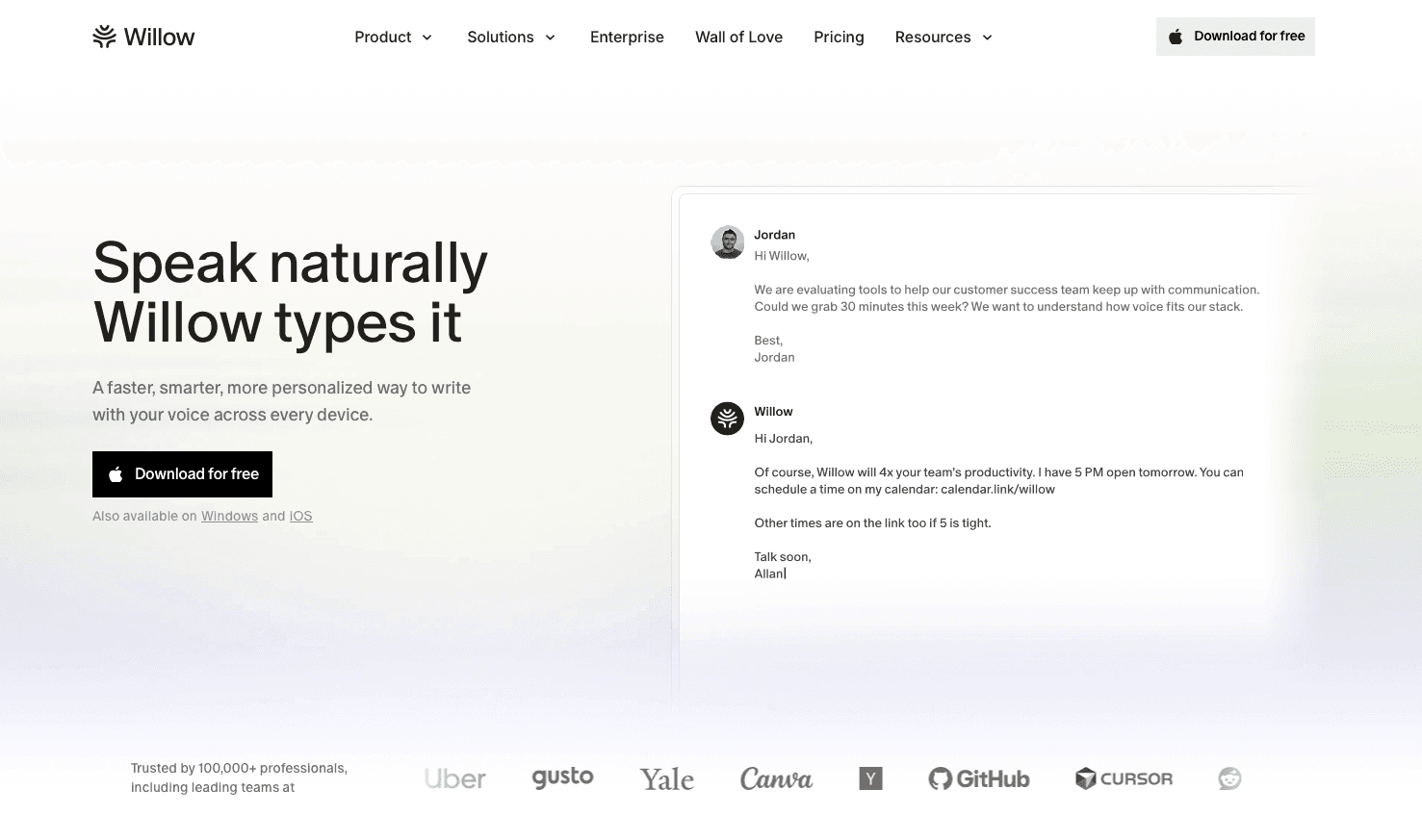
Every strategy in this guide requires one thing: a good response. Most backlogs live in the friction of typing a thorough reply when you're already stretched thin.
Speaking at 150 words per minute instead of typing at 40 turns a five-minute reply into under a minute. Willow's ~200ms latency keeps output instant so you stay in flow, while tools like Wispr Flow and Apple's built-in dictation lag at 700ms or more. Because Willow learns your writing patterns over time, the output sounds like you without cleanup. It runs natively on Mac, Windows, and iOS, with shared dictionaries and voice shortcuts available across the whole group from day one.
Tool | Latency | Learning Capability | Enterprise Compliance | Best For |
|---|---|---|---|---|
Willow Voice | 200ms response time for instant output | Learns your writing patterns and tone over time for personalized results | SOC 2 Type II and HIPAA compliant; shared dictionaries, admin controls, team leaderboards | Teams on Mac, Windows, and iOS managing high-volume threads who need fast, professional responses |
Wispr Flow | 700ms+ lag creates noticeable delay | Basic dictation without pattern learning | Standard consumer-level security | Individual users with simple dictation needs |
Apple Built-in Dictation | 700ms+ lag disrupts flow | No learning or personalization features | Consumer-grade privacy protections | Casual personal use and short messages |
Traditional Typing | 40 words per minute average speed | Full manual control but time-intensive | Depends on tool used | Short messages where precision editing is required upfront |
For teams managing high volumes of threads, voice dictation in Slack with shared dictionaries and voice shortcuts means everyone closes threads faster. SOC 2 Type II and HIPAA compliance, admin controls, and team leaderboards make Willow Voice deployment-ready across any enterprise environment, whether teams run Windows, Mac, iOS, or a mix of all three.
The bottleneck is rarely the decision. It's the message explaining it.
FAQs
What's the fastest way to unblock a stalled thread right now?
Name the person responsible directly in the message, give them a specific deadline, and narrow the ask to its smallest form. Request one piece of confirmation instead of full approval. If the thread hits 48 hours without movement, escalate verbally in your next standup or sync.
Why does voice dictation close threads faster than typing?
Speaking at 150 words per minute instead of typing at 40 means a five-minute typed response takes under a minute to speak. Willow's 200ms latency keeps output instant so you stay in flow, while tools like Wispr Flow and Apple's built-in voice dictation lag at 700ms or more, and the tool learns your writing patterns so responses sound like you without cleanup.
What's a DRI and why does it prevent thread pile-up?
A Directly Responsible Individual (DRI) is the one person who owns closing a decision thread. Assigning a DRI removes ambiguity about who decides, stops threads from staying open by default, and makes gaps visible when someone misses their response window.
Final Thoughts on Keeping Threads Closed and Work Unblocked
Learning how to close threads and unblock your team faster comes down to removing the friction of writing replies when you're already stretched thin. Speaking a response turns a five-minute task into a 60-second action, and Willow keeps up with ~200ms output while adapting to how you write so messages sound ready to send. It works across Mac, Windows, and iOS, so the whole team benefits from the same setup regardless of device. When replying no longer feels like extra work, threads close on time and work keeps moving. Try Willow Voice and clear your backlog without changing how your team works.
Most threads stay open because replying takes longer to type than anyone has time for. You already know what needs to be said, but turning it into a clear, complete message feels like a separate task, so it waits and the backlog grows. Understanding how to close threads and unblock your team faster comes down to speaking your responses instead of typing them, using voice-first response tools that capture what you mean in seconds. When a reply takes 60 seconds instead of five minutes, threads stop piling up by default.
TLDR:
Threads stall when ownership is unclear or asks are too vague. Name one DRI and set a deadline.
Workers lose 1.8 hours daily searching for info; front-load context so responses take seconds.
Force sync calls only when async has failed 3+ times or conflict needs real-time resolution.
Speaking at 150 WPM versus typing at 40 WPM cuts response time by 75% with voice dictation.
Certain voice-first tools learn your writing patterns and deliver 200ms responses so you close threads faster.
Why Thread Closures Get Delayed in Team Workflows
Most threads don't die because nobody cares. They die because the right person never saw the message, saw it and meant to reply later, or replied with something that opened three new questions instead of closing one.
The underlying pattern is predictable. Per McKinsey research on knowledge work, coordination tasks like status checks, follow-ups, and clarifications eat up roughly 60% of the workweek instead of the actual work those threads are supposed to unblock. That overhead compounds fast. One unanswered Slack thread becomes a stalled pull request. A vague email reply spawns a meeting that could have been two sentences.
The Hidden Cost of Open Threads on Team Productivity
Workplace productivity statistics show employees face interruptions every two minutes during core work hours, per a daily workplace interruption study. Every unresolved thread is a pending ping, a context switch waiting to happen. Regaining focus after a disruption takes an average of 23 minutes, so a single unanswered follow-up can wipe out nearly half an hour of focused work. When a blocker sits open, adjacent work either stalls or moves on assumptions. Both create rework.
First-Level Strategies to Close Threads Faster
Some threads need process improvements. Others just need someone to act. Before reworking how your team communicates, start with what you can do right now.
Make a Direct Ask with a Deadline
Vague requests stay open. Specific ones get answered. If your thread needs a decision, say that explicitly and include a date. "Let me know your thoughts" is easy to defer. "Can you confirm by Thursday so we can ship Friday?" is harder to ignore. Name the person responsible in the message itself instead of hoping someone picks it up.
Surface Blockers in Existing Meetings
You don't need a new process for this. Your next standup or sync already exists. Flag the open thread there, out loud, with the person who can unblock it in the room. Written threads get missed. A thirty-second verbal callout in a meeting usually gets resolved on the spot.
Narrow the Ask
Long threads often stall because the question is too big. If someone needs to approve a full spec before replying, they'll delay. Break it down. Ask for one piece of confirmation, not the whole thing. Shrinking the scope of what's needed often gets a faster yes than waiting for someone to have time for a thorough review.
State who owns the response
Set a clear deadline in the message
Reduce the decision to its smallest form
Escalate verbally when written threads hit 48 hours without movement
Track response deadlines with reminders or project management tools
Second-Level Strategies When Basic Approaches Fail
When direct asks and verbal callouts don't move things, the thread has a different problem. Someone is blocked, overwhelmed, or silently deprioritizing. That calls for a different approach.
Request Permissions Directly
Waiting for a handoff is often the bottleneck itself. If you need access, approval, or a resource, ask for it explicitly. "Can you grant me edit access so I can move this forward?" cuts the back-and-forth in half.
Volunteer to Implement
If a teammate is the blocker, offer to do the work for them. Draft the doc, write the decision summary, prepare the options. People are more likely to approve something already in front of them than build it themselves under pressure.
Force a Decision Meeting
Some threads need a room, not a reply. If a thread has gone 72+ hours without resolution, call a short sync to close it. One question, one decision, done.
Escalate Through the Chain
When peer-level nudges aren't working, loop in a manager. Not to complain, but to reframe: "This has been open for a week and is blocking X. Can you help move it?" Most managers will unblock a clear bottleneck quickly when it's tied to a real dependency.
Communication Patterns That Keep Threads Moving
Employees waste 1.8 hours a day hunting for what they need to act on, per an employee information search study. For distributed teams, that gap is wider: messages cross time zones and tool stacks before reaching the right person. Better thread structure won't eliminate that entirely, but it cuts a meaningful chunk of it.
Three habits make the biggest difference:
Set a decision default in the message. "I'll proceed with option A on Friday unless I hear otherwise" removes the reply burden while still giving people a chance to weigh in.
Front-load context. If someone has to scroll up, open a doc, or ask a clarifying question before they can respond, the thread will stall. Put the relevant background in the message itself.
Document decisions where the work happens. When a thread closes, drop a one-sentence summary in the relevant channel, doc, or ticket. Next time someone searches, they find the answer instead of a dead thread.
These are small changes to how you write messages, not sweeping process overhauls. The pattern that keeps threads moving is simple: reduce the effort required to respond.
Decision-Making Frameworks to Prevent Thread Pile-Up
Most thread pile-ups trace back to one missing detail: nobody knows who decides. Assigning a Directly Responsible Individual (DRI) to any decision thread removes that ambiguity. One person owns the response; everyone else can contribute.
Pair that with a response SLA (24 hours for standard threads, 4 hours for blockers) posted somewhere visible, like a pinned channel message or team wiki, so expectations are clear for the whole group. Keep a lightweight decision log too: one line per closed thread with what was decided, who decided it, and when. It stops the same question from resurfacing a week later.
Assign one DRI per decision thread so ownership is never assumed or shared by default.
Set explicit response windows by urgency tier so everyone knows when to expect a resolution.
Log closed decisions where the team can find them so context is never lost.
When to Force Synchronous Resolution vs. Stay Async
Not every stalled thread needs a meeting, and not every complex topic should stay in chat. Here is when each approach serves you better:
Sync is worth it when:
The topic involves conflict or sensitive feedback that loses too much in translation over text
Three or more async replies have failed to reach a decision and the back-and-forth is costing more time than a call would
The stakes are high enough that misreading tone creates real risk
Speed matters more than having a written record
Stay async when:
The answer is a status update or a simple yes/no
The recipient is in a different time zone and a real-time call would hurt their schedule
A written record of the decision matters more than getting it fast
You can maximize Slack productivity with async messages
The default in most teams leans too far toward sync. Meetings get called for things a two-sentence message could close. Flip that reflex: ask whether a well-structured async message would work before scheduling anything. For teams spread across Windows desktops, Mac laptops, and mobile devices, async often reaches everyone faster than a call ever could. If a message would work, write it.
Voice-Powered Communication to Clear Thread Backlogs with Willow Voice
Every strategy in this guide requires one thing: a good response. Most backlogs live in the friction of typing a thorough reply when you're already stretched thin.
Speaking at 150 words per minute instead of typing at 40 turns a five-minute reply into under a minute. Willow's ~200ms latency keeps output instant so you stay in flow, while tools like Wispr Flow and Apple's built-in dictation lag at 700ms or more. Because Willow learns your writing patterns over time, the output sounds like you without cleanup. It runs natively on Mac, Windows, and iOS, with shared dictionaries and voice shortcuts available across the whole group from day one.
Tool | Latency | Learning Capability | Enterprise Compliance | Best For |
|---|---|---|---|---|
Willow Voice | 200ms response time for instant output | Learns your writing patterns and tone over time for personalized results | SOC 2 Type II and HIPAA compliant; shared dictionaries, admin controls, team leaderboards | Teams on Mac, Windows, and iOS managing high-volume threads who need fast, professional responses |
Wispr Flow | 700ms+ lag creates noticeable delay | Basic dictation without pattern learning | Standard consumer-level security | Individual users with simple dictation needs |
Apple Built-in Dictation | 700ms+ lag disrupts flow | No learning or personalization features | Consumer-grade privacy protections | Casual personal use and short messages |
Traditional Typing | 40 words per minute average speed | Full manual control but time-intensive | Depends on tool used | Short messages where precision editing is required upfront |
For teams managing high volumes of threads, voice dictation in Slack with shared dictionaries and voice shortcuts means everyone closes threads faster. SOC 2 Type II and HIPAA compliance, admin controls, and team leaderboards make Willow Voice deployment-ready across any enterprise environment, whether teams run Windows, Mac, iOS, or a mix of all three.
The bottleneck is rarely the decision. It's the message explaining it.
FAQs
What's the fastest way to unblock a stalled thread right now?
Name the person responsible directly in the message, give them a specific deadline, and narrow the ask to its smallest form. Request one piece of confirmation instead of full approval. If the thread hits 48 hours without movement, escalate verbally in your next standup or sync.
Why does voice dictation close threads faster than typing?
Speaking at 150 words per minute instead of typing at 40 means a five-minute typed response takes under a minute to speak. Willow's 200ms latency keeps output instant so you stay in flow, while tools like Wispr Flow and Apple's built-in voice dictation lag at 700ms or more, and the tool learns your writing patterns so responses sound like you without cleanup.
What's a DRI and why does it prevent thread pile-up?
A Directly Responsible Individual (DRI) is the one person who owns closing a decision thread. Assigning a DRI removes ambiguity about who decides, stops threads from staying open by default, and makes gaps visible when someone misses their response window.
Final Thoughts on Keeping Threads Closed and Work Unblocked
Learning how to close threads and unblock your team faster comes down to removing the friction of writing replies when you're already stretched thin. Speaking a response turns a five-minute task into a 60-second action, and Willow keeps up with ~200ms output while adapting to how you write so messages sound ready to send. It works across Mac, Windows, and iOS, so the whole team benefits from the same setup regardless of device. When replying no longer feels like extra work, threads close on time and work keeps moving. Try Willow Voice and clear your backlog without changing how your team works.

Try Willow for free
Instant, accurate voice dictation. No card required.
Try Willow for free
Instant, accurate voice dictation. No card required.
Other stories you’ll love
Other stories you’ll love


Your keyboard is optional now
" transform="translate(5 5)" width="9.791000051498413px"/></svg>)

The voice-first interface for modern work.
© Willow Care, Inc. 2026. All rights reserved
Your keyboard is optional now
The voice-first interface for modern work.
© Willow Care, Inc. 2026. All rights reserved
Your keyboard is optional now
The voice-first interface for modern work.
© Willow Care, Inc. 2026. All rights reserved