" transform="translate(5 2)" width="10px"/></svg>)

•
5 min read
How to Reduce Email Response Time for Founders: 12 Strategies (August 2026)

•
5 min read
How to Reduce Email Response Time for Founders: 12 Strategies (August 2026)
Your inbox is not full because you lack discipline. It is full because you are processing, ranking, and writing emails in a way that slows you down at every step. Investors wait, customers drift, and your team stalls while drafts sit half finished. If you want to learn how to reduce email response time for founders, you need tighter response benchmarks, batched inbox windows, faster composition, and fewer manual decisions per message. Pair that system with a voice tool that captures your thoughts at conversation speed and adapts to how you write, and you turn email from a daily drag into a controlled workflow.
TLDR:
Founders who respond within 1 hour are 7x more likely to qualify leads than slower responders.
Voice dictation lets you write at 150 WPM vs typing at 40 WPM, saving nearly 3 hours daily.
Batch processing email at 3 designated times prevents the 1 minute 25 seconds focus loss from constant checking.
Smart filters and auto-sorting keep priority messages visible while routing low-value emails automatically.
Dedicated AI voice dictation tools can learn your writing style for faster, more accurate dictation, with sub-200ms latency, enterprise-grade security and compliance, and native support across Mac, Windows, and iOS.
Set Email Response Benchmarks and Track Performance
You can't improve what you don't measure. For founders juggling investor updates, customer inquiries, and team communications, email response time directly affects revenue and relationships.
Start by setting clear response time goals based on email type. Customer questions might warrant a 2-hour target, while internal team messages could allow 4 hours. The key is defining what "fast" means for your specific workflow.
Responding within 1 hour makes you 7x more likely to qualify a lead compared to slower responses. That gap between immediate action and delayed follow-up can mean the difference between closing a deal and losing it to a competitor.
Track your actual performance against these benchmarks weekly using proven inbox management methods. Most email clients offer timestamps that let you calculate average response times. When you spot patterns like consistently slow Friday responses, you can adjust your schedule or delegation strategy.
Batch Process Email at Designated Times
Constant email checking fragments focus. Every time you switch from deep work to scan your inbox, you lose mental momentum. Research shows it takes 1 minute 25 seconds to fully return to your original task after checking email.
Designate three specific email windows: morning (9-9:30am), midday (1-1:30pm), and end of day (4:30-5pm). Outside these blocks, keep your inbox closed. Set expectations with your team that emails sent between windows will receive responses at the next scheduled check.
Most "urgent" emails aren't actually time-sensitive. Batching responses lets you process similar messages together quickly. For truly urgent matters, direct your team to use Slack or text instead.
Email Processing Method | Time Saved Per Day | Implementation Difficulty | Best For |
|---|---|---|---|
Batch Processing (3x daily) | 1-2 hours | Easy | Reducing context switching |
Voice Dictation | 2-3 hours | Easy | Faster composition |
Templates Library | 30-60 minutes | Medium | Repetitive responses |
Smart Filters | 45-90 minutes | Medium | Auto-sorting low-priority email |
Keyboard Shortcuts | 15-30 minutes | Easy | Quick navigation and actions |
AI Writing Assistants | 1-2 hours | Easy | Drafting complex messages |
Create Email Templates for Common Scenarios
Founders answer the same questions repeatedly each week. Building a template library removes the mental work of rewriting identical responses.
Start with your most frequent email categories. Investor updates, pricing questions, feature requests, and support issues all follow patterns. Create base templates for each that include your core message while leaving blanks for personalization.
Templates shouldn't feel robotic, especially when combined with AI voice tools for email. Include bracketed sections like [specific metric] or [customer's challenge] that require context. You keep your voice while cutting composition time dramatically.
Store templates in your email client's signature feature, a note in your task manager, or a text expansion tool.
Sort Email Using the Eisenhower Matrix

Not every email deserves the same attention. The Eisenhower Matrix sorts messages into four categories, a technique used by many time management tools. Urgent and important emails like investor funding inquiries or customer escalations get immediate responses. Important but not urgent emails such as strategic partnerships need scheduled time blocks. Urgent but not important emails like event invitations should be delegated quickly. Neither urgent nor important emails warrant unsubscribing immediately to reduce inbox clutter and preserve focus.
Use Voice Dictation to Write Faster
Typing slows you down. Most founders type around 40 words per minute, but you speak at 150 words per minute. Voice dictation turns that speed gap into saved hours.
The math is simple. A 300-word email takes 7-8 minutes to type but only 2 minutes to speak. Across 30 emails daily, you reclaim nearly 3 hours by using modern voice-to-text tools.
Willow delivers ~200ms latency, making it the fastest dictation tool available. Press fn on Mac or Alt+Space on Windows to activate it in any app without switching windows. You stay in flow state instead of waiting for text to catch up. Willow also learns how you write, so you spend less time making edits after recording.
Use Keyboard Shortcuts and Text Expansion
Small actions repeated hundreds of times become massive time drains. Every time you reach for your mouse to click "archive" or type out your Zoom link, you lose seconds that accumulate into hours each month.
Learn your email client's core shortcuts first. Gmail users should memorize "e" for archive, "r" for reply, "c" for compose, and "#" for delete. Outlook users can master Ctrl+R for reply, Ctrl+Shift+V for move to folder, and Ctrl+1 for inbox view.
Text expansion tools replace short codes with full phrases. Type ";;sig" and your complete email signature appears. Type ";;zoom" for your personal meeting link. Your email, calendly link, and standard closings all become two keystrokes instead of dozens.
Set Up Smart Filters and Auto-Sorting
Your inbox fills with messages that don't need your immediate attention. Newsletters, automated notifications, and team updates bury the emails that actually matter.
Set up filters that automatically sort incoming messages before they hit your main inbox. Create a rule that sends all newsletters to a "Read Later" folder. Route automated notifications from tools like GitHub, Asana, or monitoring services to an "Alerts" label. Team announcements can flow into a "Team" folder you check once daily.
VIP filters work in reverse and can be combined with Gmail voice features for faster processing. Tag emails from investors, board members, and top customers to bypass other rules and land in your priority inbox.
When you open your inbox during designated email windows, you see only messages requiring founder-level decisions.
Create Email-Free Focus Blocks
Email destroys deep work. Every notification pulls you out of the strategic thinking that actually builds companies. Founders who keep their inbox open all day never enter the flow state required for complex problem-solving and productive work.
Schedule 3 to 4 hour blocks where email is completely off limits. During these windows, close your email client, silence notifications, and commit to uninterrupted focus on high value work like product roadmap planning, investor pitch refinement, or strategic hiring decisions.
Communicate these blocks to your team. Set an auto responder noting you're in focus mode and will respond during your next email window. For true emergencies, direct people to call or text instead.
Deploy AI Writing Assistants for Drafting
AI writing assistants remove the friction of starting emails from scratch. Instead of staring at a blank screen, you can generate a first draft in seconds and refine from there.
AI productivity tools with tone adjustment let you shift between formal investor updates and casual team messages. Length controls help you expand brief thoughts or condense rambling drafts.
Willow Assistant lets you select any text and command it to "reply to this email" or adjust tone without leaving your workflow. It operates system-wide across Mac and Windows, so you stay in whatever app you already have open. You skip the copy-paste dance with ChatGPT and stay focused on your actual message.
Implement Unsubscribe Ruthlessly
Every newsletter you ignore repeatedly wastes time. Knowledge workers spend up to 28% of their workweek reading, writing, and managing email. Reducing inbound volume attacks that problem at its source.
Apply the one-touch rule. When an email arrives that provides no value, unsubscribe immediately instead of deleting it. Newsletters you skip three times in a row should be gone.
Most marketing emails include an unsubscribe link at the bottom, saving time similar to voice prompting versus typing. Clicking takes five seconds. Deleting the same newsletter weekly wastes hours annually.
Train Your Network on Communication Preferences
Your network will treat email however you let them. If you respond to every message within minutes, people learn to expect immediate replies. If you answer weekend emails, your inbox stays full seven days a week.
Set clear expectations through your email signature. Add a line like "I respond to email twice daily at 9am and 4pm. For urgent matters, text me at [number]." This simple disclosure trains senders before they hit refresh waiting for your reply.
Direct different request types to specific channels. Financial questions go to your CFO. Product feedback routes through your product team's form. Calendar requests require your scheduling link, not back-and-forth emails.
Update your auto-responder during focus periods to reinforce these boundaries. Your network adapts quickly when you're consistent.
Use Willow to Write Emails at the Speed of Thought
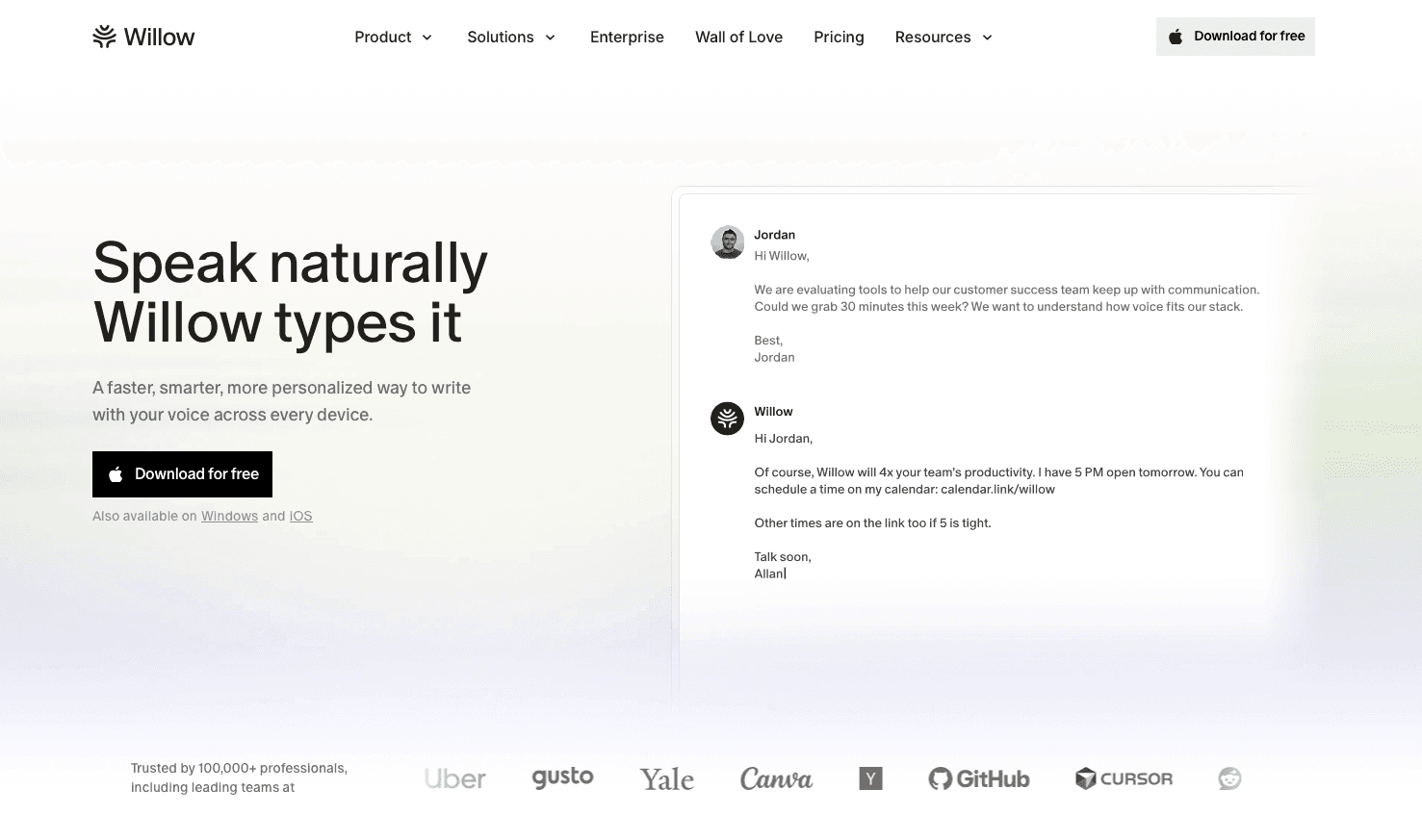
All the strategies above share one bottleneck: turning your thoughts into written text. Voice dictation solves that problem, but only if the tool is fast enough and accurate enough to match how you think.
Willow Voice delivers emails at conversation speed. Press Fn on Mac or Alt+Space on Windows inside Gmail, Slack, Outlook, or any app, speak naturally, and your message appears in under 200ms. Willow runs natively on Mac, Windows, and iOS, so the same hotkey and vocabulary follow you across devices. You stay in flow state instead of waiting for transcription to catch up.
The AI learns your writing style over time, so spoken emails need fewer edits and sound authentically like you. That personalization matters when drafting investor updates, customer responses, and team communications. For teams, shared custom dictionaries keep client names, product terms, and company shorthand consistent across every member without per-user setup, and admin controls let you push vocabulary and settings across the group from a single view. SOC 2 Type II and HIPAA compliance mean you can capture sensitive founder communications without security concerns.
FAQs
What's the main productivity difference between typing and voice dictation for email?
Typing averages 40 words per minute while speaking reaches 150 words per minute, making voice dictation nearly 4x faster. A 300-word email takes 7-8 minutes to type but only 2 minutes to speak, saving you roughly 3 hours daily across 30 emails.
When should I unsubscribe from newsletters instead of just deleting them?
Apply the three-strike rule: if you've skipped reading the same newsletter three times in a row without opening it, unsubscribe immediately. Each newsletter you repeatedly ignore wastes seconds per deletion that compounds into hours annually.
Can I use voice dictation for sensitive founder communications without security risks?
Yes. Willow maintains SOC 2 and HIPAA compliance with zero data retention policies, making it suitable for confidential investor updates, board communications, and customer discussions that contain proprietary information.
Final Thoughts on Managing Founder Email Workload
Mastering how to reduce email response time for founders comes down to one constraint: how fast you can turn decisions into sent messages. You can batch your inbox, set filters, and build templates, but if you are still typing every reply at 40 words per minute, email will keep piling up. Willow removes that bottleneck by letting you draft at conversation speed, learning your tone over time, and cutting the edit cycle that slows most founders down. When replies go out faster, deals move forward, customers feel heard, and your team stops waiting on you. Choose a few systems from this guide, add Willow to your workflow, and take back control of your inbox.
Your inbox is not full because you lack discipline. It is full because you are processing, ranking, and writing emails in a way that slows you down at every step. Investors wait, customers drift, and your team stalls while drafts sit half finished. If you want to learn how to reduce email response time for founders, you need tighter response benchmarks, batched inbox windows, faster composition, and fewer manual decisions per message. Pair that system with a voice tool that captures your thoughts at conversation speed and adapts to how you write, and you turn email from a daily drag into a controlled workflow.
TLDR:
Founders who respond within 1 hour are 7x more likely to qualify leads than slower responders.
Voice dictation lets you write at 150 WPM vs typing at 40 WPM, saving nearly 3 hours daily.
Batch processing email at 3 designated times prevents the 1 minute 25 seconds focus loss from constant checking.
Smart filters and auto-sorting keep priority messages visible while routing low-value emails automatically.
Dedicated AI voice dictation tools can learn your writing style for faster, more accurate dictation, with sub-200ms latency, enterprise-grade security and compliance, and native support across Mac, Windows, and iOS.
Set Email Response Benchmarks and Track Performance
You can't improve what you don't measure. For founders juggling investor updates, customer inquiries, and team communications, email response time directly affects revenue and relationships.
Start by setting clear response time goals based on email type. Customer questions might warrant a 2-hour target, while internal team messages could allow 4 hours. The key is defining what "fast" means for your specific workflow.
Responding within 1 hour makes you 7x more likely to qualify a lead compared to slower responses. That gap between immediate action and delayed follow-up can mean the difference between closing a deal and losing it to a competitor.
Track your actual performance against these benchmarks weekly using proven inbox management methods. Most email clients offer timestamps that let you calculate average response times. When you spot patterns like consistently slow Friday responses, you can adjust your schedule or delegation strategy.
Batch Process Email at Designated Times
Constant email checking fragments focus. Every time you switch from deep work to scan your inbox, you lose mental momentum. Research shows it takes 1 minute 25 seconds to fully return to your original task after checking email.
Designate three specific email windows: morning (9-9:30am), midday (1-1:30pm), and end of day (4:30-5pm). Outside these blocks, keep your inbox closed. Set expectations with your team that emails sent between windows will receive responses at the next scheduled check.
Most "urgent" emails aren't actually time-sensitive. Batching responses lets you process similar messages together quickly. For truly urgent matters, direct your team to use Slack or text instead.
Email Processing Method | Time Saved Per Day | Implementation Difficulty | Best For |
|---|---|---|---|
Batch Processing (3x daily) | 1-2 hours | Easy | Reducing context switching |
Voice Dictation | 2-3 hours | Easy | Faster composition |
Templates Library | 30-60 minutes | Medium | Repetitive responses |
Smart Filters | 45-90 minutes | Medium | Auto-sorting low-priority email |
Keyboard Shortcuts | 15-30 minutes | Easy | Quick navigation and actions |
AI Writing Assistants | 1-2 hours | Easy | Drafting complex messages |
Create Email Templates for Common Scenarios
Founders answer the same questions repeatedly each week. Building a template library removes the mental work of rewriting identical responses.
Start with your most frequent email categories. Investor updates, pricing questions, feature requests, and support issues all follow patterns. Create base templates for each that include your core message while leaving blanks for personalization.
Templates shouldn't feel robotic, especially when combined with AI voice tools for email. Include bracketed sections like [specific metric] or [customer's challenge] that require context. You keep your voice while cutting composition time dramatically.
Store templates in your email client's signature feature, a note in your task manager, or a text expansion tool.
Sort Email Using the Eisenhower Matrix
Not every email deserves the same attention. The Eisenhower Matrix sorts messages into four categories, a technique used by many time management tools. Urgent and important emails like investor funding inquiries or customer escalations get immediate responses. Important but not urgent emails such as strategic partnerships need scheduled time blocks. Urgent but not important emails like event invitations should be delegated quickly. Neither urgent nor important emails warrant unsubscribing immediately to reduce inbox clutter and preserve focus.
Use Voice Dictation to Write Faster
Typing slows you down. Most founders type around 40 words per minute, but you speak at 150 words per minute. Voice dictation turns that speed gap into saved hours.
The math is simple. A 300-word email takes 7-8 minutes to type but only 2 minutes to speak. Across 30 emails daily, you reclaim nearly 3 hours by using modern voice-to-text tools.
Willow delivers ~200ms latency, making it the fastest dictation tool available. Press fn on Mac or Alt+Space on Windows to activate it in any app without switching windows. You stay in flow state instead of waiting for text to catch up. Willow also learns how you write, so you spend less time making edits after recording.
Use Keyboard Shortcuts and Text Expansion
Small actions repeated hundreds of times become massive time drains. Every time you reach for your mouse to click "archive" or type out your Zoom link, you lose seconds that accumulate into hours each month.
Learn your email client's core shortcuts first. Gmail users should memorize "e" for archive, "r" for reply, "c" for compose, and "#" for delete. Outlook users can master Ctrl+R for reply, Ctrl+Shift+V for move to folder, and Ctrl+1 for inbox view.
Text expansion tools replace short codes with full phrases. Type ";;sig" and your complete email signature appears. Type ";;zoom" for your personal meeting link. Your email, calendly link, and standard closings all become two keystrokes instead of dozens.
Set Up Smart Filters and Auto-Sorting
Your inbox fills with messages that don't need your immediate attention. Newsletters, automated notifications, and team updates bury the emails that actually matter.
Set up filters that automatically sort incoming messages before they hit your main inbox. Create a rule that sends all newsletters to a "Read Later" folder. Route automated notifications from tools like GitHub, Asana, or monitoring services to an "Alerts" label. Team announcements can flow into a "Team" folder you check once daily.
VIP filters work in reverse and can be combined with Gmail voice features for faster processing. Tag emails from investors, board members, and top customers to bypass other rules and land in your priority inbox.
When you open your inbox during designated email windows, you see only messages requiring founder-level decisions.
Create Email-Free Focus Blocks
Email destroys deep work. Every notification pulls you out of the strategic thinking that actually builds companies. Founders who keep their inbox open all day never enter the flow state required for complex problem-solving and productive work.
Schedule 3 to 4 hour blocks where email is completely off limits. During these windows, close your email client, silence notifications, and commit to uninterrupted focus on high value work like product roadmap planning, investor pitch refinement, or strategic hiring decisions.
Communicate these blocks to your team. Set an auto responder noting you're in focus mode and will respond during your next email window. For true emergencies, direct people to call or text instead.
Deploy AI Writing Assistants for Drafting
AI writing assistants remove the friction of starting emails from scratch. Instead of staring at a blank screen, you can generate a first draft in seconds and refine from there.
AI productivity tools with tone adjustment let you shift between formal investor updates and casual team messages. Length controls help you expand brief thoughts or condense rambling drafts.
Willow Assistant lets you select any text and command it to "reply to this email" or adjust tone without leaving your workflow. It operates system-wide across Mac and Windows, so you stay in whatever app you already have open. You skip the copy-paste dance with ChatGPT and stay focused on your actual message.
Implement Unsubscribe Ruthlessly
Every newsletter you ignore repeatedly wastes time. Knowledge workers spend up to 28% of their workweek reading, writing, and managing email. Reducing inbound volume attacks that problem at its source.
Apply the one-touch rule. When an email arrives that provides no value, unsubscribe immediately instead of deleting it. Newsletters you skip three times in a row should be gone.
Most marketing emails include an unsubscribe link at the bottom, saving time similar to voice prompting versus typing. Clicking takes five seconds. Deleting the same newsletter weekly wastes hours annually.
Train Your Network on Communication Preferences
Your network will treat email however you let them. If you respond to every message within minutes, people learn to expect immediate replies. If you answer weekend emails, your inbox stays full seven days a week.
Set clear expectations through your email signature. Add a line like "I respond to email twice daily at 9am and 4pm. For urgent matters, text me at [number]." This simple disclosure trains senders before they hit refresh waiting for your reply.
Direct different request types to specific channels. Financial questions go to your CFO. Product feedback routes through your product team's form. Calendar requests require your scheduling link, not back-and-forth emails.
Update your auto-responder during focus periods to reinforce these boundaries. Your network adapts quickly when you're consistent.
Use Willow to Write Emails at the Speed of Thought
All the strategies above share one bottleneck: turning your thoughts into written text. Voice dictation solves that problem, but only if the tool is fast enough and accurate enough to match how you think.
Willow Voice delivers emails at conversation speed. Press Fn on Mac or Alt+Space on Windows inside Gmail, Slack, Outlook, or any app, speak naturally, and your message appears in under 200ms. Willow runs natively on Mac, Windows, and iOS, so the same hotkey and vocabulary follow you across devices. You stay in flow state instead of waiting for transcription to catch up.
The AI learns your writing style over time, so spoken emails need fewer edits and sound authentically like you. That personalization matters when drafting investor updates, customer responses, and team communications. For teams, shared custom dictionaries keep client names, product terms, and company shorthand consistent across every member without per-user setup, and admin controls let you push vocabulary and settings across the group from a single view. SOC 2 Type II and HIPAA compliance mean you can capture sensitive founder communications without security concerns.
FAQs
What's the main productivity difference between typing and voice dictation for email?
Typing averages 40 words per minute while speaking reaches 150 words per minute, making voice dictation nearly 4x faster. A 300-word email takes 7-8 minutes to type but only 2 minutes to speak, saving you roughly 3 hours daily across 30 emails.
When should I unsubscribe from newsletters instead of just deleting them?
Apply the three-strike rule: if you've skipped reading the same newsletter three times in a row without opening it, unsubscribe immediately. Each newsletter you repeatedly ignore wastes seconds per deletion that compounds into hours annually.
Can I use voice dictation for sensitive founder communications without security risks?
Yes. Willow maintains SOC 2 and HIPAA compliance with zero data retention policies, making it suitable for confidential investor updates, board communications, and customer discussions that contain proprietary information.
Final Thoughts on Managing Founder Email Workload
Mastering how to reduce email response time for founders comes down to one constraint: how fast you can turn decisions into sent messages. You can batch your inbox, set filters, and build templates, but if you are still typing every reply at 40 words per minute, email will keep piling up. Willow removes that bottleneck by letting you draft at conversation speed, learning your tone over time, and cutting the edit cycle that slows most founders down. When replies go out faster, deals move forward, customers feel heard, and your team stops waiting on you. Choose a few systems from this guide, add Willow to your workflow, and take back control of your inbox.

Try Willow for free
Instant, accurate voice dictation. No card required.
Try Willow for free
Instant, accurate voice dictation. No card required.
Other stories you’ll love
Other stories you’ll love


Your keyboard is optional now
" transform="translate(5 5)" width="9.791000051498413px"/></svg>)

The voice-first interface for modern work.
© Willow Care, Inc. 2026. All rights reserved
Your keyboard is optional now
The voice-first interface for modern work.
© Willow Care, Inc. 2026. All rights reserved
Your keyboard is optional now
The voice-first interface for modern work.
© Willow Care, Inc. 2026. All rights reserved