" transform="translate(5 2)" width="10px"/></svg>)

•
5 min read
How to Use AI Coding Agents Effectively: Best Practices for June 2026

•
5 min read
How to Use AI Coding Agents Effectively: Best Practices for June 2026
You've tried an AI coding agent inside Cursor, Claude Code, or a similar environment. It generated a function that looked right, then broke in production because it misread an edge case. Or it rewrote a module in a style that conflicts with how your team structures the codebase. Learning how to use AI agents for coding in a professional setting comes down to three things: scoping tasks the agent can actually complete without drifting, writing prompts with enough context to prevent plausible-but-wrong output, and reviewing every line before it touches a shared repo.
TLDR:
AI coding agents plan multi-step tasks and iterate on output, but treat their code as a first draft.
Precise prompts with language, framework, input/output, and edge cases produce better results.
Delegate well-scoped tasks like test scaffolding and refactoring; keep architecture decisions.
Read every line agents generate before running it and check for security gaps or hardcoded secrets.
Enterprise and cross-platform teams benefit from shared context files and consistent review habits across Windows and Mac environments.
Voice dictation can speed up prompt writing; Willow Voice learns codebase vocabulary, runs on Windows and Mac, and operates at ~200ms latency.
Understanding AI Coding Agents and What They Can Do
AI coding agents are software systems that can read your codebase, reason about what needs to change, and take action across multiple files without you directing every step. Unlike simple autocomplete, they plan multi-step tasks, call tools like terminal commands and test runners, and iterate on their output based on results.
What They Can Handle

The range of tasks has grown considerably in 2026:
Writing and refactoring functions, classes, or entire modules based on a plain-language description of the goal
Running tests, reading failure output, and revising code until tests pass
Searching documentation or the web to resolve dependency questions
Reviewing pull requests and flagging potential bugs or style violations
Drafting technical documentation, inline comments, and architecture decision records from a plain-language description
Generating sprint ticket descriptions or issue summaries from a breakdown of the planned work
Where They Still Struggle
Agents work best on well-scoped, self-contained problems. They can lose coherence on very large codebases without strong context management, and they will sometimes confidently produce plausible-looking code that contains subtle logic errors. Treating their output as a first draft instead of a final answer remains good practice.
Writing Effective Prompts and Task Descriptions
The quality of your prompts directly shapes what an AI coding agent produces. Vague instructions lead to generic output; precise, well-structured task descriptions lead to code that fits your actual requirements.
A good prompt gives the agent enough context to make sound decisions without micromanaging every line. For engineers and product managers working in Cursor or Claude Code, treat each prompt like an async handoff: include what was decided in the last sprint, which files are in scope, and what done looks like. Shared coding guidelines for AI and developers keep that standard consistent across the team.
What to include in every task description
Specify the language, framework, and any version constraints upfront so the agent doesn't make assumptions you'll have to undo later.
Describe the expected input and output clearly, including edge cases you want handled.
Reference existing patterns in your codebase when relevant, so generated code stays consistent with what's already there.
State what you don't want, whether that's a specific dependency, a particular pattern, or a style that conflicts with your conventions.
Iterating when output misses the mark
If the first result isn't right, resist rewriting from scratch. Instead, point to the specific part that's wrong and explain why. Targeted follow-up prompts consistently outperform broad rewrites because the agent retains useful context from the prior exchange.
Choosing the Right Tasks to Delegate to AI Agents
Not every task benefits from agent involvement. A useful mental filter: if you can write a clear acceptance criterion for the work, an agent can probably handle it.
Good to delegate | Handle yourself |
|---|---|
Debugging intermittent failures with no clear error | |
Updating docs and inline comments | Pixel-perfect UI implementation |
Refactoring with a consistent, repeated pattern | Working with a library outside the agent's training data |
Fixing bugs with a clear stack trace | Architectural decisions with meaningful tradeoffs |
When a feature is too large to hand off whole, break it into sub-tasks where each has a defined input, output, and acceptance condition. The agent stays focused on a contained problem; you stay in control of how the pieces fit together.
Managing Context and Agent Memory
AI coding agents can only act on what they can see. When context windows fill up or agents lose track of earlier decisions, output quality drops fast. For teams spread across Windows workstations and MacBooks, context files stored in the repo act as a shared source of truth that travels with the codebase regardless of which machine you're on.
Here are a few habits that help:
Start each session with a brief summary of what was decided previously, what files are in scope, and what the current goal is. Many agents don’t reliably carry project context across sessions by default, so priming them upfront prevents repeated backtracking.
Use structured memory files, like a
decisions.mdorcontext.mdin your repo, to log architectural choices the agent should respect across sessions. Anthropic's context engineering research covers additional strategies for curating what agents see across long tasks.
Using Subagents and Multi-Agent Workflows
Multi-agent setups let you break large coding tasks into specialized roles: one agent plans the architecture, another writes the implementation, a third reviews for bugs or security issues. This division of labor can reduce the back-and-forth that comes from asking a single agent to context-switch constantly.
Patterns Worth Knowing
A few structures come up repeatedly in effective multi-agent coding workflows:
An orchestrator agent takes a high-level task and routes subtasks to specialist agents, each scoped to a single concern like testing, documentation, or refactoring.
Parallel agents run independent subtasks simultaneously, which can cut total turnaround time when tasks have no dependencies on each other.
A critic or reviewer agent sits at the end of the pipeline and checks output against a defined standard before it reaches you.
The tradeoff is complexity: more agents mean more failure points. Start with two agents before building longer pipelines, and give each a clearly scoped role with explicit input and output expectations.
Reviewing and Verifying AI-Generated Code
Never trust AI-generated code blindly. Even the best coding agents produce errors, introduce security gaps, or make assumptions that don't fit your codebase.
Here are the review habits that matter most:
Read every line the agent writes before running it. Agents can generate plausible-looking code that compiles but behaves incorrectly in edge cases or under real load.
Check for hardcoded secrets, exposed credentials, or insecure API calls. Agents trained on public repositories sometimes reproduce insecure patterns.
Validate that dependencies the agent introduces are maintained, licensed appropriately, and free of known vulnerabilities.
Run your existing test suite against any agent-generated changes. If coverage is thin, write targeted tests for the new code before merging.
For security-sensitive paths, treat agent output the same way you would treat a junior developer's first pull request: read it carefully and ask questions.
Building Trust Through Verification and Permissions
Blind trust in AI coding agents is how bugs ship to production. Review the permissions your agent requests. Most will ask for file system access, terminal execution rights, or API credentials. Grant only what the current task requires, and revoke access when the task is done. Enterprise security best practices for AI agents cover tracing, guardrails, and evaluation frameworks that help maintain trust at scale. Engineering teams with SOC 2 or HIPAA obligations need to go further: maintain audit logs of agent activity, restrict agent access to sensitive directories and credentials, and require a human review before any agent-generated code reaches a shared branch.
Review every tool call the agent makes before approving it, especially for destructive operations like file deletion or database writes.
Run agents in sandboxed environments when testing unfamiliar workflows so any mistakes stay contained.
Treat agent-generated code with the same scrutiny you'd apply to a junior developer's pull request: read it, test it, and verify it does what you asked.
Extending Agent Capabilities with Skills and Plugins
Most agents support plugin ecosystems that let them call web search, run shell commands, query databases, or trigger CI/CD pipelines mid-task. Not every plugin improves outcomes. A few things worth considering before adding one:
Only add tools the agent can actually use in context. An agent given 20 plugins will often pick the wrong one or waste tokens deciding between them.
Prefer plugins with clear, narrow scopes. A "run SQL query" tool outperforms a vague "database tool" because the agent knows exactly when to reach for it.
Test each extension in isolation before combining them. Interaction effects between plugins are a common source of unexpected agent behavior.
Measuring Real Productivity Gains
Tracking whether AI coding agents are actually saving you time requires more than a gut feeling. A few developer productivity metrics worth watching: lines of code reviewed per hour, time spent context-switching between documentation and your editor, and how often you're re-explaining the same codebase concepts to the agent across sessions. For teams running two-week sprints, also track time spent writing PR descriptions, issue tickets, and meeting follow-ups. These async communication tasks are where agent-assisted workflows often show the clearest productivity improvements.
Developers who structure their prompts well and maintain clean context files report meaningful reductions in repetitive lookup tasks. The gains tend to show up in the unsexy parts of coding: boilerplate generation, test scaffolding, and documentation drafts.
Time spent writing tests versus writing logic, since agents that handle test scaffolding free up your attention for higher-order decisions
How frequently you're correcting agent output, which signals whether your prompts and context files need refinement
The number of back-and-forth clarification cycles per task, as fewer cycles generally means your initial prompts are carrying more of the load
Using Voice Dictation to Accelerate AI Coding Workflows
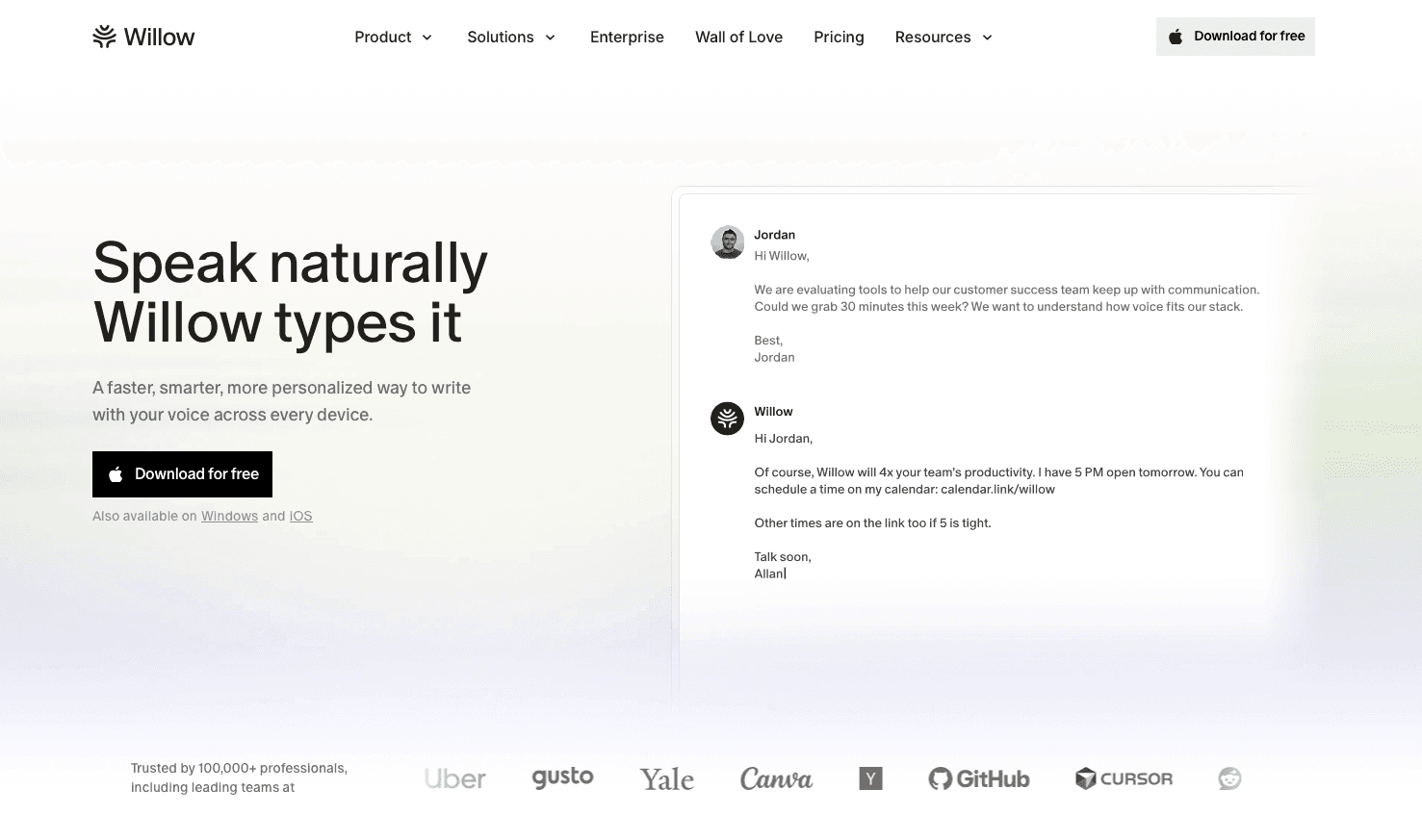
Typing out long prompts for AI coding agents takes time you could spend reviewing the output. Voice dictation changes that ratio considerably. Instead of hunting for the right phrasing at the keyboard, you can speak a detailed task description, architectural question, or code review request in seconds. This holds whether you're on a Mac in a home office, a Windows workstation at a corporate desk, or switching between the two mid-sprint.
Willow Voice is built for technical dictation and runs on both Mac and Windows, so the workflow stays consistent whether your team is fully Mac, fully Windows, or a mix of both. Willow learns your codebase vocabulary, variable names, and library references over time, so transcribed prompts match what you meant to say. At ~200ms latency, there's no gap between speaking and seeing your words appear. Engineers writing architecture notes, product managers capturing sprint decisions, and professionals in documentation-heavy roles, including clinical and administrative environments where manual notetaking creates friction, all get the same low-latency, high-accuracy input layer without switching tools.
Speaking a multi-step agent prompt out loud tends to produce more thorough instructions than typing one, because you naturally include context you'd otherwise skip for convenience.
Voice input pairs well with agentic workflows where you're directing multiple tasks in sequence, letting you keep focus on the bigger picture instead of the mechanics of input.
You'll get the most out of AI agents when you stop asking them to solve everything and start treating them as one layer in a larger system. Define clear tasks, maintain strict verification habits, and keep architectural decisions in your hands. Willow Voice fits naturally into agentic workflows since speaking prompts is faster than typing them, and you can direct multiple tasks in sequence without breaking focus.
FAQs
How do AI coding agents differ from traditional autocomplete tools like Copilot?
AI coding agents can plan multi-step tasks across multiple files, run tests, and iterate based on results, while autocomplete tools suggest the next line or function based on immediate context. Agents handle broader, self-contained problems; autocomplete accelerates line-by-line writing within a single file.
What's the fastest way to write detailed prompts for AI coding agents?
Voice dictation can significantly reduce the time required to write detailed prompts. Speaking a multi-step agent prompt takes seconds versus typing it out, and tools like Willow Voice learn your codebase vocabulary and variable names over time so transcribed prompts match what you meant to say with ~200ms latency.
Should I trust AI-generated code for security-sensitive features?
Never trust it blindly. Read every line before running it, check for hardcoded secrets or insecure API calls, validate dependencies for known vulnerabilities, and run your test suite against any changes. Treat agent output with the same scrutiny you'd apply to a junior developer's pull request.
Final Thoughts on Making AI Coding Agents Work for You
Knowing how to use AI coding agents well is less about picking the right tool and more about building the right habits: scoped tasks, precise prompts, and consistent review. The developers who get the most out of agents are the ones who stay in control of context and architecture while letting the agent handle the repetitive lifting. Willow Voice fits naturally into that workflow. At ~200ms latency, speaking your prompts is faster than typing them, and Willow learns your codebase vocabulary over time so your dictated instructions land the way you intend.
You've tried an AI coding agent inside Cursor, Claude Code, or a similar environment. It generated a function that looked right, then broke in production because it misread an edge case. Or it rewrote a module in a style that conflicts with how your team structures the codebase. Learning how to use AI agents for coding in a professional setting comes down to three things: scoping tasks the agent can actually complete without drifting, writing prompts with enough context to prevent plausible-but-wrong output, and reviewing every line before it touches a shared repo.
TLDR:
AI coding agents plan multi-step tasks and iterate on output, but treat their code as a first draft.
Precise prompts with language, framework, input/output, and edge cases produce better results.
Delegate well-scoped tasks like test scaffolding and refactoring; keep architecture decisions.
Read every line agents generate before running it and check for security gaps or hardcoded secrets.
Enterprise and cross-platform teams benefit from shared context files and consistent review habits across Windows and Mac environments.
Voice dictation can speed up prompt writing; Willow Voice learns codebase vocabulary, runs on Windows and Mac, and operates at ~200ms latency.
Understanding AI Coding Agents and What They Can Do
AI coding agents are software systems that can read your codebase, reason about what needs to change, and take action across multiple files without you directing every step. Unlike simple autocomplete, they plan multi-step tasks, call tools like terminal commands and test runners, and iterate on their output based on results.
What They Can Handle
The range of tasks has grown considerably in 2026:
Writing and refactoring functions, classes, or entire modules based on a plain-language description of the goal
Running tests, reading failure output, and revising code until tests pass
Searching documentation or the web to resolve dependency questions
Reviewing pull requests and flagging potential bugs or style violations
Drafting technical documentation, inline comments, and architecture decision records from a plain-language description
Generating sprint ticket descriptions or issue summaries from a breakdown of the planned work
Where They Still Struggle
Agents work best on well-scoped, self-contained problems. They can lose coherence on very large codebases without strong context management, and they will sometimes confidently produce plausible-looking code that contains subtle logic errors. Treating their output as a first draft instead of a final answer remains good practice.
Writing Effective Prompts and Task Descriptions
The quality of your prompts directly shapes what an AI coding agent produces. Vague instructions lead to generic output; precise, well-structured task descriptions lead to code that fits your actual requirements.
A good prompt gives the agent enough context to make sound decisions without micromanaging every line. For engineers and product managers working in Cursor or Claude Code, treat each prompt like an async handoff: include what was decided in the last sprint, which files are in scope, and what done looks like. Shared coding guidelines for AI and developers keep that standard consistent across the team.
What to include in every task description
Specify the language, framework, and any version constraints upfront so the agent doesn't make assumptions you'll have to undo later.
Describe the expected input and output clearly, including edge cases you want handled.
Reference existing patterns in your codebase when relevant, so generated code stays consistent with what's already there.
State what you don't want, whether that's a specific dependency, a particular pattern, or a style that conflicts with your conventions.
Iterating when output misses the mark
If the first result isn't right, resist rewriting from scratch. Instead, point to the specific part that's wrong and explain why. Targeted follow-up prompts consistently outperform broad rewrites because the agent retains useful context from the prior exchange.
Choosing the Right Tasks to Delegate to AI Agents
Not every task benefits from agent involvement. A useful mental filter: if you can write a clear acceptance criterion for the work, an agent can probably handle it.
Good to delegate | Handle yourself |
|---|---|
Debugging intermittent failures with no clear error | |
Updating docs and inline comments | Pixel-perfect UI implementation |
Refactoring with a consistent, repeated pattern | Working with a library outside the agent's training data |
Fixing bugs with a clear stack trace | Architectural decisions with meaningful tradeoffs |
When a feature is too large to hand off whole, break it into sub-tasks where each has a defined input, output, and acceptance condition. The agent stays focused on a contained problem; you stay in control of how the pieces fit together.
Managing Context and Agent Memory
AI coding agents can only act on what they can see. When context windows fill up or agents lose track of earlier decisions, output quality drops fast. For teams spread across Windows workstations and MacBooks, context files stored in the repo act as a shared source of truth that travels with the codebase regardless of which machine you're on.
Here are a few habits that help:
Start each session with a brief summary of what was decided previously, what files are in scope, and what the current goal is. Many agents don’t reliably carry project context across sessions by default, so priming them upfront prevents repeated backtracking.
Use structured memory files, like a
decisions.mdorcontext.mdin your repo, to log architectural choices the agent should respect across sessions. Anthropic's context engineering research covers additional strategies for curating what agents see across long tasks.
Using Subagents and Multi-Agent Workflows
Multi-agent setups let you break large coding tasks into specialized roles: one agent plans the architecture, another writes the implementation, a third reviews for bugs or security issues. This division of labor can reduce the back-and-forth that comes from asking a single agent to context-switch constantly.
Patterns Worth Knowing
A few structures come up repeatedly in effective multi-agent coding workflows:
An orchestrator agent takes a high-level task and routes subtasks to specialist agents, each scoped to a single concern like testing, documentation, or refactoring.
Parallel agents run independent subtasks simultaneously, which can cut total turnaround time when tasks have no dependencies on each other.
A critic or reviewer agent sits at the end of the pipeline and checks output against a defined standard before it reaches you.
The tradeoff is complexity: more agents mean more failure points. Start with two agents before building longer pipelines, and give each a clearly scoped role with explicit input and output expectations.
Reviewing and Verifying AI-Generated Code
Never trust AI-generated code blindly. Even the best coding agents produce errors, introduce security gaps, or make assumptions that don't fit your codebase.
Here are the review habits that matter most:
Read every line the agent writes before running it. Agents can generate plausible-looking code that compiles but behaves incorrectly in edge cases or under real load.
Check for hardcoded secrets, exposed credentials, or insecure API calls. Agents trained on public repositories sometimes reproduce insecure patterns.
Validate that dependencies the agent introduces are maintained, licensed appropriately, and free of known vulnerabilities.
Run your existing test suite against any agent-generated changes. If coverage is thin, write targeted tests for the new code before merging.
For security-sensitive paths, treat agent output the same way you would treat a junior developer's first pull request: read it carefully and ask questions.
Building Trust Through Verification and Permissions
Blind trust in AI coding agents is how bugs ship to production. Review the permissions your agent requests. Most will ask for file system access, terminal execution rights, or API credentials. Grant only what the current task requires, and revoke access when the task is done. Enterprise security best practices for AI agents cover tracing, guardrails, and evaluation frameworks that help maintain trust at scale. Engineering teams with SOC 2 or HIPAA obligations need to go further: maintain audit logs of agent activity, restrict agent access to sensitive directories and credentials, and require a human review before any agent-generated code reaches a shared branch.
Review every tool call the agent makes before approving it, especially for destructive operations like file deletion or database writes.
Run agents in sandboxed environments when testing unfamiliar workflows so any mistakes stay contained.
Treat agent-generated code with the same scrutiny you'd apply to a junior developer's pull request: read it, test it, and verify it does what you asked.
Extending Agent Capabilities with Skills and Plugins
Most agents support plugin ecosystems that let them call web search, run shell commands, query databases, or trigger CI/CD pipelines mid-task. Not every plugin improves outcomes. A few things worth considering before adding one:
Only add tools the agent can actually use in context. An agent given 20 plugins will often pick the wrong one or waste tokens deciding between them.
Prefer plugins with clear, narrow scopes. A "run SQL query" tool outperforms a vague "database tool" because the agent knows exactly when to reach for it.
Test each extension in isolation before combining them. Interaction effects between plugins are a common source of unexpected agent behavior.
Measuring Real Productivity Gains
Tracking whether AI coding agents are actually saving you time requires more than a gut feeling. A few developer productivity metrics worth watching: lines of code reviewed per hour, time spent context-switching between documentation and your editor, and how often you're re-explaining the same codebase concepts to the agent across sessions. For teams running two-week sprints, also track time spent writing PR descriptions, issue tickets, and meeting follow-ups. These async communication tasks are where agent-assisted workflows often show the clearest productivity improvements.
Developers who structure their prompts well and maintain clean context files report meaningful reductions in repetitive lookup tasks. The gains tend to show up in the unsexy parts of coding: boilerplate generation, test scaffolding, and documentation drafts.
Time spent writing tests versus writing logic, since agents that handle test scaffolding free up your attention for higher-order decisions
How frequently you're correcting agent output, which signals whether your prompts and context files need refinement
The number of back-and-forth clarification cycles per task, as fewer cycles generally means your initial prompts are carrying more of the load
Using Voice Dictation to Accelerate AI Coding Workflows
Typing out long prompts for AI coding agents takes time you could spend reviewing the output. Voice dictation changes that ratio considerably. Instead of hunting for the right phrasing at the keyboard, you can speak a detailed task description, architectural question, or code review request in seconds. This holds whether you're on a Mac in a home office, a Windows workstation at a corporate desk, or switching between the two mid-sprint.
Willow Voice is built for technical dictation and runs on both Mac and Windows, so the workflow stays consistent whether your team is fully Mac, fully Windows, or a mix of both. Willow learns your codebase vocabulary, variable names, and library references over time, so transcribed prompts match what you meant to say. At ~200ms latency, there's no gap between speaking and seeing your words appear. Engineers writing architecture notes, product managers capturing sprint decisions, and professionals in documentation-heavy roles, including clinical and administrative environments where manual notetaking creates friction, all get the same low-latency, high-accuracy input layer without switching tools.
Speaking a multi-step agent prompt out loud tends to produce more thorough instructions than typing one, because you naturally include context you'd otherwise skip for convenience.
Voice input pairs well with agentic workflows where you're directing multiple tasks in sequence, letting you keep focus on the bigger picture instead of the mechanics of input.
You'll get the most out of AI agents when you stop asking them to solve everything and start treating them as one layer in a larger system. Define clear tasks, maintain strict verification habits, and keep architectural decisions in your hands. Willow Voice fits naturally into agentic workflows since speaking prompts is faster than typing them, and you can direct multiple tasks in sequence without breaking focus.
FAQs
How do AI coding agents differ from traditional autocomplete tools like Copilot?
AI coding agents can plan multi-step tasks across multiple files, run tests, and iterate based on results, while autocomplete tools suggest the next line or function based on immediate context. Agents handle broader, self-contained problems; autocomplete accelerates line-by-line writing within a single file.
What's the fastest way to write detailed prompts for AI coding agents?
Voice dictation can significantly reduce the time required to write detailed prompts. Speaking a multi-step agent prompt takes seconds versus typing it out, and tools like Willow Voice learn your codebase vocabulary and variable names over time so transcribed prompts match what you meant to say with ~200ms latency.
Should I trust AI-generated code for security-sensitive features?
Never trust it blindly. Read every line before running it, check for hardcoded secrets or insecure API calls, validate dependencies for known vulnerabilities, and run your test suite against any changes. Treat agent output with the same scrutiny you'd apply to a junior developer's pull request.
Final Thoughts on Making AI Coding Agents Work for You
Knowing how to use AI coding agents well is less about picking the right tool and more about building the right habits: scoped tasks, precise prompts, and consistent review. The developers who get the most out of agents are the ones who stay in control of context and architecture while letting the agent handle the repetitive lifting. Willow Voice fits naturally into that workflow. At ~200ms latency, speaking your prompts is faster than typing them, and Willow learns your codebase vocabulary over time so your dictated instructions land the way you intend.

Try Willow for free
Instant, accurate voice dictation. No card required.
Try Willow for free
Instant, accurate voice dictation. No card required.
Other stories you’ll love
Other stories you’ll love


Your keyboard is optional now
" transform="translate(5 5)" width="9.791000051498413px"/></svg>)

The voice-first interface for modern work.
© Willow Care, Inc. 2026. All rights reserved
Your keyboard is optional now
The voice-first interface for modern work.
© Willow Care, Inc. 2026. All rights reserved
Your keyboard is optional now
The voice-first interface for modern work.
© Willow Care, Inc. 2026. All rights reserved