" transform="translate(5 2)" width="10px"/></svg>)

•
5 min read
Best Speech to Text Tool for Customer Support Teams in August 2026

•
5 min read
Best Speech to Text Tool for Customer Support Teams in August 2026
Typing every case note, follow-up, and internal handoff message adds up fast across a full shift. Voice input is the obvious fix, but the correction loop that comes with low-accuracy tools often costs more time than it saves. Research on AI agent productivity shows that reducing writing friction is the main driver of measurable gains for support teams. Finding the best speech to text tools for customer support teams comes down to one question: is accuracy high enough that agents can trust it from the first session, across every app and every device your team already uses?
TLDR:
Support agents typing thousands of words per shift face a bottleneck that voice input can solve, but only when accuracy is high enough to eliminate the correction loop.
Tools processing at ~200ms keep agents in flow; tools running at 700ms+ break composure between interactions and erase the net time gain.
Shared custom dictionaries and admin controls are what separate individual dictation tools from team-deployable ones; without them, vocabulary diverges across agents.
System-wide dictation that works across every app an agent uses is the only tool type that covers the full support workflow; platform-specific voice features and meeting transcription tools solve different, narrower problems.
The top-ranked tool in this review delivers 98%+ accuracy and 3x fewer errors than built-in tools, runs on Mac, Windows, and iOS, and starts with a free unlimited plan with no word cap.
What Are Speech to Text Tools for Customer Support Teams?
Customer support agents spend their days inside a relentless feedback loop: a ticket comes in, they type a response, another ticket arrives, they type again. Across a full shift, that typing adds up to thousands of words of documentation, follow-up notes, CRM updates, and internal handoff messages, all produced under time pressure while a customer is waiting on the other end.
Speech to text tools let agents speak those responses instead of typing them. The words appear in whatever field is open, whether that's a Zendesk ticket, a Salesforce case note, a Slack thread, or an internal knowledge base entry. The agent speaks at a natural pace, the text lands, and the next interaction can begin.
By mid-2026, this category has matured well past novelty, and professional teams across support, success, and operations are where adoption is sticking. The best dictation software tools covered here fall into a few distinct types:
Real-time voice recognition software that works system-wide across any app or text field, letting agents speak into whatever software their team already uses without switching context or opening a separate interface.
Meeting and call transcription tools that capture spoken conversations after the fact, producing searchable records of customer interactions instead of helping agents compose written responses in the moment.
Built-in OS dictation features like Windows Voice Typing or Apple Dictation, which offer a baseline capability at no cost but without custom vocabulary support, learning loops, or team-level configuration.
Integrated voice features inside specific support platforms, which only function within that platform's interface and offer no portability across the rest of an agent's workflow.
Support teams need more than raw transcription: agents need the tool to recognize product names and internal terminology without a correction loop, and team leads need shared vocabulary settings that work the same way across every agent's machine.
Why Accuracy and Speed Both Matter Here
The support context creates particular demands. A contact center speech-to-text guide notes that the best voice recognition tools can approach 97% accuracy in English, a threshold many general-purpose tools don't hit on domain-specific vocabulary.
Latency is equally relevant. A tool that takes 700ms or more to process each phrase breaks the agent's composure during a live interaction. Tools processing audio at closer to 200ms keep the workflow intact. HubSpot customer service research finds that 75% of CRM leaders say AI has reduced their team's response times, and accuracy is inseparable from that calculus.
How We Ranked These Speech to Text Tools
When reviewing the best speech to text tools for customer support teams, we focused on the criteria that actually matter in a high-volume service environment, looking beyond raw transcription speed or general accuracy benchmarks.
Here's what we weighted in our evaluation:
Accuracy on customer service vocabulary, including product names, account terminology, and industry-specific language that general dictation models tend to misfire on. Tools that require constant manual correction add time instead of saving it.
Latency under realistic conditions, meaning how quickly transcribed text appears during live use across multiple apps simultaneously. At ~200ms, the best tools keep pace with thought; at 700ms or more, agents lose momentum between interactions.
Cross-app compatibility, since support teams rarely work in a single tool. We looked at whether each tool works across CRMs, ticketing systems, Slack, email clients, and internal documentation without requiring app-specific plugins.
Team-level features, including shared dictionaries, admin controls, and the ability to standardize vocabulary across the whole support org. A tool that one agent loves but can't be deployed consistently across a team of fifty, or across a mixed fleet of Windows and Mac machines, has limited value at scale.
Voice dictation security and privacy posture, particularly SOC 2 Type II certification and data handling practices. Teams handling customer PII need confidence that audio and text data aren't being retained or routed through unvetted third-party processors.
Pricing structure relative to team size, because per-seat costs compound quickly in support environments where headcount can shift seasonally.
We also factored in setup friction when comparing AI dictation tools. A tool that takes weeks of individual calibration before it's accurate enough to use isn't practical for a team with ongoing onboarding cycles. We favored tools where accuracy holds from the first session or improves quickly without requiring manual vocabulary entry per user.
Criterion | System-wide dictation (e.g. Willow Voice) | Meeting / call transcription | Built-in OS dictation | Platform-specific voice |
|---|---|---|---|---|
Accuracy on support vocabulary | High: custom dictionary + learning loop | Moderate: optimized for spoken conversation, not typed output | Low: no custom vocabulary support | Varies: limited to the platform's own model |
Latency | ~200ms (keeps agents in flow) | Post-session: not real-time | 700ms+ (breaks composure mid-interaction) | Varies by platform |
Cross-app compatibility | Yes: works in any text field across all apps | No: records calls only | Partial: OS-level but no plugin support | No: limited to one platform |
Shared dictionaries & admin controls | Yes: team-wide vocabulary and admin dashboard | Not applicable | No: per-device configuration only | No |
SOC 2 Type II / compliance | Yes (Willow Voice) | Varies by vendor | Not available | Varies by platform |
Pricing model | Free unlimited plan; $10 to $12/user/mo for team features | Typically per-seat or per-hour of recording | Free (included with OS) | Bundled with platform subscription |
Best Overall Speech to Text Tool for Customer Support: Willow Voice
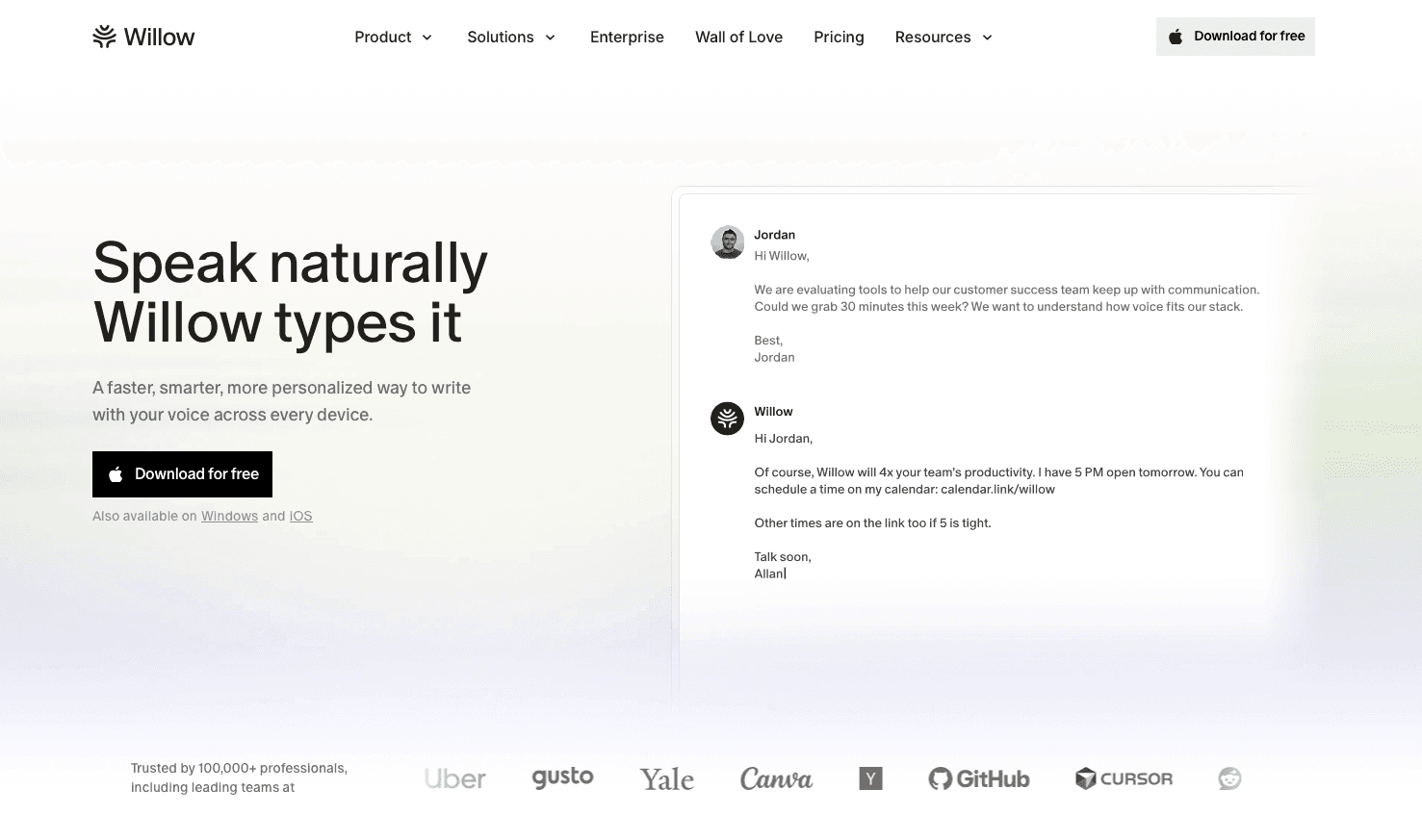
Support agents who need to handle more tickets and write better answers voice ticket responses, case notes, follow-ups, and internal summaries dozens of times per shift. The friction compounds fast: slow transcription breaks the response rhythm, missed terminology means correction loops, and tools that work on one device but not another create gaps in coverage across a mixed-device team.
Willow Voice is built around the workflow demands that make those problems acute. Press the function key on Mac or Alt+Space on Windows, speak naturally, and text appears in roughly 200ms across any application your team uses: AI voice dictation in Zendesk, Intercom, Salesforce, Slack, Notion, or any other text field. There is no mode-switching, no copy-paste, no application-specific setup.
The accuracy gap matters most in support contexts. Willow delivers 98%+ accuracy and 3x fewer errors than built-in tools, which means agents using voice dictation for customer success spend less time correcting and more time closing tickets. Willow's Auto-Dictionary learns product names, internal terminology, and customer-specific vocabulary over time without manual entry, so the correction loop that erodes net time savings gradually disappears.
Built for Teams, Not Individual Agents Alone
What breaks down at the team level is consistency: vocabulary configurations do not carry from one agent to the next, and there is no visibility into whether voice adoption is taking hold across the group.
Willow closes that gap through shared custom dictionaries and admin controls that let managers push vocabulary changes across the entire team without touching individual installs, whether agents are on Windows workstations or Macs. New agents onboard faster because the terminology is already there, helping support agents respond faster. Team leaderboards surface usage and time-saved data across the group, giving support leads visibility into where voice adoption is working and where it is not.
For enterprise support teams that handle sensitive customer data and need agents to write client emails faster and handle sensitive customer data, Willow is SOC 2 Type II certified and HIPAA compliant with zero data retention. A signed Business Associate Agreement is available for organizations that need it. That infrastructure means org-wide rollout fits within existing enterprise security review requirements without a separate compliance process.
Willow runs natively on Mac, Windows, and iOS, so agents across a mixed-device org work from the same shared vocabulary and configuration. The Individual plan ($12 per month billed annually) and Team plan ($10 per user per month billed annually; $12 per user per month billed monthly) both deliver faster, more accurate dictation plus unlimited Willow Scribe, the AI-assisted writing mode that generates complete responses from a voice prompt instead of transcribing word-for-word. The Team plan adds shared dictionaries, admin controls, and team leaderboards. A free plan is also available with unlimited AI dictation, no word cap, and no credit card required. See the Willow vs Wispr Flow for support teams comparison for a full breakdown. Enterprise pricing is available for organizations with custom compliance or deployment needs.
FAQs
How do I choose the right speech to text tool for my customer support team's specific needs?
Start with your team's workflow: if agents work across multiple apps like Zendesk, Salesforce, and Slack simultaneously, you need a system-wide dictation tool like Willow Voice over a platform-specific or browser-bound option. If your primary need is searchable records of customer calls and not real-time response drafting, a meeting transcription tool fits better. Match the tool type to where the actual bottleneck sits in your agents' daily work.
Is Willow Voice better than built-in OS dictation tools like Windows Voice Typing for customer support teams?
For high-volume support environments, yes. Built-in tools like Windows Voice Typing lack custom vocabulary support, team-level configuration, and the learning loop that handles product names and internal terminology correctly. Willow delivers 98%+ accuracy with 3x fewer errors than built-in tools and processes at roughly 200ms versus 700ms or more for OS-level dictation, which keeps agents in flow during live interactions instead of waiting for text to catch up.
What features should I look for in a speech to text tool before rolling it out across a support team of 50 or more agents?
Shared custom dictionaries and admin controls are the most important team-level requirements. Without them, each agent configures vocabulary independently and consistency breaks down over time. You also need SOC 2 Type II certification and a clear data retention policy before routing customer PII through any tool. Per-seat pricing structure matters too, since support headcount can shift seasonally and costs compound quickly at scale.
Final Thoughts on Finding the Right Speech to Text Tool for Your Support Team
The best speech to text tools for customer support teams hold up across your CRM, your ticketing system, and your team's specific vocabulary without a correction loop that slows agents down. Shared configuration across Windows and Mac, consistent accuracy from the first session, and compliance that fits your existing security review process are what separate a tool worth rolling out from one worth passing on. Download Willow Voice and see how it performs across your actual support stack.
Typing every case note, follow-up, and internal handoff message adds up fast across a full shift. Voice input is the obvious fix, but the correction loop that comes with low-accuracy tools often costs more time than it saves. Research on AI agent productivity shows that reducing writing friction is the main driver of measurable gains for support teams. Finding the best speech to text tools for customer support teams comes down to one question: is accuracy high enough that agents can trust it from the first session, across every app and every device your team already uses?
TLDR:
Support agents typing thousands of words per shift face a bottleneck that voice input can solve, but only when accuracy is high enough to eliminate the correction loop.
Tools processing at ~200ms keep agents in flow; tools running at 700ms+ break composure between interactions and erase the net time gain.
Shared custom dictionaries and admin controls are what separate individual dictation tools from team-deployable ones; without them, vocabulary diverges across agents.
System-wide dictation that works across every app an agent uses is the only tool type that covers the full support workflow; platform-specific voice features and meeting transcription tools solve different, narrower problems.
The top-ranked tool in this review delivers 98%+ accuracy and 3x fewer errors than built-in tools, runs on Mac, Windows, and iOS, and starts with a free unlimited plan with no word cap.
What Are Speech to Text Tools for Customer Support Teams?
Customer support agents spend their days inside a relentless feedback loop: a ticket comes in, they type a response, another ticket arrives, they type again. Across a full shift, that typing adds up to thousands of words of documentation, follow-up notes, CRM updates, and internal handoff messages, all produced under time pressure while a customer is waiting on the other end.
Speech to text tools let agents speak those responses instead of typing them. The words appear in whatever field is open, whether that's a Zendesk ticket, a Salesforce case note, a Slack thread, or an internal knowledge base entry. The agent speaks at a natural pace, the text lands, and the next interaction can begin.
By mid-2026, this category has matured well past novelty, and professional teams across support, success, and operations are where adoption is sticking. The best dictation software tools covered here fall into a few distinct types:
Real-time voice recognition software that works system-wide across any app or text field, letting agents speak into whatever software their team already uses without switching context or opening a separate interface.
Meeting and call transcription tools that capture spoken conversations after the fact, producing searchable records of customer interactions instead of helping agents compose written responses in the moment.
Built-in OS dictation features like Windows Voice Typing or Apple Dictation, which offer a baseline capability at no cost but without custom vocabulary support, learning loops, or team-level configuration.
Integrated voice features inside specific support platforms, which only function within that platform's interface and offer no portability across the rest of an agent's workflow.
Support teams need more than raw transcription: agents need the tool to recognize product names and internal terminology without a correction loop, and team leads need shared vocabulary settings that work the same way across every agent's machine.
Why Accuracy and Speed Both Matter Here
The support context creates particular demands. A contact center speech-to-text guide notes that the best voice recognition tools can approach 97% accuracy in English, a threshold many general-purpose tools don't hit on domain-specific vocabulary.
Latency is equally relevant. A tool that takes 700ms or more to process each phrase breaks the agent's composure during a live interaction. Tools processing audio at closer to 200ms keep the workflow intact. HubSpot customer service research finds that 75% of CRM leaders say AI has reduced their team's response times, and accuracy is inseparable from that calculus.
How We Ranked These Speech to Text Tools
When reviewing the best speech to text tools for customer support teams, we focused on the criteria that actually matter in a high-volume service environment, looking beyond raw transcription speed or general accuracy benchmarks.
Here's what we weighted in our evaluation:
Accuracy on customer service vocabulary, including product names, account terminology, and industry-specific language that general dictation models tend to misfire on. Tools that require constant manual correction add time instead of saving it.
Latency under realistic conditions, meaning how quickly transcribed text appears during live use across multiple apps simultaneously. At ~200ms, the best tools keep pace with thought; at 700ms or more, agents lose momentum between interactions.
Cross-app compatibility, since support teams rarely work in a single tool. We looked at whether each tool works across CRMs, ticketing systems, Slack, email clients, and internal documentation without requiring app-specific plugins.
Team-level features, including shared dictionaries, admin controls, and the ability to standardize vocabulary across the whole support org. A tool that one agent loves but can't be deployed consistently across a team of fifty, or across a mixed fleet of Windows and Mac machines, has limited value at scale.
Voice dictation security and privacy posture, particularly SOC 2 Type II certification and data handling practices. Teams handling customer PII need confidence that audio and text data aren't being retained or routed through unvetted third-party processors.
Pricing structure relative to team size, because per-seat costs compound quickly in support environments where headcount can shift seasonally.
We also factored in setup friction when comparing AI dictation tools. A tool that takes weeks of individual calibration before it's accurate enough to use isn't practical for a team with ongoing onboarding cycles. We favored tools where accuracy holds from the first session or improves quickly without requiring manual vocabulary entry per user.
Criterion | System-wide dictation (e.g. Willow Voice) | Meeting / call transcription | Built-in OS dictation | Platform-specific voice |
|---|---|---|---|---|
Accuracy on support vocabulary | High: custom dictionary + learning loop | Moderate: optimized for spoken conversation, not typed output | Low: no custom vocabulary support | Varies: limited to the platform's own model |
Latency | ~200ms (keeps agents in flow) | Post-session: not real-time | 700ms+ (breaks composure mid-interaction) | Varies by platform |
Cross-app compatibility | Yes: works in any text field across all apps | No: records calls only | Partial: OS-level but no plugin support | No: limited to one platform |
Shared dictionaries & admin controls | Yes: team-wide vocabulary and admin dashboard | Not applicable | No: per-device configuration only | No |
SOC 2 Type II / compliance | Yes (Willow Voice) | Varies by vendor | Not available | Varies by platform |
Pricing model | Free unlimited plan; $10 to $12/user/mo for team features | Typically per-seat or per-hour of recording | Free (included with OS) | Bundled with platform subscription |
Best Overall Speech to Text Tool for Customer Support: Willow Voice
Support agents who need to handle more tickets and write better answers voice ticket responses, case notes, follow-ups, and internal summaries dozens of times per shift. The friction compounds fast: slow transcription breaks the response rhythm, missed terminology means correction loops, and tools that work on one device but not another create gaps in coverage across a mixed-device team.
Willow Voice is built around the workflow demands that make those problems acute. Press the function key on Mac or Alt+Space on Windows, speak naturally, and text appears in roughly 200ms across any application your team uses: AI voice dictation in Zendesk, Intercom, Salesforce, Slack, Notion, or any other text field. There is no mode-switching, no copy-paste, no application-specific setup.
The accuracy gap matters most in support contexts. Willow delivers 98%+ accuracy and 3x fewer errors than built-in tools, which means agents using voice dictation for customer success spend less time correcting and more time closing tickets. Willow's Auto-Dictionary learns product names, internal terminology, and customer-specific vocabulary over time without manual entry, so the correction loop that erodes net time savings gradually disappears.
Built for Teams, Not Individual Agents Alone
What breaks down at the team level is consistency: vocabulary configurations do not carry from one agent to the next, and there is no visibility into whether voice adoption is taking hold across the group.
Willow closes that gap through shared custom dictionaries and admin controls that let managers push vocabulary changes across the entire team without touching individual installs, whether agents are on Windows workstations or Macs. New agents onboard faster because the terminology is already there, helping support agents respond faster. Team leaderboards surface usage and time-saved data across the group, giving support leads visibility into where voice adoption is working and where it is not.
For enterprise support teams that handle sensitive customer data and need agents to write client emails faster and handle sensitive customer data, Willow is SOC 2 Type II certified and HIPAA compliant with zero data retention. A signed Business Associate Agreement is available for organizations that need it. That infrastructure means org-wide rollout fits within existing enterprise security review requirements without a separate compliance process.
Willow runs natively on Mac, Windows, and iOS, so agents across a mixed-device org work from the same shared vocabulary and configuration. The Individual plan ($12 per month billed annually) and Team plan ($10 per user per month billed annually; $12 per user per month billed monthly) both deliver faster, more accurate dictation plus unlimited Willow Scribe, the AI-assisted writing mode that generates complete responses from a voice prompt instead of transcribing word-for-word. The Team plan adds shared dictionaries, admin controls, and team leaderboards. A free plan is also available with unlimited AI dictation, no word cap, and no credit card required. See the Willow vs Wispr Flow for support teams comparison for a full breakdown. Enterprise pricing is available for organizations with custom compliance or deployment needs.
FAQs
How do I choose the right speech to text tool for my customer support team's specific needs?
Start with your team's workflow: if agents work across multiple apps like Zendesk, Salesforce, and Slack simultaneously, you need a system-wide dictation tool like Willow Voice over a platform-specific or browser-bound option. If your primary need is searchable records of customer calls and not real-time response drafting, a meeting transcription tool fits better. Match the tool type to where the actual bottleneck sits in your agents' daily work.
Is Willow Voice better than built-in OS dictation tools like Windows Voice Typing for customer support teams?
For high-volume support environments, yes. Built-in tools like Windows Voice Typing lack custom vocabulary support, team-level configuration, and the learning loop that handles product names and internal terminology correctly. Willow delivers 98%+ accuracy with 3x fewer errors than built-in tools and processes at roughly 200ms versus 700ms or more for OS-level dictation, which keeps agents in flow during live interactions instead of waiting for text to catch up.
What features should I look for in a speech to text tool before rolling it out across a support team of 50 or more agents?
Shared custom dictionaries and admin controls are the most important team-level requirements. Without them, each agent configures vocabulary independently and consistency breaks down over time. You also need SOC 2 Type II certification and a clear data retention policy before routing customer PII through any tool. Per-seat pricing structure matters too, since support headcount can shift seasonally and costs compound quickly at scale.
Final Thoughts on Finding the Right Speech to Text Tool for Your Support Team
The best speech to text tools for customer support teams hold up across your CRM, your ticketing system, and your team's specific vocabulary without a correction loop that slows agents down. Shared configuration across Windows and Mac, consistent accuracy from the first session, and compliance that fits your existing security review process are what separate a tool worth rolling out from one worth passing on. Download Willow Voice and see how it performs across your actual support stack.

Try Willow for free
Instant, accurate voice dictation. No card required.
Try Willow for free
Instant, accurate voice dictation. No card required.
Other stories you’ll love
Other stories you’ll love


Your keyboard is optional now
" transform="translate(5 5)" width="9.791000051498413px"/></svg>)

The voice-first interface for modern work.
© Willow Care, Inc. 2026. All rights reserved
Your keyboard is optional now
The voice-first interface for modern work.
© Willow Care, Inc. 2026. All rights reserved
Your keyboard is optional now
The voice-first interface for modern work.
© Willow Care, Inc. 2026. All rights reserved