" transform="translate(5 2)" width="10px"/></svg>)

•
5 min read
Willow: Fastest Journalist Dictation Software (August 2026)

•
5 min read
Willow: Fastest Journalist Dictation Software (August 2026)
Willow is the fastest dictation software built to eliminate the typing bottleneck that keeps journalists from meeting deadlines. When you're racing against deadlines with three stories in progress, manual typing at 40 words per minute eats into time that should go toward actual journalism. Dictation software for journalists brings you to 150 words per minute by letting you speak instead of type. Here are the 7 necessary features that separate professional dictation tools from basic speech-to-text.
TLDR:
Speaking at 150 WPM vs. typing at 40 WPM means dictation can reclaim hours lost to drafts, emails, and notes.
Professional transcription requires at least 96% accuracy. One wrong word in a quote changes meaning and creates legal risk.
Response time under 200ms keeps you in flow state; other tools run at 700ms or slower, breaking concentration mid-draft.
SOC 2 Type II and HIPAA compliance with zero data retention protects source confidentiality for routine and investigative work.
The best dictation tools build a personalized dictionary from your corrections, so beat-specific terms, source names, and policy language stop requiring repeated fixes.
Feature #1: Speed That Matches Your Thoughts
Newsroom budgets have been gutted. Journalists report overwhelming productivity demands as declining revenues force reporters to produce more stories with fewer resources and smaller staff. The math doesn't work when you're expected to file three stories a day while also conducting interviews, verifying facts, and investigating leads.

The bottleneck isn't reporting. It's the typing. Journalists type around average typing speed data shows 40 words per minute, which means every draft, every follow-up email, and every background note eats into time that should go toward actual journalism. When you're racing against a deadline with multiple pieces in progress, manual typing is the limiting factor.
Dictation software solves this by letting journalists speak at 150 words per minute instead. That's four times faster than typing. You can draft an article outline while walking between interviews, capture key quotes immediately after a phone call, or narrate your notes while details are fresh. The time saved on transcription work goes back into reporting, source development, and deeper analysis.
Feature #2: Instant Response Time Keeps You in Flow State
Dictation software and interview transcription tools serve different purposes in a journalist's workflow. Dictation lets you compose original content by speaking directly as you write articles, draft emails, or narrate notes in real time. The text appears instantly as you talk, keeping you in flow state without switching between thinking and typing.
Interview transcription tools process audio files after recording. You conduct an interview, upload the file, and receive a transcript later. This handles quote extraction and source review, but it doesn't speed up your writing.
Journalists need both. Transcription tools handle interview audio and quote extraction. Dictation software handles everything else: article drafts, background research notes, pitch emails, and quick edits. The writing process is where dictation creates the biggest time savings, because that's where you're generating new content under deadline pressure.
Feature #3: Beat-Specific Vocabulary That Learns As You Work
When you cover the same beat every day, your writing fills with specialized terminology, agency names, policy language, and source names that generic dictation tools routinely mishear. One misspelled official’s name or one mangled technical term can cost time in edits and risk credibility. Standard speech-to-text forces you to correct the same mistakes repeatedly.
Professional journalists need dictation software that adapts to their reporting domain. As you correct a source’s name, a regulatory acronym, or a recurring technical phrase, the system should remember it. Over time, your tool should build a working knowledge of your beat so it stops guessing and starts recognizing.
Willow learns from your corrections automatically, creating a personalized dictionary that updates as you work. Whether you cover city hall, healthcare policy, courts, or climate science, it gets better with every story you file. Instead of retraining the software every day, you build long-term accuracy that reduces editing time and protects the precision your reporting demands.
Feature #4: 96% Accuracy Protects Your Credibility and Sources
Transcription accuracy measures how many words the software transcribes correctly. According to AI vs human transcription accuracy research, 96% is the minimum threshold for professional transcription work, meaning only 4 out of every 100 words can be wrong.
For journalists, that accuracy bar isn't optional. Misquoting a source or misspelling a name damages credibility and creates legal risk. A single wrong word in a quote changes meaning completely. When you're covering city council meetings, medical studies, or technical policy debates, your dictation software must handle specialized vocabulary without guessing.
Smart dictation that understands you analyzes what you're writing to understand technical terms, proper nouns, and industry-specific language. Willow's learning engine remembers corrections you make, building a personalized dictionary that grows more accurate over time as it adapts to your beat and writing style. This personalization cuts editing time on specialized vocabulary.
Feature #5: Built for How Journalists Actually Work
Feature | Why It Matters for Journalists | Willow | Wispr Flow | Apple Built-in Dictation | Standard Dictation Tools |
|---|---|---|---|---|---|
Response Time | Maintain flow state during breaking news deadlines | 200ms | 700ms+ | 1000ms+ | 700ms+ |
Accuracy | Protect quote integrity and source credibility | 98%+ with learning | 90-95% | 85-90% | 90-95% |
Beat-Specific Vocabulary Learning | Reduce editing time on specialized terms and source names | Auto-dictionary with corrections memory | Limited learning | No learning | Manual dictionary only |
Universal Compatibility | Work across CMS, email, Slack without switching tools | Mac, Windows, iOS | Yes | Limited | Limited |
Quiet Mode | Use in open newsrooms without disrupting colleagues | Yes | No | No | Rarely available |
Security Compliance | Protect confidential sources and sensitive reporting | SOC 2 Type II, HIPAA, offline mode | Basic privacy | Apple privacy only | Varies |
Filler Word Removal | Get clean text without verbal tics from natural speech | Automatic | Limited | No | Manual editing required |
Journalists switch between content management systems, email, messaging apps, and document editors throughout the day, whether they are on a Windows desktop in the newsroom or a Mac laptop at home. Dictation software that works across environments saves you from constant context switching.
Formatting commands like "new paragraph" or "bullet point" let you structure articles while speaking instead of stopping to format manually. This keeps your drafting process moving.
Beat coverage demands specialized vocabulary. If you cover healthcare or legal issues, your dictation tool must recognize industry terminology without constant corrections. Willow's auto-dictionary learns these terms as you work and applies corrections automatically.
Filler word removal strips "um," "uh," and repeated words before they reach the page. You speak naturally and receive clean text without verbal tics that appear in raw speech.
Quiet mode solves the open newsroom challenge. You can speak softly or whisper without disrupting colleagues, making dictation practical in shared work environments where full volume conversations aren't an option.
Willow's custom iOS voice keyboard extends the same dictation experience to your phone. Reporters in the field can capture quotes, draft notes, and send updates from any location without switching apps or retyping content when they return to their desk.
Feature #6: Enterprise Security for Source Protection
Journalists working with confidential sources face unique security requirements. When protecting a whistleblower's identity or handling leaked documents, your dictation software is part of your security infrastructure.
Cloud-based dictation with proper security works for most reporting. Look for SOC 2 Type II and HIPAA compliance, which indicate strict audit trails and enterprise-grade protections. Zero data retention policies matter more than where the work happens. If your dictation service never stores voice recordings or transcripts after it responds, cloud-based tools carry minimal risk for routine newsroom work.
Offline mode is necessary for specific investigative scenarios. If you're documenting conversations with protected sources or operating in hostile environments where adversaries monitor internet traffic, local-only tools remove transmission risk entirely. Willow delivers offline mode for situations where keeping data on your device is the only acceptable option.
For news organizations rolling out dictation across a team, Willow scales from a single reporter's setup to org-wide deployment. Shared custom dictionaries let editors push beat-specific vocabulary, source names, and house style to every reporter at once instead of having each person build their own. Admin controls let IT or senior editors manage the rollout from one place, and team leaderboards show adoption and time saved across the group without manual tracking. SOC 2 Type II certification means newsroom-wide deployment fits within existing security review requirements without a separate compliance process.
Feature #7: Learns Your Writing Style
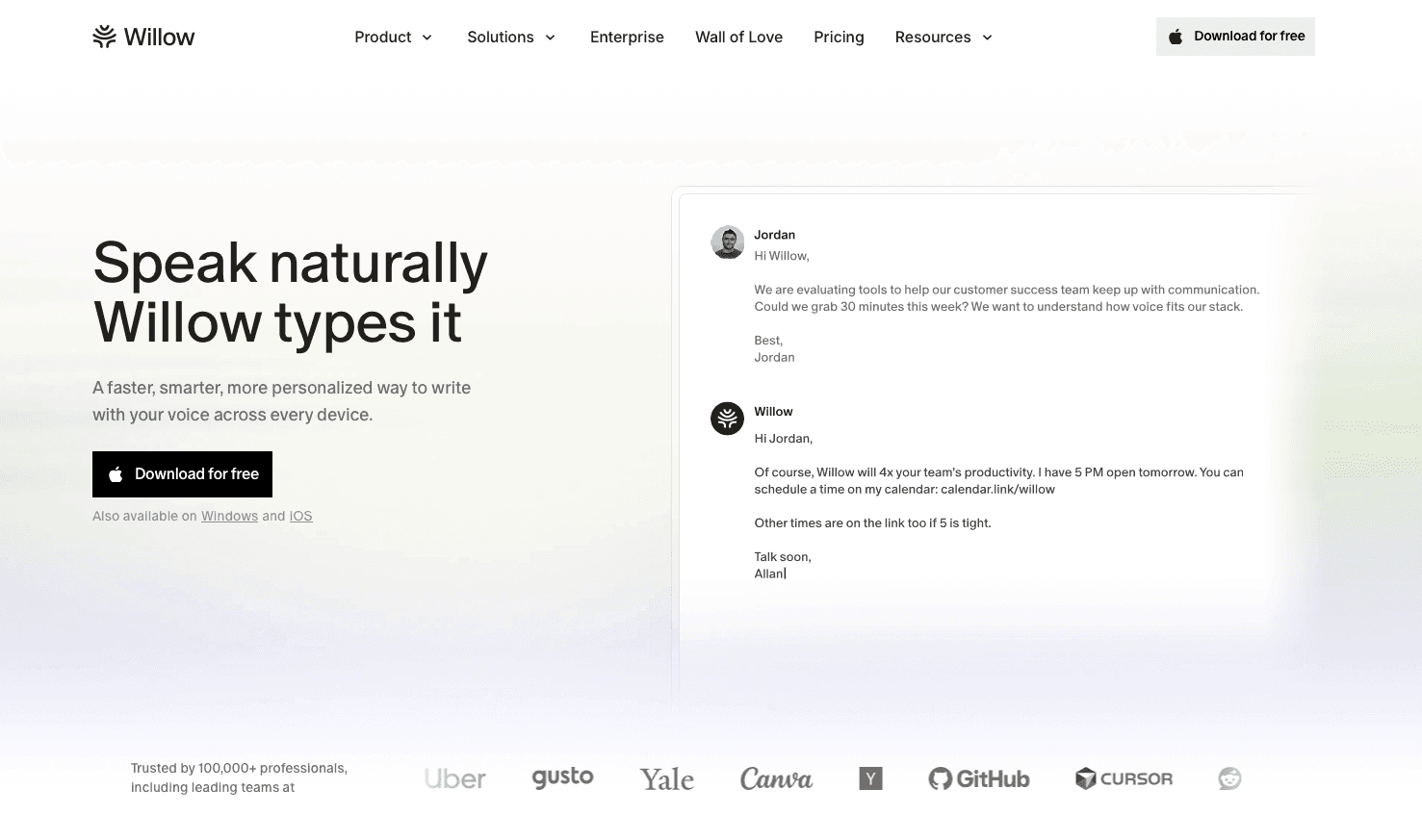
Willow goes beyond transcription by adapting to how you write. It adapts to your tone, sentence structure, and formatting habits. Over time, your drafts start sounding like you from the first sentence.
The personalization engine learns your beat terminology, source names, and writing patterns. When you correct "Dr. Patel" or a technical policy term once, Willow remembers it. This reduces editing work on specialized vocabulary that generic dictation tools miss.
Willow's 200ms response time keeps you in flow state. Text appears as you speak instead of lagging seconds behind, so you can draft breaking news stories, email sources, and write background notes without waiting. Other dictation tools operate at 700ms or slower.
SOC 2 certification overview covers the audit standards behind SOC 2 Type II. Paired with HIPAA compliance and zero data retention policies, these protections cover source confidentiality for individual reporters and newsroom-wide deployments alike. Offline mode handles situations where you must keep data local. Available on Mac and iOS, it gives reporters a fully private, on-device fallback for the most sensitive work.
Universal compatibility means you work across your CMS, email, Slack, and document editors. You speak directly where you already write, whether that's filing a story or messaging an editor about deadline changes.
FAQs
How fast does dictation software need to be for professional journalism work?
Response time under one second is necessary to maintain flow state when drafting articles under deadline pressure. Willow responds in 200 milliseconds, keeping text synchronized with your thoughts, while competing tools operate at 700 milliseconds or slower, creating noticeable delays that interrupt your concentration.
What accuracy rate do journalists need for quote verification?
Professional transcription requires at least 96% accuracy to avoid misquoting sources or misspelling names. Willow's learning engine remembers corrections you make for specialized vocabulary and source names, building a personalized dictionary that grows more accurate as it adapts to your beat and writing style.
Can I use dictation software in an open newsroom without disrupting colleagues?
Yes, quiet mode allows you to speak softly or whisper while the software accurately captures your words. This makes dictation practical in shared work environments where full-volume conversations would interrupt other reporters.
How does dictation software protect confidential sources?
SOC 2 and HIPAA compliance with zero data retention policies protect routine newsroom work, while offline mode keeps data entirely on your device for sensitive investigative scenarios where internet transmission creates security risks.
Does dictation software work across different writing platforms journalists use daily?
Universal compatibility means you can speak directly into your content management system, email client, Slack, Google Docs, and other applications without switching tools or copy-pasting between platforms. This eliminates context switching when you're moving between filing stories, messaging editors, and conducting research.
The Bottom Line: Stop Letting Typing Slow You Down
The real takeaway is simple: typing should never be the bottleneck between your reporting and your deadline. The best dictation software for journalists keeps up with how you think, adapts to your voice, and fades into the background while you focus on the story. Willow does exactly that with 200ms transcription, style learning that improves with every correction, and support across the tools you already use. If you want to file faster and spend more time reporting than rewriting, try Willow and turn heavy news days into manageable ones.
Willow is the fastest dictation software built to eliminate the typing bottleneck that keeps journalists from meeting deadlines. When you're racing against deadlines with three stories in progress, manual typing at 40 words per minute eats into time that should go toward actual journalism. Dictation software for journalists brings you to 150 words per minute by letting you speak instead of type. Here are the 7 necessary features that separate professional dictation tools from basic speech-to-text.
TLDR:
Speaking at 150 WPM vs. typing at 40 WPM means dictation can reclaim hours lost to drafts, emails, and notes.
Professional transcription requires at least 96% accuracy. One wrong word in a quote changes meaning and creates legal risk.
Response time under 200ms keeps you in flow state; other tools run at 700ms or slower, breaking concentration mid-draft.
SOC 2 Type II and HIPAA compliance with zero data retention protects source confidentiality for routine and investigative work.
The best dictation tools build a personalized dictionary from your corrections, so beat-specific terms, source names, and policy language stop requiring repeated fixes.
Feature #1: Speed That Matches Your Thoughts
Newsroom budgets have been gutted. Journalists report overwhelming productivity demands as declining revenues force reporters to produce more stories with fewer resources and smaller staff. The math doesn't work when you're expected to file three stories a day while also conducting interviews, verifying facts, and investigating leads.
The bottleneck isn't reporting. It's the typing. Journalists type around average typing speed data shows 40 words per minute, which means every draft, every follow-up email, and every background note eats into time that should go toward actual journalism. When you're racing against a deadline with multiple pieces in progress, manual typing is the limiting factor.
Dictation software solves this by letting journalists speak at 150 words per minute instead. That's four times faster than typing. You can draft an article outline while walking between interviews, capture key quotes immediately after a phone call, or narrate your notes while details are fresh. The time saved on transcription work goes back into reporting, source development, and deeper analysis.
Feature #2: Instant Response Time Keeps You in Flow State
Dictation software and interview transcription tools serve different purposes in a journalist's workflow. Dictation lets you compose original content by speaking directly as you write articles, draft emails, or narrate notes in real time. The text appears instantly as you talk, keeping you in flow state without switching between thinking and typing.
Interview transcription tools process audio files after recording. You conduct an interview, upload the file, and receive a transcript later. This handles quote extraction and source review, but it doesn't speed up your writing.
Journalists need both. Transcription tools handle interview audio and quote extraction. Dictation software handles everything else: article drafts, background research notes, pitch emails, and quick edits. The writing process is where dictation creates the biggest time savings, because that's where you're generating new content under deadline pressure.
Feature #3: Beat-Specific Vocabulary That Learns As You Work
When you cover the same beat every day, your writing fills with specialized terminology, agency names, policy language, and source names that generic dictation tools routinely mishear. One misspelled official’s name or one mangled technical term can cost time in edits and risk credibility. Standard speech-to-text forces you to correct the same mistakes repeatedly.
Professional journalists need dictation software that adapts to their reporting domain. As you correct a source’s name, a regulatory acronym, or a recurring technical phrase, the system should remember it. Over time, your tool should build a working knowledge of your beat so it stops guessing and starts recognizing.
Willow learns from your corrections automatically, creating a personalized dictionary that updates as you work. Whether you cover city hall, healthcare policy, courts, or climate science, it gets better with every story you file. Instead of retraining the software every day, you build long-term accuracy that reduces editing time and protects the precision your reporting demands.
Feature #4: 96% Accuracy Protects Your Credibility and Sources
Transcription accuracy measures how many words the software transcribes correctly. According to AI vs human transcription accuracy research, 96% is the minimum threshold for professional transcription work, meaning only 4 out of every 100 words can be wrong.
For journalists, that accuracy bar isn't optional. Misquoting a source or misspelling a name damages credibility and creates legal risk. A single wrong word in a quote changes meaning completely. When you're covering city council meetings, medical studies, or technical policy debates, your dictation software must handle specialized vocabulary without guessing.
Smart dictation that understands you analyzes what you're writing to understand technical terms, proper nouns, and industry-specific language. Willow's learning engine remembers corrections you make, building a personalized dictionary that grows more accurate over time as it adapts to your beat and writing style. This personalization cuts editing time on specialized vocabulary.
Feature #5: Built for How Journalists Actually Work
Feature | Why It Matters for Journalists | Willow | Wispr Flow | Apple Built-in Dictation | Standard Dictation Tools |
|---|---|---|---|---|---|
Response Time | Maintain flow state during breaking news deadlines | 200ms | 700ms+ | 1000ms+ | 700ms+ |
Accuracy | Protect quote integrity and source credibility | 98%+ with learning | 90-95% | 85-90% | 90-95% |
Beat-Specific Vocabulary Learning | Reduce editing time on specialized terms and source names | Auto-dictionary with corrections memory | Limited learning | No learning | Manual dictionary only |
Universal Compatibility | Work across CMS, email, Slack without switching tools | Mac, Windows, iOS | Yes | Limited | Limited |
Quiet Mode | Use in open newsrooms without disrupting colleagues | Yes | No | No | Rarely available |
Security Compliance | Protect confidential sources and sensitive reporting | SOC 2 Type II, HIPAA, offline mode | Basic privacy | Apple privacy only | Varies |
Filler Word Removal | Get clean text without verbal tics from natural speech | Automatic | Limited | No | Manual editing required |
Journalists switch between content management systems, email, messaging apps, and document editors throughout the day, whether they are on a Windows desktop in the newsroom or a Mac laptop at home. Dictation software that works across environments saves you from constant context switching.
Formatting commands like "new paragraph" or "bullet point" let you structure articles while speaking instead of stopping to format manually. This keeps your drafting process moving.
Beat coverage demands specialized vocabulary. If you cover healthcare or legal issues, your dictation tool must recognize industry terminology without constant corrections. Willow's auto-dictionary learns these terms as you work and applies corrections automatically.
Filler word removal strips "um," "uh," and repeated words before they reach the page. You speak naturally and receive clean text without verbal tics that appear in raw speech.
Quiet mode solves the open newsroom challenge. You can speak softly or whisper without disrupting colleagues, making dictation practical in shared work environments where full volume conversations aren't an option.
Willow's custom iOS voice keyboard extends the same dictation experience to your phone. Reporters in the field can capture quotes, draft notes, and send updates from any location without switching apps or retyping content when they return to their desk.
Feature #6: Enterprise Security for Source Protection
Journalists working with confidential sources face unique security requirements. When protecting a whistleblower's identity or handling leaked documents, your dictation software is part of your security infrastructure.
Cloud-based dictation with proper security works for most reporting. Look for SOC 2 Type II and HIPAA compliance, which indicate strict audit trails and enterprise-grade protections. Zero data retention policies matter more than where the work happens. If your dictation service never stores voice recordings or transcripts after it responds, cloud-based tools carry minimal risk for routine newsroom work.
Offline mode is necessary for specific investigative scenarios. If you're documenting conversations with protected sources or operating in hostile environments where adversaries monitor internet traffic, local-only tools remove transmission risk entirely. Willow delivers offline mode for situations where keeping data on your device is the only acceptable option.
For news organizations rolling out dictation across a team, Willow scales from a single reporter's setup to org-wide deployment. Shared custom dictionaries let editors push beat-specific vocabulary, source names, and house style to every reporter at once instead of having each person build their own. Admin controls let IT or senior editors manage the rollout from one place, and team leaderboards show adoption and time saved across the group without manual tracking. SOC 2 Type II certification means newsroom-wide deployment fits within existing security review requirements without a separate compliance process.
Feature #7: Learns Your Writing Style
Willow goes beyond transcription by adapting to how you write. It adapts to your tone, sentence structure, and formatting habits. Over time, your drafts start sounding like you from the first sentence.
The personalization engine learns your beat terminology, source names, and writing patterns. When you correct "Dr. Patel" or a technical policy term once, Willow remembers it. This reduces editing work on specialized vocabulary that generic dictation tools miss.
Willow's 200ms response time keeps you in flow state. Text appears as you speak instead of lagging seconds behind, so you can draft breaking news stories, email sources, and write background notes without waiting. Other dictation tools operate at 700ms or slower.
SOC 2 certification overview covers the audit standards behind SOC 2 Type II. Paired with HIPAA compliance and zero data retention policies, these protections cover source confidentiality for individual reporters and newsroom-wide deployments alike. Offline mode handles situations where you must keep data local. Available on Mac and iOS, it gives reporters a fully private, on-device fallback for the most sensitive work.
Universal compatibility means you work across your CMS, email, Slack, and document editors. You speak directly where you already write, whether that's filing a story or messaging an editor about deadline changes.
FAQs
How fast does dictation software need to be for professional journalism work?
Response time under one second is necessary to maintain flow state when drafting articles under deadline pressure. Willow responds in 200 milliseconds, keeping text synchronized with your thoughts, while competing tools operate at 700 milliseconds or slower, creating noticeable delays that interrupt your concentration.
What accuracy rate do journalists need for quote verification?
Professional transcription requires at least 96% accuracy to avoid misquoting sources or misspelling names. Willow's learning engine remembers corrections you make for specialized vocabulary and source names, building a personalized dictionary that grows more accurate as it adapts to your beat and writing style.
Can I use dictation software in an open newsroom without disrupting colleagues?
Yes, quiet mode allows you to speak softly or whisper while the software accurately captures your words. This makes dictation practical in shared work environments where full-volume conversations would interrupt other reporters.
How does dictation software protect confidential sources?
SOC 2 and HIPAA compliance with zero data retention policies protect routine newsroom work, while offline mode keeps data entirely on your device for sensitive investigative scenarios where internet transmission creates security risks.
Does dictation software work across different writing platforms journalists use daily?
Universal compatibility means you can speak directly into your content management system, email client, Slack, Google Docs, and other applications without switching tools or copy-pasting between platforms. This eliminates context switching when you're moving between filing stories, messaging editors, and conducting research.
The Bottom Line: Stop Letting Typing Slow You Down
The real takeaway is simple: typing should never be the bottleneck between your reporting and your deadline. The best dictation software for journalists keeps up with how you think, adapts to your voice, and fades into the background while you focus on the story. Willow does exactly that with 200ms transcription, style learning that improves with every correction, and support across the tools you already use. If you want to file faster and spend more time reporting than rewriting, try Willow and turn heavy news days into manageable ones.

Try Willow for free
Instant, accurate voice dictation. No card required.
Try Willow for free
Instant, accurate voice dictation. No card required.
Other stories you’ll love
Other stories you’ll love

Your keyboard is optional now
" transform="translate(5 5)" width="9.791000051498413px"/></svg>)

The voice-first interface for modern work.
© Willow Care, Inc. 2026. All rights reserved
Your keyboard is optional now
The voice-first interface for modern work.
© Willow Care, Inc. 2026. All rights reserved
Your keyboard is optional now
The voice-first interface for modern work.
© Willow Care, Inc. 2026. All rights reserved