" transform="translate(5 2)" width="10px"/></svg>)

•
5 min read
Top AI Writing Tools: Voice, Speed & Quality Tested August 2026

•
5 min read
Top AI Writing Tools: Voice, Speed & Quality Tested August 2026
There's a specific frustration that comes from adopting a new writing tool, spending a week learning it, and then realizing it only works well for a narrow slice of what you actually do. That problem gets harder to ignore on professional teams, where writers work across Windows desktops, Macs, and mobile, and a tool that's browser-only or locked to one platform adds a layer of overhead nobody asked for. We've been testing the AI-powered writing tools people reach for most in mid-2026, looking past the marketing and focusing on three things: how well voice input holds up, how fast the response feels in practice, and how much of the first draft you'd actually keep.
TLDR:
Pick your AI writing tool by interaction mode: autocomplete, generation, editing, or specialized; the wrong fit slows you down.
Net output quality matters more than raw speed; a tool that drops to 70% accuracy on domain vocabulary costs you more time than it saves.
Sudowrite fits fiction writers, Jenni AI fits academic researchers, and browser-only tools like Compose AI can't reach outside Chrome.
Free tiers from dedicated writing tools are typically too limited for full manuscripts; general LLMs with good prompts often outperform them.
Certain dedicated voice input tools operate as a system-wide layer with ~200ms latency, 98%+ accuracy, shared dictionaries for teams, and a genuinely unlimited free plan across Mac, Windows, and iOS.
What Separates a Strong AI Writing Tool from a Generic Wrapper
The difference between tools that actually improve your writing and those that just autocomplete sentences comes down to a few things worth testing before you commit.
Vocabulary handling is the first real dividing line. Generic wrappers apply general language models to every input equally. Tools built for specific contexts, whether academic writing, fiction, or business content, recognize domain terminology and maintain consistent register across longer pieces. A student writing a research paper and a novelist drafting dialogue have fundamentally different needs, and the tool's output quality reflects whether it was built with those differences in mind.

Speed and latency matter more than most reviews acknowledge. A tool that takes two seconds after every sentence breaks thinking in ways that accumulate. Writers focused on faster writing techniques often cite latency as the single biggest drag on output. The gap between 200ms and 700ms sounds small until you're working through a complex argument.
The third factor is how much correction the output actually requires. Raw generation speed is easy to benchmark. Net output quality, meaning how much of what the tool produces you keep without editing, is harder to measure but more relevant to your real workflow.
AI Writing Tools Compared: July 2026 at a Glance
Here is a comparison table covering the primary tools tested for this roundup, followed by brief orientation on what the columns reflect and how to read the results.
The table isolates the dimensions that matter most when selecting an AI writing tool: what it is built for, where it runs, what it costs to start, and where its architecture creates friction. Every cell reflects observed behavior or published specs as of July 2026.
Tool | Type | Best For | Platforms | Key Features | Free Tier | Starting Price | Key Limitation |
|---|---|---|---|---|---|---|---|
Willow Voice | System-wide voice input layer | Voice-first writing and dictation across all apps | Mac, Windows, iOS | ~200ms latency; Auto-Dictionary; Willow Scribe; shared team dictionaries; admin controls; SOC 2 Type II; HIPAA compliant | Unlimited, no word cap | $12/month (billed annually) | Not a standalone text editor |
Jenni AI | AI writing assistant | Academic writing and research papers | Web | Inline autocomplete; citation support; references panel | Yes, limited | $20/month | Weak voice input; web only |
Sudowrite | AI writing assistant (fiction) | Fiction and novel writing | Web | Prose generation in your style; scene-building; canvas manuscript view | No | $19/month | No voice dictation layer |
NovelCrafter | AI writing assistant (fiction) | Long-form novel structure and worldbuilding | Web | Codex system for characters/lore; automatic context injection; outline tools | Limited trial | $10/month | Niche scope; no real-time dictation |
Grammarly | AI editing and writing assistant | Grammar, tone, and style polish | Web, browser extension, desktop | Grammar correction; tone adjustment; report writing; Google Docs integration | Yes, capped | $30/month | Generative output is surface-level |
Compose AI | Browser-based autocomplete extension | Autocomplete and inline text generation via Chrome | Chrome extension | Inline autocomplete; text field integration across Gmail, Google Docs, and similar surfaces | Yes | $9.99/month | Chrome-only; no voice layer |
Speed reflects the gap between thought and captured text, not raw word count. Voice column results reflect real-world dictation across Mac, Windows, and iOS with no pre-loaded vocabulary unless noted. Quality reflects first-pass output requiring minimal editing; platform coverage and compliance certifications are noted where they affect team deployment decisions.
Best AI Writing Tools for Content and Professional Writing
By mid-2026, AI writing tools have split into two categories: general-purpose content assistants for marketers, bloggers, and professionals drafting everyday documents, and specialized tools for technical or creative writing that demand different depth.

For content and professional writing, the tools below are the ones that consistently perform across voice quality, output speed, and editing accuracy. A broader look at the top AI dictation tools covers the full category beyond writing-specific use cases.
General-Purpose AI Writing Assistants
Most professionals want something that drafts quickly, edits cleanly, and works inside the apps they already use. For teams across Windows desktops, Macs, and mobile, that compatibility requirement goes from preference to necessity. The tools in this tier cover emails, reports, proposals, social copy, and long-form articles.
Jasper remains the go-to for marketing teams producing volume content. Its Brand Voice feature learns tone and terminology from existing content, which cuts editing time for teams with strict style guidelines. Output quality is solid for structured formats like ad copy and product descriptions, though longer editorial pieces often need a second pass.
Copy.ai has narrowed its focus to sales and GTM workflows, making it genuinely useful for reps drafting outreach sequences or SDRs generating personalized follow-ups at scale. Less suited to editorial or research-heavy writing.
Grammarly's AI layer has expanded well beyond grammar correction into full draft generation and tone adjustment. For professionals who write in browser-based tools, its AI-powered report writing and document drafting features work without switching apps, which is its clearest advantage over standalone tools.
Notion AI earns its place for teams already inside Notion. Summarizing meeting notes, drafting project briefs, and generating structured documents from bullet points all happen in context, without exporting to another tool.
Best Free AI Writing Tools
Most AI writing tools charge you before you've written a single word worth keeping. The good news: several strong options are genuinely free, at least to start.
Google Docs Voice Typing is the most accessible entry point. It's built into any browser, requires no download, and handles general prose reasonably well. For a full comparison of best voice to text software options beyond free tiers, the category has several strong paid alternatives worth reviewing. The ceiling hits fast though: no custom vocabulary, no learning loop, and accuracy drops sharply on technical or specialized content.
Jenni AI offers a free tier aimed at students and researchers, with AI-assisted completions and citation support built in. It's a focused tool for academic writing, not general-purpose drafting.
For novelists and long-form writers, Sudowrite and NovelCrafter both offer free trials. Sudowrite leans into creative generation and prose enhancement. NovelCrafter adds structural tools for managing plot, characters, and story arcs across a longer project.
Compose AI's Chrome extension brings AI-powered autocomplete into Gmail, Google Docs, and most browser-based text fields, with a free tier that covers basic completions. Mac users researching the broader category should also review the best dictation software for Mac before committing to any one tool.
The pattern across all of these: free tiers work well for low-volume, general use. Where they break down is domain-specific vocabulary, output that needs minimal correction, and workflows that span multiple apps.
Willow Voice takes a different approach. Most competing tools cap free tier usage; Jenni AI's free tier includes usage limits, and most dedicated writing tools restrict output volume on free plans. Willow's free plan is genuinely unlimited: no word cap, no credit card required. Accurate text appears in any app at roughly 200ms, learning your vocabulary over time. The paid plan adds faster, more accurate dictation plus unlimited Willow Scribe.
Willow Voice: The Voice Input Layer for Any AI Writing Workflow
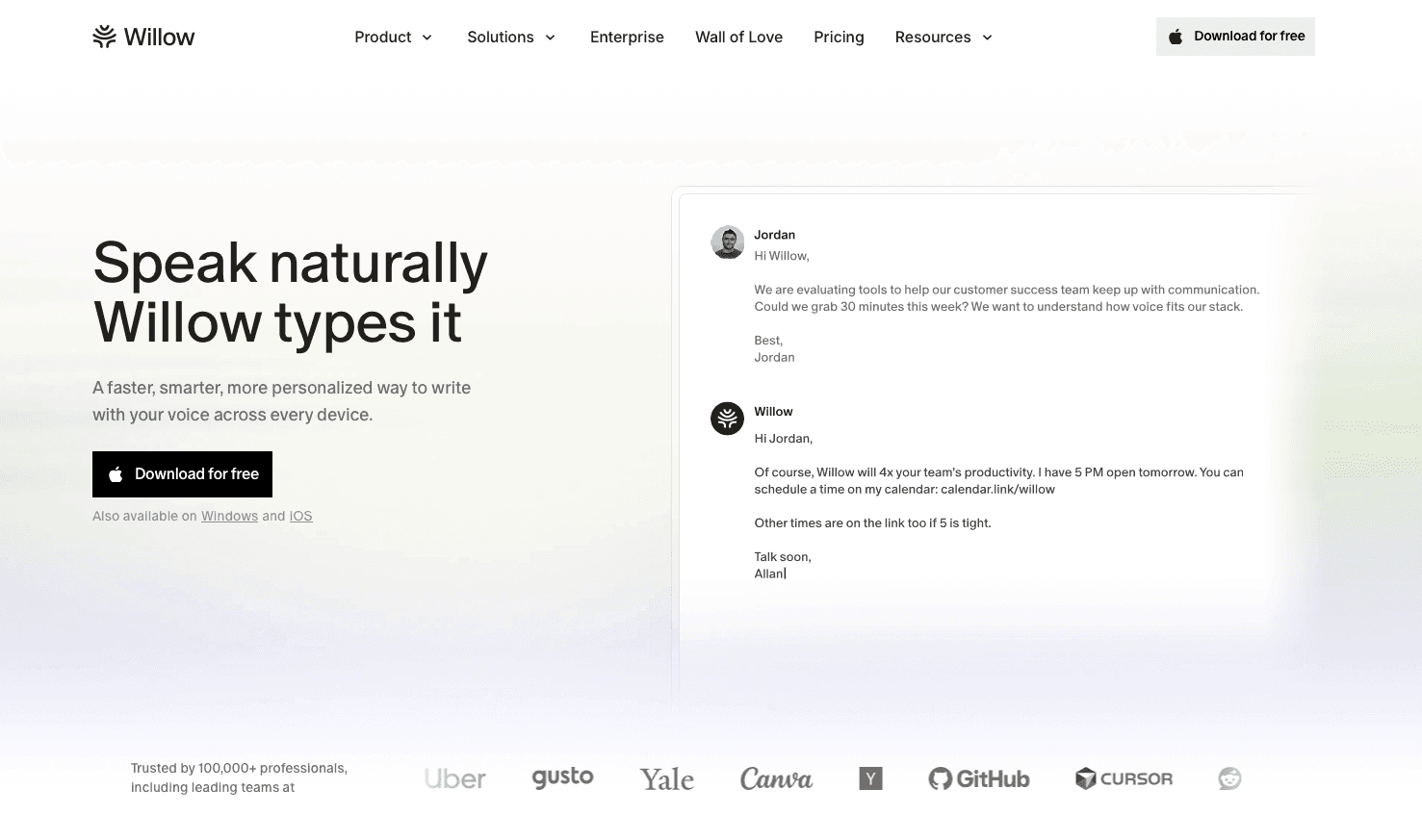
Willow Voice sits at a different layer from the tools reviewed above. Where Sudowrite, Jenni AI, and NovelCrafter each operate inside their own editor, Willow Voice works as a system-wide voice input layer across Mac, Windows, and iOS. Whether a writer works in Google Docs on a Windows desktop, a clinician documents notes in an EHR, or a developer drafts prompts in Cursor on a MacBook, the same voice layer covers all of them without switching contexts or copying output between apps.
For writers who think faster than they type, that distinction matters. Speaking runs at roughly 150 WPM versus 40 WPM typing, and Willow processes audio at ~200ms, so text lands before the next thought forms.
What Makes It Different for Writers
Personalization is the core differentiator here. Willow's Auto-Dictionary learns your vocabulary over time, picking up character names, genre-specific terminology, and stylistic patterns without manual setup. The more you use it, the less you correct.
Speak directly into Sudowrite, NovelCrafter, Google Docs, Scrivener, or any other text field without switching tools or copying output between apps
~200ms latency keeps you in flow without waiting for transcription to catch up
98%+ accuracy with 3x fewer errors than built-in tools like Apple Dictation or Windows voice typing
Willow Scribe (Fn + Control on Mac, Alt+Shift+Space on Windows) generates complete drafted content from a voice prompt instead of transcribing word for word
SOC 2 Type II certified with zero data retention, so manuscript content stays private
Available across Mac, Windows, and iOS
Teams get shared custom dictionaries, admin controls, and team leaderboards. Individual writers get a genuinely unlimited free plan with no word cap and no credit card required. The paid plan starts at $12 per month billed annually and delivers faster, more accurate dictation plus unlimited Willow Scribe.
FAQs
Sudowrite vs NovelCrafter for long-form fiction: which should I use?
Sudowrite is better for writers who want AI help with prose and scene writing. NovelCrafter is stronger for managing characters, lore, and plot across long manuscripts, making it a better fit for complex series.
What's the best free AI writing tool for students?
Jenni AI offers one of the strongest free options for academic writing with inline autocomplete and citation support. Google Docs Voice Typing and Compose AI are also useful free tools, though dedicated free plans become limiting for longer or more specialized work.
What is Willow Scribe and how does it differ from standard AI dictation?
Willow Scribe generates complete drafts from a voice prompt instead of simply transcribing your words. You describe what you want to write, and Scribe creates a polished first draft, while standard dictation only converts speech to text.
Final Thoughts on AI-Powered Writing Tools Across Every Use Case
AI-powered writing tools have matured enough that the gap between a purpose-built fiction tool and a general writing assistant is real and measurable. Picking based on your primary use case, whether that's research papers, novel writing, or professional content, will get you further than picking based on brand recognition. Most writers end up using more than one tool anyway, so the question worth asking is which one covers your highest-volume work with the least cleanup. For teams working across Windows desktops, Macs, and mobile, that question also includes whether the tool actually runs everywhere your people work. Willow Voice fits into that stack as the voice input layer, working inside whatever editor you already prefer, across every device your team uses.
There's a specific frustration that comes from adopting a new writing tool, spending a week learning it, and then realizing it only works well for a narrow slice of what you actually do. That problem gets harder to ignore on professional teams, where writers work across Windows desktops, Macs, and mobile, and a tool that's browser-only or locked to one platform adds a layer of overhead nobody asked for. We've been testing the AI-powered writing tools people reach for most in mid-2026, looking past the marketing and focusing on three things: how well voice input holds up, how fast the response feels in practice, and how much of the first draft you'd actually keep.
TLDR:
Pick your AI writing tool by interaction mode: autocomplete, generation, editing, or specialized; the wrong fit slows you down.
Net output quality matters more than raw speed; a tool that drops to 70% accuracy on domain vocabulary costs you more time than it saves.
Sudowrite fits fiction writers, Jenni AI fits academic researchers, and browser-only tools like Compose AI can't reach outside Chrome.
Free tiers from dedicated writing tools are typically too limited for full manuscripts; general LLMs with good prompts often outperform them.
Certain dedicated voice input tools operate as a system-wide layer with ~200ms latency, 98%+ accuracy, shared dictionaries for teams, and a genuinely unlimited free plan across Mac, Windows, and iOS.
What Separates a Strong AI Writing Tool from a Generic Wrapper
The difference between tools that actually improve your writing and those that just autocomplete sentences comes down to a few things worth testing before you commit.
Vocabulary handling is the first real dividing line. Generic wrappers apply general language models to every input equally. Tools built for specific contexts, whether academic writing, fiction, or business content, recognize domain terminology and maintain consistent register across longer pieces. A student writing a research paper and a novelist drafting dialogue have fundamentally different needs, and the tool's output quality reflects whether it was built with those differences in mind.
Speed and latency matter more than most reviews acknowledge. A tool that takes two seconds after every sentence breaks thinking in ways that accumulate. Writers focused on faster writing techniques often cite latency as the single biggest drag on output. The gap between 200ms and 700ms sounds small until you're working through a complex argument.
The third factor is how much correction the output actually requires. Raw generation speed is easy to benchmark. Net output quality, meaning how much of what the tool produces you keep without editing, is harder to measure but more relevant to your real workflow.
AI Writing Tools Compared: July 2026 at a Glance
Here is a comparison table covering the primary tools tested for this roundup, followed by brief orientation on what the columns reflect and how to read the results.
The table isolates the dimensions that matter most when selecting an AI writing tool: what it is built for, where it runs, what it costs to start, and where its architecture creates friction. Every cell reflects observed behavior or published specs as of July 2026.
Tool | Type | Best For | Platforms | Key Features | Free Tier | Starting Price | Key Limitation |
|---|---|---|---|---|---|---|---|
Willow Voice | System-wide voice input layer | Voice-first writing and dictation across all apps | Mac, Windows, iOS | ~200ms latency; Auto-Dictionary; Willow Scribe; shared team dictionaries; admin controls; SOC 2 Type II; HIPAA compliant | Unlimited, no word cap | $12/month (billed annually) | Not a standalone text editor |
Jenni AI | AI writing assistant | Academic writing and research papers | Web | Inline autocomplete; citation support; references panel | Yes, limited | $20/month | Weak voice input; web only |
Sudowrite | AI writing assistant (fiction) | Fiction and novel writing | Web | Prose generation in your style; scene-building; canvas manuscript view | No | $19/month | No voice dictation layer |
NovelCrafter | AI writing assistant (fiction) | Long-form novel structure and worldbuilding | Web | Codex system for characters/lore; automatic context injection; outline tools | Limited trial | $10/month | Niche scope; no real-time dictation |
Grammarly | AI editing and writing assistant | Grammar, tone, and style polish | Web, browser extension, desktop | Grammar correction; tone adjustment; report writing; Google Docs integration | Yes, capped | $30/month | Generative output is surface-level |
Compose AI | Browser-based autocomplete extension | Autocomplete and inline text generation via Chrome | Chrome extension | Inline autocomplete; text field integration across Gmail, Google Docs, and similar surfaces | Yes | $9.99/month | Chrome-only; no voice layer |
Speed reflects the gap between thought and captured text, not raw word count. Voice column results reflect real-world dictation across Mac, Windows, and iOS with no pre-loaded vocabulary unless noted. Quality reflects first-pass output requiring minimal editing; platform coverage and compliance certifications are noted where they affect team deployment decisions.
Best AI Writing Tools for Content and Professional Writing
By mid-2026, AI writing tools have split into two categories: general-purpose content assistants for marketers, bloggers, and professionals drafting everyday documents, and specialized tools for technical or creative writing that demand different depth.
For content and professional writing, the tools below are the ones that consistently perform across voice quality, output speed, and editing accuracy. A broader look at the top AI dictation tools covers the full category beyond writing-specific use cases.
General-Purpose AI Writing Assistants
Most professionals want something that drafts quickly, edits cleanly, and works inside the apps they already use. For teams across Windows desktops, Macs, and mobile, that compatibility requirement goes from preference to necessity. The tools in this tier cover emails, reports, proposals, social copy, and long-form articles.
Jasper remains the go-to for marketing teams producing volume content. Its Brand Voice feature learns tone and terminology from existing content, which cuts editing time for teams with strict style guidelines. Output quality is solid for structured formats like ad copy and product descriptions, though longer editorial pieces often need a second pass.
Copy.ai has narrowed its focus to sales and GTM workflows, making it genuinely useful for reps drafting outreach sequences or SDRs generating personalized follow-ups at scale. Less suited to editorial or research-heavy writing.
Grammarly's AI layer has expanded well beyond grammar correction into full draft generation and tone adjustment. For professionals who write in browser-based tools, its AI-powered report writing and document drafting features work without switching apps, which is its clearest advantage over standalone tools.
Notion AI earns its place for teams already inside Notion. Summarizing meeting notes, drafting project briefs, and generating structured documents from bullet points all happen in context, without exporting to another tool.
Best Free AI Writing Tools
Most AI writing tools charge you before you've written a single word worth keeping. The good news: several strong options are genuinely free, at least to start.
Google Docs Voice Typing is the most accessible entry point. It's built into any browser, requires no download, and handles general prose reasonably well. For a full comparison of best voice to text software options beyond free tiers, the category has several strong paid alternatives worth reviewing. The ceiling hits fast though: no custom vocabulary, no learning loop, and accuracy drops sharply on technical or specialized content.
Jenni AI offers a free tier aimed at students and researchers, with AI-assisted completions and citation support built in. It's a focused tool for academic writing, not general-purpose drafting.
For novelists and long-form writers, Sudowrite and NovelCrafter both offer free trials. Sudowrite leans into creative generation and prose enhancement. NovelCrafter adds structural tools for managing plot, characters, and story arcs across a longer project.
Compose AI's Chrome extension brings AI-powered autocomplete into Gmail, Google Docs, and most browser-based text fields, with a free tier that covers basic completions. Mac users researching the broader category should also review the best dictation software for Mac before committing to any one tool.
The pattern across all of these: free tiers work well for low-volume, general use. Where they break down is domain-specific vocabulary, output that needs minimal correction, and workflows that span multiple apps.
Willow Voice takes a different approach. Most competing tools cap free tier usage; Jenni AI's free tier includes usage limits, and most dedicated writing tools restrict output volume on free plans. Willow's free plan is genuinely unlimited: no word cap, no credit card required. Accurate text appears in any app at roughly 200ms, learning your vocabulary over time. The paid plan adds faster, more accurate dictation plus unlimited Willow Scribe.
Willow Voice: The Voice Input Layer for Any AI Writing Workflow
Willow Voice sits at a different layer from the tools reviewed above. Where Sudowrite, Jenni AI, and NovelCrafter each operate inside their own editor, Willow Voice works as a system-wide voice input layer across Mac, Windows, and iOS. Whether a writer works in Google Docs on a Windows desktop, a clinician documents notes in an EHR, or a developer drafts prompts in Cursor on a MacBook, the same voice layer covers all of them without switching contexts or copying output between apps.
For writers who think faster than they type, that distinction matters. Speaking runs at roughly 150 WPM versus 40 WPM typing, and Willow processes audio at ~200ms, so text lands before the next thought forms.
What Makes It Different for Writers
Personalization is the core differentiator here. Willow's Auto-Dictionary learns your vocabulary over time, picking up character names, genre-specific terminology, and stylistic patterns without manual setup. The more you use it, the less you correct.
Speak directly into Sudowrite, NovelCrafter, Google Docs, Scrivener, or any other text field without switching tools or copying output between apps
~200ms latency keeps you in flow without waiting for transcription to catch up
98%+ accuracy with 3x fewer errors than built-in tools like Apple Dictation or Windows voice typing
Willow Scribe (Fn + Control on Mac, Alt+Shift+Space on Windows) generates complete drafted content from a voice prompt instead of transcribing word for word
SOC 2 Type II certified with zero data retention, so manuscript content stays private
Available across Mac, Windows, and iOS
Teams get shared custom dictionaries, admin controls, and team leaderboards. Individual writers get a genuinely unlimited free plan with no word cap and no credit card required. The paid plan starts at $12 per month billed annually and delivers faster, more accurate dictation plus unlimited Willow Scribe.
FAQs
Sudowrite vs NovelCrafter for long-form fiction: which should I use?
Sudowrite is better for writers who want AI help with prose and scene writing. NovelCrafter is stronger for managing characters, lore, and plot across long manuscripts, making it a better fit for complex series.
What's the best free AI writing tool for students?
Jenni AI offers one of the strongest free options for academic writing with inline autocomplete and citation support. Google Docs Voice Typing and Compose AI are also useful free tools, though dedicated free plans become limiting for longer or more specialized work.
What is Willow Scribe and how does it differ from standard AI dictation?
Willow Scribe generates complete drafts from a voice prompt instead of simply transcribing your words. You describe what you want to write, and Scribe creates a polished first draft, while standard dictation only converts speech to text.
Final Thoughts on AI-Powered Writing Tools Across Every Use Case
AI-powered writing tools have matured enough that the gap between a purpose-built fiction tool and a general writing assistant is real and measurable. Picking based on your primary use case, whether that's research papers, novel writing, or professional content, will get you further than picking based on brand recognition. Most writers end up using more than one tool anyway, so the question worth asking is which one covers your highest-volume work with the least cleanup. For teams working across Windows desktops, Macs, and mobile, that question also includes whether the tool actually runs everywhere your people work. Willow Voice fits into that stack as the voice input layer, working inside whatever editor you already prefer, across every device your team uses.

Try Willow for free
Instant, accurate voice dictation. No card required.
Try Willow for free
Instant, accurate voice dictation. No card required.
Other stories you’ll love
Other stories you’ll love

Your keyboard is optional now
" transform="translate(5 5)" width="9.791000051498413px"/></svg>)

The voice-first interface for modern work.
© Willow Care, Inc. 2026. All rights reserved
Your keyboard is optional now
The voice-first interface for modern work.
© Willow Care, Inc. 2026. All rights reserved
Your keyboard is optional now
The voice-first interface for modern work.
© Willow Care, Inc. 2026. All rights reserved