" transform="translate(5 2)" width="10px"/></svg>)

•
5 min read
Rubber Duck Debugging: How This Simple Method Solves Complex Problems in May 2026

•
5 min read
Rubber Duck Debugging: How This Simple Method Solves Complex Problems in May 2026
Debugging alone in your head lets your brain take shortcuts you don't even notice. You scan familiar patterns, assume certain steps work the way you remember, and miss the gap between what you meant to write and what you actually wrote. Rubber duck debugging fixes that by making you explain the code out loud to an object that cannot respond or help. Articulating your logic sequentially forces you to slow down and rebuild your mental model from scratch, which is where bugs surface. The method was popularized by a story in The Pragmatic Programmer and later became a widely recognized part of developer culture. The duck doesn't solve the problem. Explaining your code to it does.
TLDR:
Explaining code line by line to an object forces your brain to rebuild logic from scratch, exposing skipped assumptions.
The method works because verbalization triggers linear processing; you can't gloss over steps when speaking them aloud.
It works best for logical errors you can walk through step by step, less well for environment-specific bugs or knowledge gaps.
Beyond coding, the technique applies anywhere you need to move from fuzzy intuition to clear reasoning.
Certain tools transcribe debugging explanations at ~200ms with codebase auto-tagging, preserving your reasoning flow.
What Is Rubber Duck Debugging?
Rubber duck debugging is a problem-solving method where a programmer explains their code, line by line, to an inanimate object, most commonly a rubber duck. The act of articulating the problem out loud forces a mental shift: you stop assuming your code works and start describing what it actually does. That gap between intention and description is often where the bug lives.

The method gets its name from a story in "The Pragmatic Programmer" by Andrew Hunt and David Thomas, where a developer carries a rubber duck and talks through code with it. No responses needed. The duck just listens.
Why It Works
The core mechanism is self-explanation. When you narrate your logic to someone, or something, that cannot fill in gaps for you, your brain is forced to construct the reasoning from scratch. That reconstruction surfaces assumptions you never questioned.
Explaining code sequentially exposes skipped steps you glossed over mentally.
Verbalizing expected behavior makes it easier to spot where actual behavior diverges.
The slight awkwardness of talking to an object keeps you slow and deliberate, which counters the tunnel vision that comes with deep debugging sessions.
The Origin Story: From The Pragmatic Programmer to Your Desk
The rubber duck debugging method traces back to a single anecdote in Andrew Hunt and David Thomas's 1999 book, The Pragmatic Programmer. A developer carries a rubber duck and explains their code to it line by line. The act of explaining, not the duck itself, triggers the insight.
The technique spread through developer culture before landing on forums, memes, and dedicated rubber duck debugging websites and apps. Today you can find dev ducks on Amazon and entire Reddit threads debating the best one for debugging sessions.
Why Developers Still Talk About It in 2026
Zero setup, no special software required. It spread widely and works just as well as voice dictation technology has evolved.
It works regardless of language, stack, or experience level, making it one of the few debugging habits junior and senior developers share.
Meme culture keeps new developers finding it organically, through xkcd, Reddit, or a gif a teammate sends.
The Psychology Behind Why Talking to a Duck Actually Works
Talking to a rubber duck works because verbalization triggers a different cognitive mode than silent reading. When you explain a problem out loud, your brain serializes abstract thoughts into linear language, exposing gaps you cannot see while scanning code quietly.
This relates to the protégé effect, a phenomenon in which teaching or explaining concepts often improves the explainer's understanding. You become more rigorous when you know someone is listening, even when that someone is made of plastic. Some research on robot duck debugging has shown that attentive listening behaviors can improve problem-solving outcomes.
Explaining code out loud also activates self-monitoring: you observe your own thinking in real time and often catch errors mid-sentence. Guardian's analysis of the protégé effect places it among the most effective ways to deepen knowledge and understanding.
Why the Duck?
A visible, silent, non-judgmental object removes social anxiety from the equation. You will say things to a rubber duck that you would hesitate to say in a code review, and that psychological safety is what lets the method work at full depth.
How to Practice Rubber Duck Debugging: A Step by Step Method
Pick a rubber duck, a stuffed animal, or any inanimate object nearby. What matters is that you treat it as a patient, non-judgmental listener.
Here is how the method works in practice:
Place the object where you can see it and speak to it directly. Facing something takes your mental mode from passive frustration to active explanation.
Start at the very beginning of the problem, not where you think the bug is. Walk through what the code is supposed to do, line by line if needed. Articulating the intended behavior often surfaces the gap between what you wrote and what you meant, a skill that translates directly to coding by voice.
Slow down when something feels awkward to explain. If a step is hard to put into words, your understanding of it probably has a hole in it.
Keep going until you spot the issue or reach the end of your explanation. Many developers find the answer arrives mid-sentence, before they finish describing the problem.
Why Speaking Out Loud Matters
Reading code silently lets your brain skip over familiar patterns and fill in gaps automatically. Speaking forces linear, sequential processing. You cannot gloss over a step when explaining it to someone else, even an imaginary someone.
When Rubber Duck Debugging Works Best and When It Doesn't
It works well when:
You have a logical error you can walk through step by step. Narrating forces you to slow down and catch the assumption you skipped.
You're stuck and spinning without progress. Speaking out loud changes you from passive frustration to active explanation.
You need to explain your code to someone else later. Rehearsing with a rubber duck often produces the clearest version of it.
It works less well when:
The bug requires live data or environment context you can't reproduce by talking through it. Narration won't surface a race condition in a distributed system.
You lack the foundational knowledge to recognize what's wrong. Explaining code you don't understand rarely produces insight on its own.
You need a second opinion on architecture or design tradeoffs, where a collaborator or AI tool can offer something a physical duck cannot.
Solo narration doesn't replace code review and won't catch what you don't know to look for.
Beyond Programming: Rubber Duck Debugging for Any Complex Problem
The method works just as well outside of coding. Writers use voice dictation for technical documentation to untangle arguments that aren't landing. Lawyers talk through case theories before opposing counsel does. Product managers explain a roadmap decision out loud and catch the assumption they hadn't questioned. Students use it before exams to find exactly where their understanding breaks down.

The core mechanism is the same: articulating a problem to an audience that cannot help you forces your brain to fill in every gap. You stop assuming and start explaining, and the explanation reveals what was missing.
When the Rubber Duck Method Transfers Best
You keep circling back to the same paragraph, unsure why it doesn't work. Explaining it aloud forces you to state what you're actually trying to say.
A decision feels wrong but you can't articulate why. Talking through it with a physical object before the meeting often surfaces the real objection, much like developers write bug reports faster when they verbalize the problem first.
You feel confident studying until you try to explain a concept, at which point the gaps appear immediately.
AI Powered Rubber Duck Debugging: When Your Duck Talks Back
AI tools have changed what rubber duck debugging looks like. Instead of explaining your code to a silent plastic toy, you can talk through problems with an AI that responds, asks questions, and points out gaps in your reasoning.
You describe a bug out loud, and the system reflects your explanation back, flags inconsistencies, and prompts you to think deeper. The act of articulating the problem still does the heavy cognitive lifting, but the AI adds targeted feedback a physical duck cannot.
Willow Voice fits naturally into this workflow. Developers dictate their problem explanation in real time, letting the words flow without stopping to type. Speaking with low-latency transcription helps keep your thought process intact, whether you're using AI voice dictation for Warp or another terminal-based workflow. You get the core benefit of rubber duck debugging, with the option to route that spoken explanation into an AI chat or documentation tool.
Approach | Core Mechanism | Best For |
|---|---|---|
Traditional Rubber Duck (Physical Object) | Silent object forces complete self-explanation without any external input or feedback loop | Logical errors you can walk through step by step when you need zero distraction |
AI-Powered Rubber Duck | Interactive system reflects your explanation back and flags inconsistencies in real time | Complex bugs where targeted follow-up questions help expose hidden assumptions |
Voice Dictation with Willow | Transcribes spoken explanation at 150 WPM with codebase auto-tagging and around 200ms latency | Debugging sessions where typing breaks your reasoning chain and you want a durable record |
Voice Dictation Meets Rubber Duck Debugging: Speaking Your Way to Better Code with Willow
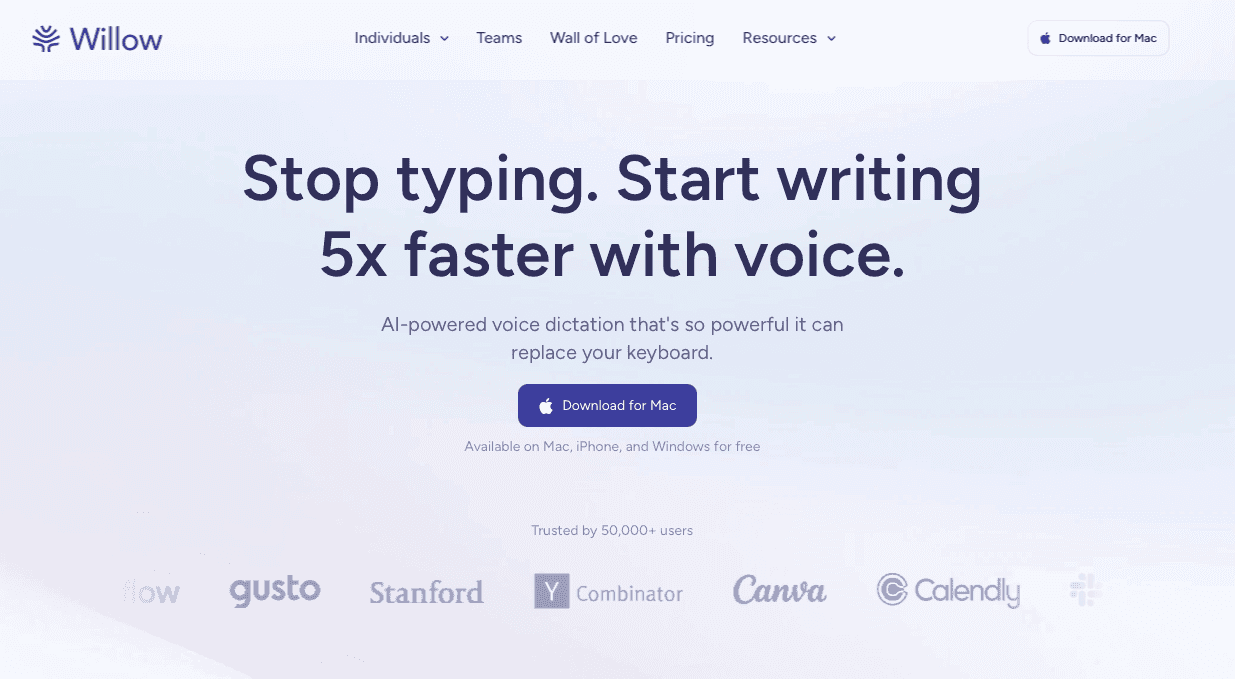
One challenge with rubber duck debugging is that documenting your reasoning can interrupt your flow. Stopping mid-explanation to type breaks the reasoning chain. Speaking at 150 WPM while Willow transcribes in near real time keeps your explanation running continuously, the exact condition the method needs.
Where Willow earns its place is codebase auto-tagging. When you dictate a debugging session in Cursor or Windsurf, Willow reads your open files and learns your class names, function names, and variable references. Say "the fetchUserData function isn't handling the null case in the response handler" and it transcribes correctly with voice dictation for Windsurf IDE, without manual correction. Those spoken explanations land cleanly as code comments, debugging notes, or documentation at 98%+ accuracy.
If you're explaining code out loud anyway, Willow Voice transcribes it so your debugging session becomes documentation instead of disappearing into the air.
FAQs
What is rubber duck debugging and why does it work?
Rubber duck debugging is explaining your code line by line to an inanimate object, forcing your brain to construct the reasoning from scratch. That verbalization exposes gaps you can't see while scanning code silently, which is the same mechanism behind the protégé effect.
Can I use rubber duck debugging for problems outside of programming?
Yes. It applies to writing, legal theory, product decisions, or exam prep. Articulating a problem to an audience that can't help forces you to fill in every gap yourself.
When does rubber duck debugging not work well?
The method breaks down when the bug requires live data or environment context you can't reproduce by talking through it, when you lack the foundational knowledge to recognize what's wrong, or when you need a second opinion on architecture tradeoffs.
Final Thoughts on Rubber Duck Debugging and Why It Still Works
Rubber duck debugging has lasted because the core idea is correct: you cannot talk through a problem and stay stuck in the same mental loop at the same time. Whether you use a physical duck, an AI tool, or a voice dictation tool like Willow to capture your reasoning as you go, the mechanism is the same. Articulating your logic forces your brain to rebuild it, and rebuilding it is where the fix appears. No special software required, no experience level required. Just explain the code out loud, and let the explanation do the work.
Debugging alone in your head lets your brain take shortcuts you don't even notice. You scan familiar patterns, assume certain steps work the way you remember, and miss the gap between what you meant to write and what you actually wrote. Rubber duck debugging fixes that by making you explain the code out loud to an object that cannot respond or help. Articulating your logic sequentially forces you to slow down and rebuild your mental model from scratch, which is where bugs surface. The method was popularized by a story in The Pragmatic Programmer and later became a widely recognized part of developer culture. The duck doesn't solve the problem. Explaining your code to it does.
TLDR:
Explaining code line by line to an object forces your brain to rebuild logic from scratch, exposing skipped assumptions.
The method works because verbalization triggers linear processing; you can't gloss over steps when speaking them aloud.
It works best for logical errors you can walk through step by step, less well for environment-specific bugs or knowledge gaps.
Beyond coding, the technique applies anywhere you need to move from fuzzy intuition to clear reasoning.
Certain tools transcribe debugging explanations at ~200ms with codebase auto-tagging, preserving your reasoning flow.
What Is Rubber Duck Debugging?
Rubber duck debugging is a problem-solving method where a programmer explains their code, line by line, to an inanimate object, most commonly a rubber duck. The act of articulating the problem out loud forces a mental shift: you stop assuming your code works and start describing what it actually does. That gap between intention and description is often where the bug lives.
The method gets its name from a story in "The Pragmatic Programmer" by Andrew Hunt and David Thomas, where a developer carries a rubber duck and talks through code with it. No responses needed. The duck just listens.
Why It Works
The core mechanism is self-explanation. When you narrate your logic to someone, or something, that cannot fill in gaps for you, your brain is forced to construct the reasoning from scratch. That reconstruction surfaces assumptions you never questioned.
Explaining code sequentially exposes skipped steps you glossed over mentally.
Verbalizing expected behavior makes it easier to spot where actual behavior diverges.
The slight awkwardness of talking to an object keeps you slow and deliberate, which counters the tunnel vision that comes with deep debugging sessions.
The Origin Story: From The Pragmatic Programmer to Your Desk
The rubber duck debugging method traces back to a single anecdote in Andrew Hunt and David Thomas's 1999 book, The Pragmatic Programmer. A developer carries a rubber duck and explains their code to it line by line. The act of explaining, not the duck itself, triggers the insight.
The technique spread through developer culture before landing on forums, memes, and dedicated rubber duck debugging websites and apps. Today you can find dev ducks on Amazon and entire Reddit threads debating the best one for debugging sessions.
Why Developers Still Talk About It in 2026
Zero setup, no special software required. It spread widely and works just as well as voice dictation technology has evolved.
It works regardless of language, stack, or experience level, making it one of the few debugging habits junior and senior developers share.
Meme culture keeps new developers finding it organically, through xkcd, Reddit, or a gif a teammate sends.
The Psychology Behind Why Talking to a Duck Actually Works
Talking to a rubber duck works because verbalization triggers a different cognitive mode than silent reading. When you explain a problem out loud, your brain serializes abstract thoughts into linear language, exposing gaps you cannot see while scanning code quietly.
This relates to the protégé effect, a phenomenon in which teaching or explaining concepts often improves the explainer's understanding. You become more rigorous when you know someone is listening, even when that someone is made of plastic. Some research on robot duck debugging has shown that attentive listening behaviors can improve problem-solving outcomes.
Explaining code out loud also activates self-monitoring: you observe your own thinking in real time and often catch errors mid-sentence. Guardian's analysis of the protégé effect places it among the most effective ways to deepen knowledge and understanding.
Why the Duck?
A visible, silent, non-judgmental object removes social anxiety from the equation. You will say things to a rubber duck that you would hesitate to say in a code review, and that psychological safety is what lets the method work at full depth.
How to Practice Rubber Duck Debugging: A Step by Step Method
Pick a rubber duck, a stuffed animal, or any inanimate object nearby. What matters is that you treat it as a patient, non-judgmental listener.
Here is how the method works in practice:
Place the object where you can see it and speak to it directly. Facing something takes your mental mode from passive frustration to active explanation.
Start at the very beginning of the problem, not where you think the bug is. Walk through what the code is supposed to do, line by line if needed. Articulating the intended behavior often surfaces the gap between what you wrote and what you meant, a skill that translates directly to coding by voice.
Slow down when something feels awkward to explain. If a step is hard to put into words, your understanding of it probably has a hole in it.
Keep going until you spot the issue or reach the end of your explanation. Many developers find the answer arrives mid-sentence, before they finish describing the problem.
Why Speaking Out Loud Matters
Reading code silently lets your brain skip over familiar patterns and fill in gaps automatically. Speaking forces linear, sequential processing. You cannot gloss over a step when explaining it to someone else, even an imaginary someone.
When Rubber Duck Debugging Works Best and When It Doesn't
It works well when:
You have a logical error you can walk through step by step. Narrating forces you to slow down and catch the assumption you skipped.
You're stuck and spinning without progress. Speaking out loud changes you from passive frustration to active explanation.
You need to explain your code to someone else later. Rehearsing with a rubber duck often produces the clearest version of it.
It works less well when:
The bug requires live data or environment context you can't reproduce by talking through it. Narration won't surface a race condition in a distributed system.
You lack the foundational knowledge to recognize what's wrong. Explaining code you don't understand rarely produces insight on its own.
You need a second opinion on architecture or design tradeoffs, where a collaborator or AI tool can offer something a physical duck cannot.
Solo narration doesn't replace code review and won't catch what you don't know to look for.
Beyond Programming: Rubber Duck Debugging for Any Complex Problem
The method works just as well outside of coding. Writers use voice dictation for technical documentation to untangle arguments that aren't landing. Lawyers talk through case theories before opposing counsel does. Product managers explain a roadmap decision out loud and catch the assumption they hadn't questioned. Students use it before exams to find exactly where their understanding breaks down.
The core mechanism is the same: articulating a problem to an audience that cannot help you forces your brain to fill in every gap. You stop assuming and start explaining, and the explanation reveals what was missing.
When the Rubber Duck Method Transfers Best
You keep circling back to the same paragraph, unsure why it doesn't work. Explaining it aloud forces you to state what you're actually trying to say.
A decision feels wrong but you can't articulate why. Talking through it with a physical object before the meeting often surfaces the real objection, much like developers write bug reports faster when they verbalize the problem first.
You feel confident studying until you try to explain a concept, at which point the gaps appear immediately.
AI Powered Rubber Duck Debugging: When Your Duck Talks Back
AI tools have changed what rubber duck debugging looks like. Instead of explaining your code to a silent plastic toy, you can talk through problems with an AI that responds, asks questions, and points out gaps in your reasoning.
You describe a bug out loud, and the system reflects your explanation back, flags inconsistencies, and prompts you to think deeper. The act of articulating the problem still does the heavy cognitive lifting, but the AI adds targeted feedback a physical duck cannot.
Willow Voice fits naturally into this workflow. Developers dictate their problem explanation in real time, letting the words flow without stopping to type. Speaking with low-latency transcription helps keep your thought process intact, whether you're using AI voice dictation for Warp or another terminal-based workflow. You get the core benefit of rubber duck debugging, with the option to route that spoken explanation into an AI chat or documentation tool.
Approach | Core Mechanism | Best For |
|---|---|---|
Traditional Rubber Duck (Physical Object) | Silent object forces complete self-explanation without any external input or feedback loop | Logical errors you can walk through step by step when you need zero distraction |
AI-Powered Rubber Duck | Interactive system reflects your explanation back and flags inconsistencies in real time | Complex bugs where targeted follow-up questions help expose hidden assumptions |
Voice Dictation with Willow | Transcribes spoken explanation at 150 WPM with codebase auto-tagging and around 200ms latency | Debugging sessions where typing breaks your reasoning chain and you want a durable record |
Voice Dictation Meets Rubber Duck Debugging: Speaking Your Way to Better Code with Willow
One challenge with rubber duck debugging is that documenting your reasoning can interrupt your flow. Stopping mid-explanation to type breaks the reasoning chain. Speaking at 150 WPM while Willow transcribes in near real time keeps your explanation running continuously, the exact condition the method needs.
Where Willow earns its place is codebase auto-tagging. When you dictate a debugging session in Cursor or Windsurf, Willow reads your open files and learns your class names, function names, and variable references. Say "the fetchUserData function isn't handling the null case in the response handler" and it transcribes correctly with voice dictation for Windsurf IDE, without manual correction. Those spoken explanations land cleanly as code comments, debugging notes, or documentation at 98%+ accuracy.
If you're explaining code out loud anyway, Willow Voice transcribes it so your debugging session becomes documentation instead of disappearing into the air.
FAQs
What is rubber duck debugging and why does it work?
Rubber duck debugging is explaining your code line by line to an inanimate object, forcing your brain to construct the reasoning from scratch. That verbalization exposes gaps you can't see while scanning code silently, which is the same mechanism behind the protégé effect.
Can I use rubber duck debugging for problems outside of programming?
Yes. It applies to writing, legal theory, product decisions, or exam prep. Articulating a problem to an audience that can't help forces you to fill in every gap yourself.
When does rubber duck debugging not work well?
The method breaks down when the bug requires live data or environment context you can't reproduce by talking through it, when you lack the foundational knowledge to recognize what's wrong, or when you need a second opinion on architecture tradeoffs.
Final Thoughts on Rubber Duck Debugging and Why It Still Works
Rubber duck debugging has lasted because the core idea is correct: you cannot talk through a problem and stay stuck in the same mental loop at the same time. Whether you use a physical duck, an AI tool, or a voice dictation tool like Willow to capture your reasoning as you go, the mechanism is the same. Articulating your logic forces your brain to rebuild it, and rebuilding it is where the fix appears. No special software required, no experience level required. Just explain the code out loud, and let the explanation do the work.

Try Willow for free
Instant, accurate voice dictation. No card required.
Try Willow for free
Instant, accurate voice dictation. No card required.
Other stories you’ll love
Other stories you’ll love


Your keyboard is optional now
" transform="translate(5 5)" width="9.791000051498413px"/></svg>)

The voice-first interface for modern work.
© Willow Care, Inc. 2026. All rights reserved
Your keyboard is optional now
The voice-first interface for modern work.
© Willow Care, Inc. 2026. All rights reserved
Your keyboard is optional now
The voice-first interface for modern work.
© Willow Care, Inc. 2026. All rights reserved