" transform="translate(5 2)" width="10px"/></svg>)

•
5 min read
Write Legal Briefs Faster With Voice Dictation: August 2026

•
5 min read
Write Legal Briefs Faster With Voice Dictation: August 2026
Writing a strong brief has never been the hard part; it's the time it takes to get there. Between research, structuring arguments, and tightening language, most of the delay comes from how the work moves, not the thinking behind it. Learning how to write legal briefs fasterhow to write legal briefs faster starts with removing those slow points so your ideas can move from outline to finished draft without friction.
TLDR:
Legal briefs take 20-40 hours to complete due to research, precise writing, and multiple revision passes.
Voice dictation lets you draft at 150 WPM versus typing at 40 WPM, cutting drafting time considerably.
Faster drafting comes from removing workflow interruptions, not cutting corners on analysis.
Edit in three separate passes: argument logic first, citations second, and word choice third.
Some modern dictation tools learn legal terminology and case names after one correction, delivering 200ms response times that keep you in flow state while maintaining SOC 2 Type II and HIPAA compliance. The best options run natively on Mac and Windows and support firm-wide shared legal dictionaries so every attorney works from consistent terminology from day one.
Why Legal Brief Writing Takes So Long
Legal briefs demand precision in every sentence. A single argument requires case research, statutory analysis, and careful construction of legal reasoning. Attorneys spend 20 to 40 hours on a complex legal brief, including drafting, formatting, and editing. That's nearly a full work week devoted to one document.

The time drain comes from multiple sources. Research eats hours as you hunt for controlling authority and distinguish adverse precedent. Writing itself slows down because legal language requires accuracy over speed. You can't afford ambiguity or casual phrasing when judges review your work. After drafting comes multiple revision passes for substance, citation checking, and formatting compliance with court rules.
The Research Phase: Finding Relevant Authority Faster
Start with jurisdiction-specific databases to narrow your search scope immediately. If you're writing for a federal circuit court, filter results to that circuit and the Supreme Court before you read a single case. This cuts irrelevant precedent from other jurisdictions that won't help your argument.
Boolean search operators save hours of scrolling. Combine terms with AND, OR, and quotation marks to pinpoint cases discussing specific legal tests. Search "qualified immunity" AND "clearly settled" AND "Fourth Amendment" instead of broad terms that return thousands of results.
Find a successful brief from a similar case and mine its citations. Appellate court dockets and legal databases often include briefs from prior cases. If someone already won on facts like yours, their research gives you a vetted starting point.
Create a Clear Brief Structure Before Writing
Break each argument into component parts: issue statement, rule of law, application to facts, and conclusion. This IRAC framework creates a predictable structure that courts expect. When you know exactly what belongs in each section, drafting moves faster because you're filling in a blueprint instead of figuring out organization while writing.
Write descriptive headings that telegraph your argument. "The District Court Erred in Denying Summary Judgment" tells the reader more than "Summary Judgment." Effective headings function as a standalone outline of your brief.
Write Your First Draft Without Editing
Get your argument down without stopping to polish. Write every section in one continuous session, even when sentences feel clunky or citations are incomplete. Note missing case names in brackets and keep moving.
Skip research mid-draft. If you need additional authority, type "NEED CASE ON X" and continue with your analysis. Stopping to search breaks your train of thought and extends drafting time by hours. Batch all research tasks during revision instead.
Ignore formatting on the first pass. Don't adjust margins, fix spacing, or format citations to Bluebook standards while drafting. These mechanical tasks kill creative flow and pull your attention away from legal reasoning.
Your first draft will be rough, and that's fine. No attorney produces court-ready prose on the first attempt.
Use Templates and Standard Language
Build a personal library of language that works. Every brief includes sections that follow predictable patterns: jurisdictional statements, standards of review, procedural histories. Save successful versions and adapt them for future cases. When you've written clear language for a summary judgment standard, reuse it instead of starting over.
Create templates for argument structures that recur in your practice. If you regularly write motions to dismiss under Rule 12(b)(6), save your best explanation of the Twombly/Iqbal plausibility standard. Adapt the facts and allegations while keeping the legal framework that already passed judicial scrutiny.
Store boilerplate for common procedural sections. Certificate of service language, word count certifications, and appearance blocks rarely change. Keep these formatted correctly so you can drop them into any brief without checking court rules again.
Speak Instead of Type to Increase Speed
Speaking your argument aloud with the best dictation software often produces clearer reasoning than typing it. Attorneys naturally structure thoughts verbally when arguing in court or conferring with colleagues. That same skill applies to drafting briefs, where you can speak at 150 words per minute compared to typing at 40 words per minute.

Start with sections you know well, like reciting procedural history from the record. Speak in full sentences instead of fragments. Pause between thoughts to let the tool catch up, then continue. Within a week of regular use with professional voice to text tools, speaking complete paragraphs becomes automatic.
Willow learns legal terminology over time, remembering case names after you correct them once and building a personalized dictionary that gets more accurate with every brief. The 200ms response time means text appears as fast as you speak, keeping you in flow state instead of waiting. Willow runs natively on Mac and Windows, so attorneys activate it with fn on Mac or Alt+Space on Windows without changing their workflow. For firms handling sensitive matters, team plans include shared legal dictionaries across the whole group along with SOC 2 Type II and HIPAA compliance with zero data retention for client confidentiality.
Edit Systematically in Multiple Passes
Treat editing as three separate tasks instead of one review. Your brain works in different modes for each type of correction, so switching between structural revisions and comma placement slows you down.
First pass: check argument logic and organization. Move sections and remove weak points that don't strengthen your case. Skip typos and citation formatting.
Second pass: verify every citation and quotation against sources. Check that pinpoint citations match actual page numbers and quoted language appears word for word in the original.
Third pass: cut excess words and tighten language. Remove phrases like "it is important to note that" and replace passive constructions with active verbs. Read sentences aloud to catch awkward phrasing.
Use AI Tools for Drafting and Research
AI legal research tools scan databases faster than manual searches, surfacing relevant cases by analyzing fact patterns and legal issues. Document analysis features summarize depositions and discovery materials, pulling key facts you'd otherwise spend hours reading to find.
Use AI to generate argument outlines from your research notes. Feed the tool your strongest cases and let it draft a structure you can refine. Legal professionals save 5 hours weekly using AI for routine tasks, though you'll spend some of that time verifying outputs.
Never file AI-generated citations without checking them. Verify every case name, holding, and quotation against the actual source.
Reduce Cognitive Load with Better Organization
Set up multiple monitors to view source documents alongside your draft. One screen displays the brief while the other shows cases, deposition transcripts, or your research notes. Switching between windows breaks concentration and forces your brain to reload context each time.
Create a single folder for each brief with subfolders for research, drafts, and exhibits. Name files descriptively: "Smith_v_Jones_Qualified_Immunity_Cases.pdf" beats "Research1.pdf." When everything lives in one location with clear labels, you won't waste mental energy hunting for the motion you saved last Tuesday.
Keep only the current brief's materials open. Close unrelated tabs and documents. Every visible item competes for attention, even when you're not actively looking at it.
Simplify Citations and Formatting
Some citation tools can help speed up Bluebook formatting, but citations should still be reviewed manually. Tools like Zotero or legal citation generators can help generate citations from case names or statute numbers, but they still need manual review. Input the source once, and the software formats every subsequent reference correctly.
Create keyboard shortcuts for formatting marks that repeat in every brief with voice dictation software for professionals. Assign hotkeys to italicize case names, insert section symbols, or apply hanging indents. Four clicks become one keystroke.
Set up brief templates with margins, fonts, and spacing already matching court rules. When you open a new document, formatting requirements are built in.
Tool | Latency | Accuracy vs Built-in | Learning Capability | Security |
|---|---|---|---|---|
Willow Voice | 200ms response time | 3x more accurate than OS dictation | Learns case names and legal terms after one correction | SOC 2 Type II and HIPAA compliant with zero data retention |
Wispr Flow | 700ms or more | Standard accuracy with frequent fixes required | Limited legal terminology recognition | Consumer-grade security features |
Apple Built-in Dictation | Typically higher latency than specialized dictation tools | Baseline accuracy | No learning from corrections | Standard OS-level security |
How Voice Dictation Changes Legal Brief Writing
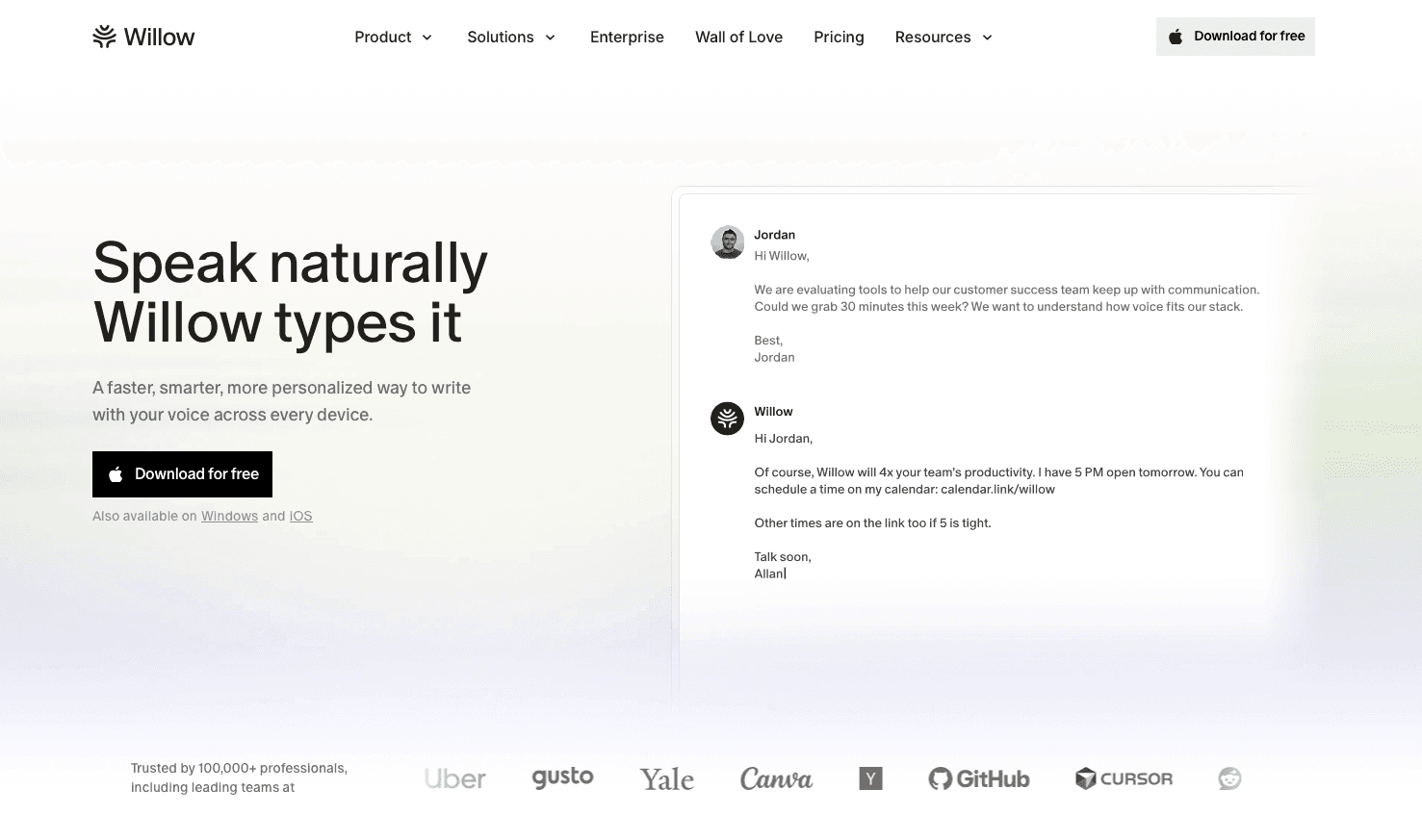
Voice can capture a more natural, conversational tone that may improve clarity in legal arguments. When you speak an argument, you naturally stress key points and structure reasoning the way you'd present it in court.
Willow learns your writing style over time, remembering case names, party identities, and practice-specific terminology after a single correction. Standard dictation tools like Apple's built-in voice dictation or Wispr Flow require constant fixes. The 200ms latency keeps you in flow state while competitors lag at 700ms or more, creating awkward pauses between speech and text. SOC 2 Type II and HIPAA compliance with zero data retention protects attorney-client privilege. Willow runs natively on both Windows and Mac, covering the mixed IT environments common at larger firms. Offline mode, quiet mode for shared offices, and custom dictionaries for legal terms round out features built for law firms.
FAQs
Should I speak my entire brief or just certain sections?
Start by speaking sections you know well, like procedural history or familiar legal standards, then expand as you get comfortable. Most attorneys find success speaking first drafts completely, then switching to keyboard for detailed citation work and final edits during the systematic revision passes.
Can I use voice dictation in a shared office without disturbing colleagues?
Yes, Willow's quiet mode allows you to speak softly or whisper while still producing accurate transcription. You can also use offline mode for complete privacy when working on sensitive matters that require attorney-client privilege protection.
What's the best way to edit a brief that was spoken instead of typed?
Use the same three-pass system: first review argument structure and logic, then verify all citations against sources, and finally tighten language and remove excess words. Reading spoken sections aloud during the final pass helps catch any remaining awkward phrasing that slipped through.
Final Thoughts on Making Legal Brief Writing Less Time-Consuming
Mastering how to write legal briefs fasterhow to write legal briefs faster comes down to removing the delays between thinking, drafting, and refining your argument. When each step flows without constant interruptions, you spend less time reworking sections and more time strengthening your position. Willow supports that process through voice-based drafting, learning your legal terminology over time, and running natively across the Mac and Windows environments most firms already run. For teams deploying across multiple attorneys, shared dictionaries and SOC 2 Type II compliance mean the whole group works from a consistent setup from day one. Learning how to write legal briefs faster while maintaining accuracy becomes far more achievable when your workflow keeps pace with your thinking.
Writing a strong brief has never been the hard part; it's the time it takes to get there. Between research, structuring arguments, and tightening language, most of the delay comes from how the work moves, not the thinking behind it. Learning how to write legal briefs fasterhow to write legal briefs faster starts with removing those slow points so your ideas can move from outline to finished draft without friction.
TLDR:
Legal briefs take 20-40 hours to complete due to research, precise writing, and multiple revision passes.
Voice dictation lets you draft at 150 WPM versus typing at 40 WPM, cutting drafting time considerably.
Faster drafting comes from removing workflow interruptions, not cutting corners on analysis.
Edit in three separate passes: argument logic first, citations second, and word choice third.
Some modern dictation tools learn legal terminology and case names after one correction, delivering 200ms response times that keep you in flow state while maintaining SOC 2 Type II and HIPAA compliance. The best options run natively on Mac and Windows and support firm-wide shared legal dictionaries so every attorney works from consistent terminology from day one.
Why Legal Brief Writing Takes So Long
Legal briefs demand precision in every sentence. A single argument requires case research, statutory analysis, and careful construction of legal reasoning. Attorneys spend 20 to 40 hours on a complex legal brief, including drafting, formatting, and editing. That's nearly a full work week devoted to one document.
The time drain comes from multiple sources. Research eats hours as you hunt for controlling authority and distinguish adverse precedent. Writing itself slows down because legal language requires accuracy over speed. You can't afford ambiguity or casual phrasing when judges review your work. After drafting comes multiple revision passes for substance, citation checking, and formatting compliance with court rules.
The Research Phase: Finding Relevant Authority Faster
Start with jurisdiction-specific databases to narrow your search scope immediately. If you're writing for a federal circuit court, filter results to that circuit and the Supreme Court before you read a single case. This cuts irrelevant precedent from other jurisdictions that won't help your argument.
Boolean search operators save hours of scrolling. Combine terms with AND, OR, and quotation marks to pinpoint cases discussing specific legal tests. Search "qualified immunity" AND "clearly settled" AND "Fourth Amendment" instead of broad terms that return thousands of results.
Find a successful brief from a similar case and mine its citations. Appellate court dockets and legal databases often include briefs from prior cases. If someone already won on facts like yours, their research gives you a vetted starting point.
Create a Clear Brief Structure Before Writing
Break each argument into component parts: issue statement, rule of law, application to facts, and conclusion. This IRAC framework creates a predictable structure that courts expect. When you know exactly what belongs in each section, drafting moves faster because you're filling in a blueprint instead of figuring out organization while writing.
Write descriptive headings that telegraph your argument. "The District Court Erred in Denying Summary Judgment" tells the reader more than "Summary Judgment." Effective headings function as a standalone outline of your brief.
Write Your First Draft Without Editing
Get your argument down without stopping to polish. Write every section in one continuous session, even when sentences feel clunky or citations are incomplete. Note missing case names in brackets and keep moving.
Skip research mid-draft. If you need additional authority, type "NEED CASE ON X" and continue with your analysis. Stopping to search breaks your train of thought and extends drafting time by hours. Batch all research tasks during revision instead.
Ignore formatting on the first pass. Don't adjust margins, fix spacing, or format citations to Bluebook standards while drafting. These mechanical tasks kill creative flow and pull your attention away from legal reasoning.
Your first draft will be rough, and that's fine. No attorney produces court-ready prose on the first attempt.
Use Templates and Standard Language
Build a personal library of language that works. Every brief includes sections that follow predictable patterns: jurisdictional statements, standards of review, procedural histories. Save successful versions and adapt them for future cases. When you've written clear language for a summary judgment standard, reuse it instead of starting over.
Create templates for argument structures that recur in your practice. If you regularly write motions to dismiss under Rule 12(b)(6), save your best explanation of the Twombly/Iqbal plausibility standard. Adapt the facts and allegations while keeping the legal framework that already passed judicial scrutiny.
Store boilerplate for common procedural sections. Certificate of service language, word count certifications, and appearance blocks rarely change. Keep these formatted correctly so you can drop them into any brief without checking court rules again.
Speak Instead of Type to Increase Speed
Speaking your argument aloud with the best dictation software often produces clearer reasoning than typing it. Attorneys naturally structure thoughts verbally when arguing in court or conferring with colleagues. That same skill applies to drafting briefs, where you can speak at 150 words per minute compared to typing at 40 words per minute.
Start with sections you know well, like reciting procedural history from the record. Speak in full sentences instead of fragments. Pause between thoughts to let the tool catch up, then continue. Within a week of regular use with professional voice to text tools, speaking complete paragraphs becomes automatic.
Willow learns legal terminology over time, remembering case names after you correct them once and building a personalized dictionary that gets more accurate with every brief. The 200ms response time means text appears as fast as you speak, keeping you in flow state instead of waiting. Willow runs natively on Mac and Windows, so attorneys activate it with fn on Mac or Alt+Space on Windows without changing their workflow. For firms handling sensitive matters, team plans include shared legal dictionaries across the whole group along with SOC 2 Type II and HIPAA compliance with zero data retention for client confidentiality.
Edit Systematically in Multiple Passes
Treat editing as three separate tasks instead of one review. Your brain works in different modes for each type of correction, so switching between structural revisions and comma placement slows you down.
First pass: check argument logic and organization. Move sections and remove weak points that don't strengthen your case. Skip typos and citation formatting.
Second pass: verify every citation and quotation against sources. Check that pinpoint citations match actual page numbers and quoted language appears word for word in the original.
Third pass: cut excess words and tighten language. Remove phrases like "it is important to note that" and replace passive constructions with active verbs. Read sentences aloud to catch awkward phrasing.
Use AI Tools for Drafting and Research
AI legal research tools scan databases faster than manual searches, surfacing relevant cases by analyzing fact patterns and legal issues. Document analysis features summarize depositions and discovery materials, pulling key facts you'd otherwise spend hours reading to find.
Use AI to generate argument outlines from your research notes. Feed the tool your strongest cases and let it draft a structure you can refine. Legal professionals save 5 hours weekly using AI for routine tasks, though you'll spend some of that time verifying outputs.
Never file AI-generated citations without checking them. Verify every case name, holding, and quotation against the actual source.
Reduce Cognitive Load with Better Organization
Set up multiple monitors to view source documents alongside your draft. One screen displays the brief while the other shows cases, deposition transcripts, or your research notes. Switching between windows breaks concentration and forces your brain to reload context each time.
Create a single folder for each brief with subfolders for research, drafts, and exhibits. Name files descriptively: "Smith_v_Jones_Qualified_Immunity_Cases.pdf" beats "Research1.pdf." When everything lives in one location with clear labels, you won't waste mental energy hunting for the motion you saved last Tuesday.
Keep only the current brief's materials open. Close unrelated tabs and documents. Every visible item competes for attention, even when you're not actively looking at it.
Simplify Citations and Formatting
Some citation tools can help speed up Bluebook formatting, but citations should still be reviewed manually. Tools like Zotero or legal citation generators can help generate citations from case names or statute numbers, but they still need manual review. Input the source once, and the software formats every subsequent reference correctly.
Create keyboard shortcuts for formatting marks that repeat in every brief with voice dictation software for professionals. Assign hotkeys to italicize case names, insert section symbols, or apply hanging indents. Four clicks become one keystroke.
Set up brief templates with margins, fonts, and spacing already matching court rules. When you open a new document, formatting requirements are built in.
Tool | Latency | Accuracy vs Built-in | Learning Capability | Security |
|---|---|---|---|---|
Willow Voice | 200ms response time | 3x more accurate than OS dictation | Learns case names and legal terms after one correction | SOC 2 Type II and HIPAA compliant with zero data retention |
Wispr Flow | 700ms or more | Standard accuracy with frequent fixes required | Limited legal terminology recognition | Consumer-grade security features |
Apple Built-in Dictation | Typically higher latency than specialized dictation tools | Baseline accuracy | No learning from corrections | Standard OS-level security |
How Voice Dictation Changes Legal Brief Writing
Voice can capture a more natural, conversational tone that may improve clarity in legal arguments. When you speak an argument, you naturally stress key points and structure reasoning the way you'd present it in court.
Willow learns your writing style over time, remembering case names, party identities, and practice-specific terminology after a single correction. Standard dictation tools like Apple's built-in voice dictation or Wispr Flow require constant fixes. The 200ms latency keeps you in flow state while competitors lag at 700ms or more, creating awkward pauses between speech and text. SOC 2 Type II and HIPAA compliance with zero data retention protects attorney-client privilege. Willow runs natively on both Windows and Mac, covering the mixed IT environments common at larger firms. Offline mode, quiet mode for shared offices, and custom dictionaries for legal terms round out features built for law firms.
FAQs
Should I speak my entire brief or just certain sections?
Start by speaking sections you know well, like procedural history or familiar legal standards, then expand as you get comfortable. Most attorneys find success speaking first drafts completely, then switching to keyboard for detailed citation work and final edits during the systematic revision passes.
Can I use voice dictation in a shared office without disturbing colleagues?
Yes, Willow's quiet mode allows you to speak softly or whisper while still producing accurate transcription. You can also use offline mode for complete privacy when working on sensitive matters that require attorney-client privilege protection.
What's the best way to edit a brief that was spoken instead of typed?
Use the same three-pass system: first review argument structure and logic, then verify all citations against sources, and finally tighten language and remove excess words. Reading spoken sections aloud during the final pass helps catch any remaining awkward phrasing that slipped through.
Final Thoughts on Making Legal Brief Writing Less Time-Consuming
Mastering how to write legal briefs fasterhow to write legal briefs faster comes down to removing the delays between thinking, drafting, and refining your argument. When each step flows without constant interruptions, you spend less time reworking sections and more time strengthening your position. Willow supports that process through voice-based drafting, learning your legal terminology over time, and running natively across the Mac and Windows environments most firms already run. For teams deploying across multiple attorneys, shared dictionaries and SOC 2 Type II compliance mean the whole group works from a consistent setup from day one. Learning how to write legal briefs faster while maintaining accuracy becomes far more achievable when your workflow keeps pace with your thinking.

Try Willow for free
Instant, accurate voice dictation. No card required.
Try Willow for free
Instant, accurate voice dictation. No card required.
Other stories you’ll love
Other stories you’ll love


Your keyboard is optional now
" transform="translate(5 5)" width="9.791000051498413px"/></svg>)

The voice-first interface for modern work.
© Willow Care, Inc. 2026. All rights reserved
Your keyboard is optional now
The voice-first interface for modern work.
© Willow Care, Inc. 2026. All rights reserved
Your keyboard is optional now
The voice-first interface for modern work.
© Willow Care, Inc. 2026. All rights reserved