" transform="translate(5 2)" width="10px"/></svg>)

•
5 min read
Top Voice-to-Text Tools for Developers (August 2026)

•
5 min read
Top Voice-to-Text Tools for Developers (August 2026)
Your hands shouldn't be the bottleneck in your development workflow, and voice-to-text tools make it possible to speak code, documentation, and prompts at natural conversational speed instead of tapping away on a keyboard. These tools continue to grow in capability, giving developers a fresh way to write, refactor, and probe ideas quickly while staying fully engaged with the logic of their projects. For example, a developer might speak a full prompt to Cursor (describing a function's inputs, expected output, and edge cases) in under 20 seconds, where typing the same prompt would take two minutes. Or they might narrate inline documentation for a complex module without ever leaving the keyboard shortcut that keeps their IDE in focus. We compared the top options to see which ones actually understand programming languages with enough accuracy to be useful and which ones are still prone to constant corrections, awkward pauses, or misheard syntax that break your focus and slow down creative momentum.
TLDR:
Voice-to-text tools let developers code 4x faster by speaking at 150 WPM vs typing at 40 WPM.
Context-aware AI recognizes programming syntax and technical terms that basic dictation misses.
Free options like Apple Dictation and Talon Voice require setup time or lack coding accuracy.
Some advanced speech engines now deliver sub-1-second latency with markedly higher accuracy across coding tools and IDEs.
Modern speech models can adapt to unusual variable names, custom terminology, and project-specific language patterns.
What Are Voice-to-Text Tools for Developers?
Voice-to-text tools for developers are AI-powered speech recognition software that translate spoken words into written code and technical documentation. Unlike consumer dictation apps designed for emails or notes, these tools understand programming languages, syntax patterns, and technical terminology.
The speed difference matters. Most developers type around 40 words per minute when coding, while voice dictation allows speaking at 150+ words per minute. This makes voice input useful for writing boilerplate code, documentation, AI prompts in tools like Cursor or ChatGPT, and code comments.
Context awareness separates coding-focused voice tools from basic dictation. When you say "equals equals" in a JavaScript file, the tool knows you mean == instead of spelling out the words. It recognizes function names, variable declarations, and programming-specific phrases that would confuse general-purpose dictation software.
For developers dealing with RSI, carpal tunnel, or looking to speed up their workflow, voice coding has become a practical option.
How We Ranked Voice-to-Text Tools for Developers
We assessed voice-to-text tools across five core criteria that matter most for developers:
Accuracy for technical terminology was our first benchmark. The best tools recognize programming language keywords, function names, and API terminology without constant corrections.
Context-aware syntax recognition determines whether a tool understands programming patterns. When you say "arrow function" or "for loop," does it output the correct syntax?
Speed and latency directly affect workflow. We focus on tools with sub-1 second processing times, since waiting for transcription breaks your concentration when writing code.
Integration capabilities with IDEs, terminals, and development tools separated general dictation from developer-focused solutions. We looked into compatibility with popular coding environments and AI tools like Cursor and ChatGPT.
Accessibility features for RSI support. RSI affects many developers who spend hours coding, with symptoms including hand, wrist, and arm pain that can impact productivity.
Willow
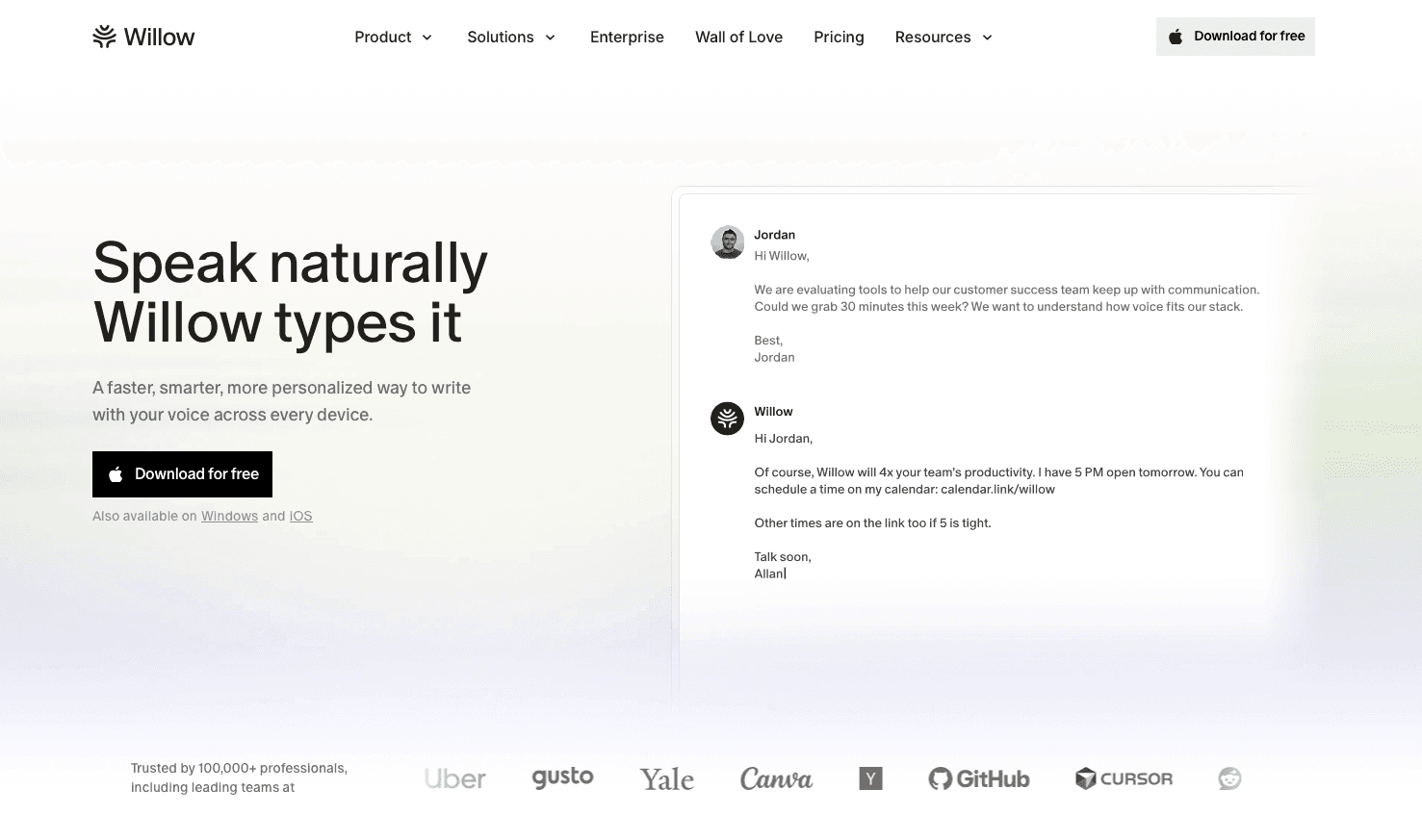
Willow Voice is a Mac, Windows, and iOS app built for developer productivity. It delivers 3x+ higher accuracy than built-in dictation tools with ~200ms latency for real-time coding workflows, whether you're on a Windows workstation, a Mac, or switching between devices during the day.
Press the Function key, speak naturally, and watch your technical requirements appear instantly in Cursor, ChatGPT, or any coding environment. The context-aware AI recognizes programming terminology and function names that trip up basic dictation software.
Core Strengths
Context-aware AI that understands technical terms, programming languages, and development workflows without requiring training or setup
Works across all coding environments on Mac and Windows, including Cursor, VS Code, Claude Code, ChatGPT, and any text field, with no per-app plugins required
Hotkey activation (fn on Mac, Alt+Space on Windows) for quick integration into existing development workflows, reassignable to any key combination you prefer
Custom dictionaries for company names, technical terms, and programming-specific vocabulary
The result: 4x faster input than typing while maintaining accuracy for programming contexts.
Apple Built-in Dictation
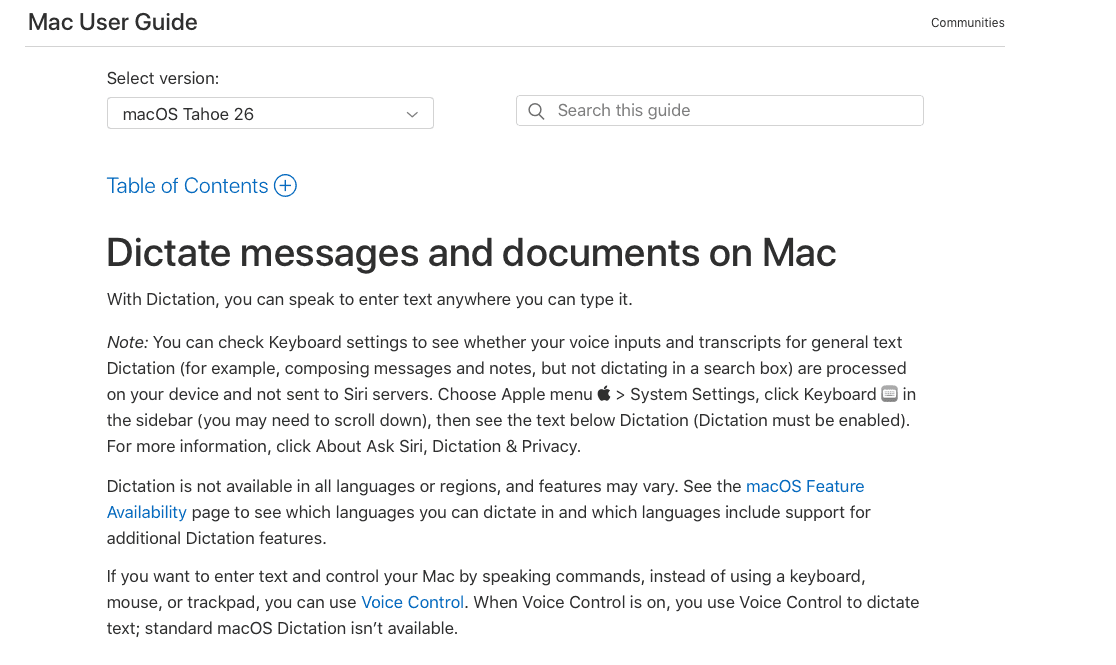
Apple's native dictation feature uses Siri-powered speech recognition built into macOS. While Mavericks Dictation achieved 89.6% accuracy compared to Dragon's 96.6%, it lacks the learning capabilities needed for development workflows.
What They Offer
Pre-installed on all Mac devices with no additional setup required
Enhanced dictation mode for offline processing and unlimited session length
Multi-language support with automatic language detection
Voice commands for basic punctuation and formatting
The 30-second time limit per session becomes problematic when explaining complex coding concepts. Apple's dictation also struggles with programming context awareness, frequently misinterpreting technical terminology as regular English words.
Bottom line: Adequate for basic text input but insufficient for serious development work requiring technical accuracy and extended coding sessions.
Talon Voice
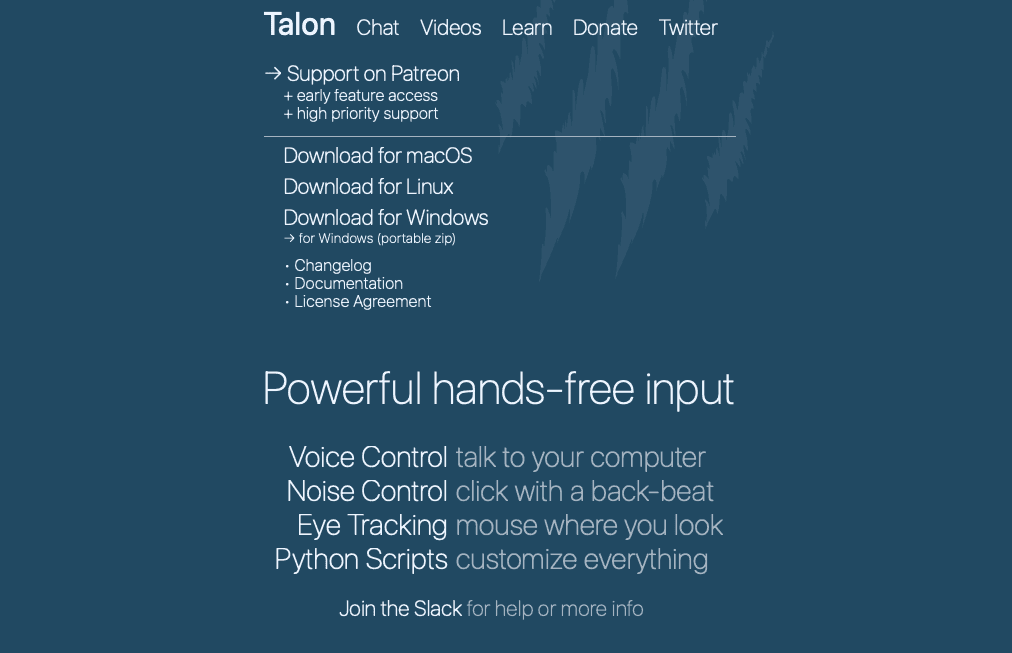
Talon Voice lets developers write code, play games, and control computers through voice, eye tracking, or noise recognition. Ryan Hileman built it for software developers who need hands-free computing.
What They Offer
Free speech recognition engine with Dragon compatibility for voice input
Eye tracking mouse control using Tobii hardware integration
Customizable Python scripting for personalized voice commands
Community-maintained command sets for immediate productivity
Talon's flexibility requires technical expertise to configure properly, which limits accessibility for developers without scripting experience.
Limitation: Requires Python knowledge to customize effectively.
Bottom line: Powerful hands-free coding solution for developers willing to invest time learning the system and writing custom configurations.
Serenade

Serenade began as an open-source speech-to-code engine built for developers. Founded in 2019 by Matt Wiethoff after a repetitive strain injury diagnosis, it translates programming intent through natural language commands.
What They Offer
Natural language programming that converts commands like "add function factorial" into actual code
VS Code integration with context-aware speech engines
Cloud or local processing options for different privacy needs
Onboarding resources and documentation to help new users get started
Limitation: Requires learning specific command syntax instead of conversational speech.
Bottom line: Programming-focused solution that demands memorizing command structures instead of natural speaking.
Best Speech-to-Text APIs for Developers Building Voice Features
The tools reviewed above help you use your voice while coding. If you are building a product that needs transcription or voice input built in, you need a speech recognition API instead. These four APIs are what most developers reach for when adding voice features to their own apps.
API | Response Latency | Price Per Minute (approx.) | Languages | Best For |
|---|---|---|---|---|
OpenAI Whisper | 2-5s async; real-time streaming available | $0.006/min (API); free self-hosted | 99+ | Multilingual apps, open-source projects |
Deepgram | ~300ms streaming | From $0.0043/min (Nova-2) | 36+ | Low-latency production apps, call analytics |
AssemblyAI | Real-time streaming available | $0.011/min async; $0.10/hr real-time | 99+ | Enriched transcription with sentiment, speaker ID |
Google Cloud Speech-to-Text | Sub-second streaming | $0.024/min standard; $0.036/min enhanced | 125+ | Wide language coverage, Google Cloud ecosystem |
OpenAI Whisper API
Whisper is OpenAI's open-source ASR model, available as a self-hosted model or through the OpenAI API. It covers 99+ languages and handles a wide range of audio quality levels without per-domain tuning.
Free self-hosted model or API access at $0.006 per minute
Real-time streaming available with the latest Whisper models
Open-source: inspect and modify the model for your use case
Handles multilingual audio without separate language detection steps
Best for: Multilingual transcription, open-source projects, and apps where cost per minute is a key constraint.
Deepgram
Deepgram is a low-latency API built for production voice applications. It offers custom model training for specific domains and some of the lowest streaming latency in the API category.
Nova-2 model starts at $0.0043 per minute for pre-recorded audio
Real-time streaming at approximately 300ms latency
Custom model training for domain-specific vocabulary
SDKs for Python, Node.js, Go, .NET, and Rust
Best for: Low-latency production apps, call analytics, and high-volume transcription where per-minute cost matters.
AssemblyAI
AssemblyAI adds intelligence on top of transcription: speaker diarization, sentiment analysis, auto chapters, and PII redaction. It is built for developers who need more than a raw transcript from their audio pipeline.
Async transcription at $0.65 per hour; real-time at $0.10 per hour
Speaker diarization, sentiment analysis, and topic detection included
Free tier available for development and testing
Best for: Apps that need enriched transcription with summaries, sentiment, or speaker identification built in.
Google Cloud Speech-to-Text
Google's speech API covers 125+ languages and includes specialized models for phone calls, video, and command-and-search contexts. It connects naturally with other Google Cloud services.
Standard model at $0.006 per 15 seconds ($0.024 per minute)
Enhanced model at $0.009 per 15 seconds for better accuracy
Streaming recognition with sub-second latency
Medical, phone, and video-specific model variants
Best for: Apps already in the Google Cloud ecosystem and projects needing wide language coverage or specialized audio models.
Why Willow Is the Best Voice-to-Text Tool for Developers
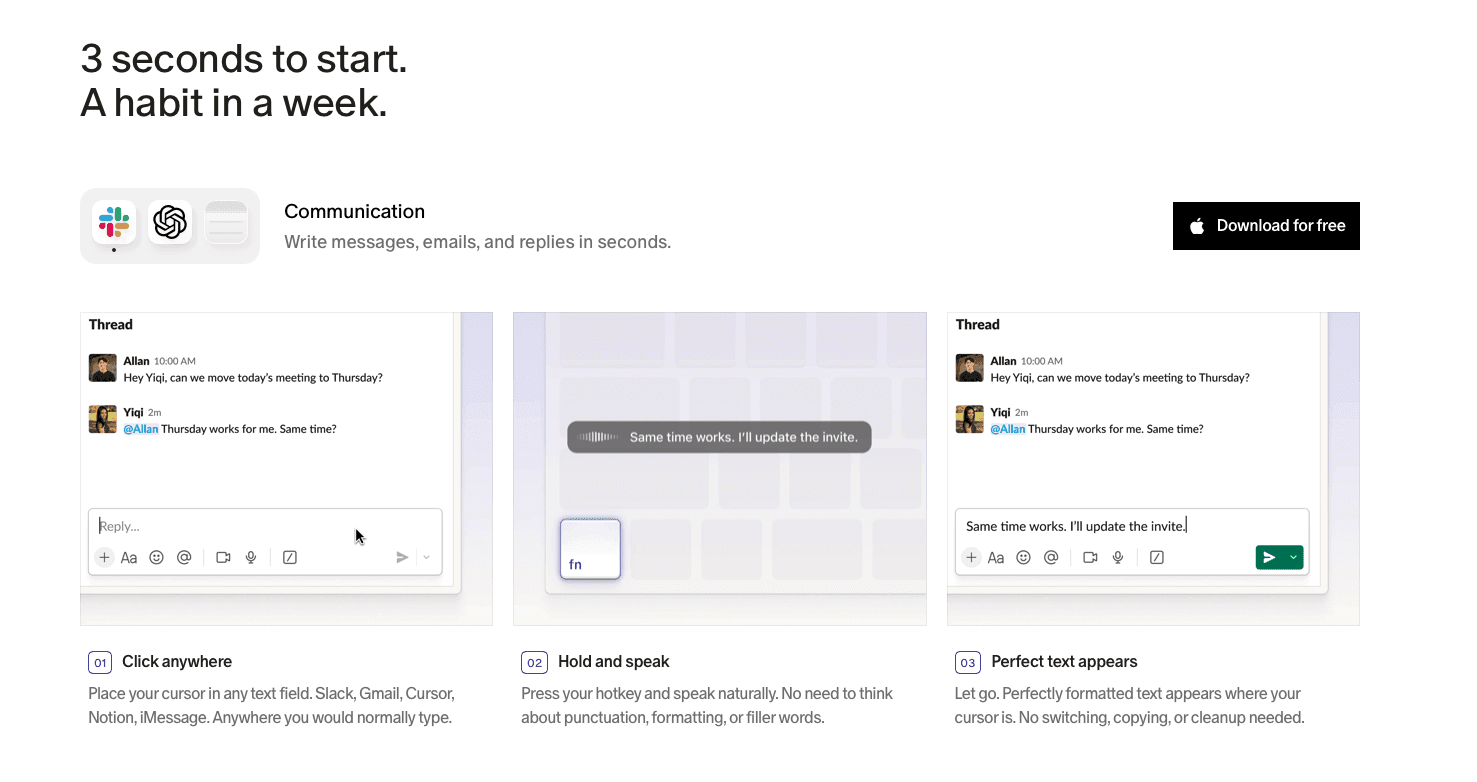
Willow Voice delivers faster development by letting you speak at 150 words per minute instead of typing at 40. The context-aware AI understands technical vocabulary across any development tool without memorization or complex setup. By speaking function requirements to Cursor, describing sprint tickets in Linear, filing PR descriptions through Claude Code, or drafting architecture docs, you get near-instant transcription triggered through a simple hotkey on Mac or Windows that matches your current workflow. SOC 2 Type II certified and HIPAA compliant, Willow is built for teams and organizations where security review is part of any tooling decision.
Willow supports long coding sessions, rapid idea exploration, and quick iteration whether you're working through complex logic or capturing async notes between meetings. For engineering teams running across Windows workstations and Macs, shared custom dictionaries keep codebase terminology consistent across every developer without per-user setup. The same hotkey and vocabulary that work on a Windows machine follow you to a Mac or iOS device, so the dictation habit forms and holds across your entire stack.
By speaking freely, you can browse through ideas, test approaches, and maintain steady progress during long problem-solving sessions.
FAQs
How do voice-to-text tools handle programming syntax and technical terms?
Modern voice-to-text tools use context-aware AI to recognize programming patterns and technical vocabulary. When you say "arrow function" or "equals equals" in a JavaScript file, the tool outputs the correct syntax (==) instead of spelling out the words, understanding your development environment.
Can I use voice dictation with AI coding assistants like Cursor and ChatGPT?
Yes, many voice-to-text tools work across a wide range of development environments, including Cursor, VS Code, Claude Code, ChatGPT, and other AI prompting tools. The best solutions activate with a simple hotkey (fn on Mac, Alt+Space on Windows) and work universally wherever you type on Mac, Windows, or iOS, making it easy to speak prompts, PR descriptions, and code explanations naturally.
What's the main difference between free and paid voice coding tools?
Free options like Apple Dictation and Talon Voice either lack programming context awareness or require extensive technical setup and scripting knowledge. Paid tools often offer higher accuracy (3x+ better), instant setup, and built-in understanding of technical terminology without memorizing custom commands.
How much faster is voice dictation compared to typing code?
Voice dictation lets you speak at 150 words per minute compared to typing at 40 words per minute, roughly 4x faster. This speed advantage works best for writing documentation, AI prompts, code comments, and boilerplate code instead of complex algorithm implementation.
Do voice-to-text tools help developers with RSI or carpal tunnel?
Yes, voice-to-text tools provide a practical solution for developers experiencing repetitive strain injuries, carpal tunnel, or hand and wrist pain from extended coding sessions. Speaking instead of typing reduces physical strain while maintaining productivity across your development workflow.
Final thoughts on speech recognition for developers
Modern AI voice-to-text tools have reached a point where developers can speak naturally and still get accurate code output, and Willow is a strong example of how this approach can fit into everyday work. When you can explain requirements, describe logic, or draft documentation at conversational speed, you open space for deeper thinking and quicker iteration without breaking concentration to tap out every detail. The real value shows up when the tool fades into the background, letting you press a key, talk through an idea, and watch it take shape.
Your hands shouldn't be the bottleneck in your development workflow, and voice-to-text tools make it possible to speak code, documentation, and prompts at natural conversational speed instead of tapping away on a keyboard. These tools continue to grow in capability, giving developers a fresh way to write, refactor, and probe ideas quickly while staying fully engaged with the logic of their projects. For example, a developer might speak a full prompt to Cursor (describing a function's inputs, expected output, and edge cases) in under 20 seconds, where typing the same prompt would take two minutes. Or they might narrate inline documentation for a complex module without ever leaving the keyboard shortcut that keeps their IDE in focus. We compared the top options to see which ones actually understand programming languages with enough accuracy to be useful and which ones are still prone to constant corrections, awkward pauses, or misheard syntax that break your focus and slow down creative momentum.
TLDR:
Voice-to-text tools let developers code 4x faster by speaking at 150 WPM vs typing at 40 WPM.
Context-aware AI recognizes programming syntax and technical terms that basic dictation misses.
Free options like Apple Dictation and Talon Voice require setup time or lack coding accuracy.
Some advanced speech engines now deliver sub-1-second latency with markedly higher accuracy across coding tools and IDEs.
Modern speech models can adapt to unusual variable names, custom terminology, and project-specific language patterns.
What Are Voice-to-Text Tools for Developers?
Voice-to-text tools for developers are AI-powered speech recognition software that translate spoken words into written code and technical documentation. Unlike consumer dictation apps designed for emails or notes, these tools understand programming languages, syntax patterns, and technical terminology.
The speed difference matters. Most developers type around 40 words per minute when coding, while voice dictation allows speaking at 150+ words per minute. This makes voice input useful for writing boilerplate code, documentation, AI prompts in tools like Cursor or ChatGPT, and code comments.
Context awareness separates coding-focused voice tools from basic dictation. When you say "equals equals" in a JavaScript file, the tool knows you mean == instead of spelling out the words. It recognizes function names, variable declarations, and programming-specific phrases that would confuse general-purpose dictation software.
For developers dealing with RSI, carpal tunnel, or looking to speed up their workflow, voice coding has become a practical option.
How We Ranked Voice-to-Text Tools for Developers
We assessed voice-to-text tools across five core criteria that matter most for developers:
Accuracy for technical terminology was our first benchmark. The best tools recognize programming language keywords, function names, and API terminology without constant corrections.
Context-aware syntax recognition determines whether a tool understands programming patterns. When you say "arrow function" or "for loop," does it output the correct syntax?
Speed and latency directly affect workflow. We focus on tools with sub-1 second processing times, since waiting for transcription breaks your concentration when writing code.
Integration capabilities with IDEs, terminals, and development tools separated general dictation from developer-focused solutions. We looked into compatibility with popular coding environments and AI tools like Cursor and ChatGPT.
Accessibility features for RSI support. RSI affects many developers who spend hours coding, with symptoms including hand, wrist, and arm pain that can impact productivity.
Willow
Willow Voice is a Mac, Windows, and iOS app built for developer productivity. It delivers 3x+ higher accuracy than built-in dictation tools with ~200ms latency for real-time coding workflows, whether you're on a Windows workstation, a Mac, or switching between devices during the day.
Press the Function key, speak naturally, and watch your technical requirements appear instantly in Cursor, ChatGPT, or any coding environment. The context-aware AI recognizes programming terminology and function names that trip up basic dictation software.
Core Strengths
Context-aware AI that understands technical terms, programming languages, and development workflows without requiring training or setup
Works across all coding environments on Mac and Windows, including Cursor, VS Code, Claude Code, ChatGPT, and any text field, with no per-app plugins required
Hotkey activation (fn on Mac, Alt+Space on Windows) for quick integration into existing development workflows, reassignable to any key combination you prefer
Custom dictionaries for company names, technical terms, and programming-specific vocabulary
The result: 4x faster input than typing while maintaining accuracy for programming contexts.
Apple Built-in Dictation
Apple's native dictation feature uses Siri-powered speech recognition built into macOS. While Mavericks Dictation achieved 89.6% accuracy compared to Dragon's 96.6%, it lacks the learning capabilities needed for development workflows.
What They Offer
Pre-installed on all Mac devices with no additional setup required
Enhanced dictation mode for offline processing and unlimited session length
Multi-language support with automatic language detection
Voice commands for basic punctuation and formatting
The 30-second time limit per session becomes problematic when explaining complex coding concepts. Apple's dictation also struggles with programming context awareness, frequently misinterpreting technical terminology as regular English words.
Bottom line: Adequate for basic text input but insufficient for serious development work requiring technical accuracy and extended coding sessions.
Talon Voice
Talon Voice lets developers write code, play games, and control computers through voice, eye tracking, or noise recognition. Ryan Hileman built it for software developers who need hands-free computing.
What They Offer
Free speech recognition engine with Dragon compatibility for voice input
Eye tracking mouse control using Tobii hardware integration
Customizable Python scripting for personalized voice commands
Community-maintained command sets for immediate productivity
Talon's flexibility requires technical expertise to configure properly, which limits accessibility for developers without scripting experience.
Limitation: Requires Python knowledge to customize effectively.
Bottom line: Powerful hands-free coding solution for developers willing to invest time learning the system and writing custom configurations.
Serenade
Serenade began as an open-source speech-to-code engine built for developers. Founded in 2019 by Matt Wiethoff after a repetitive strain injury diagnosis, it translates programming intent through natural language commands.
What They Offer
Natural language programming that converts commands like "add function factorial" into actual code
VS Code integration with context-aware speech engines
Cloud or local processing options for different privacy needs
Onboarding resources and documentation to help new users get started
Limitation: Requires learning specific command syntax instead of conversational speech.
Bottom line: Programming-focused solution that demands memorizing command structures instead of natural speaking.
Best Speech-to-Text APIs for Developers Building Voice Features
The tools reviewed above help you use your voice while coding. If you are building a product that needs transcription or voice input built in, you need a speech recognition API instead. These four APIs are what most developers reach for when adding voice features to their own apps.
API | Response Latency | Price Per Minute (approx.) | Languages | Best For |
|---|---|---|---|---|
OpenAI Whisper | 2-5s async; real-time streaming available | $0.006/min (API); free self-hosted | 99+ | Multilingual apps, open-source projects |
Deepgram | ~300ms streaming | From $0.0043/min (Nova-2) | 36+ | Low-latency production apps, call analytics |
AssemblyAI | Real-time streaming available | $0.011/min async; $0.10/hr real-time | 99+ | Enriched transcription with sentiment, speaker ID |
Google Cloud Speech-to-Text | Sub-second streaming | $0.024/min standard; $0.036/min enhanced | 125+ | Wide language coverage, Google Cloud ecosystem |
OpenAI Whisper API
Whisper is OpenAI's open-source ASR model, available as a self-hosted model or through the OpenAI API. It covers 99+ languages and handles a wide range of audio quality levels without per-domain tuning.
Free self-hosted model or API access at $0.006 per minute
Real-time streaming available with the latest Whisper models
Open-source: inspect and modify the model for your use case
Handles multilingual audio without separate language detection steps
Best for: Multilingual transcription, open-source projects, and apps where cost per minute is a key constraint.
Deepgram
Deepgram is a low-latency API built for production voice applications. It offers custom model training for specific domains and some of the lowest streaming latency in the API category.
Nova-2 model starts at $0.0043 per minute for pre-recorded audio
Real-time streaming at approximately 300ms latency
Custom model training for domain-specific vocabulary
SDKs for Python, Node.js, Go, .NET, and Rust
Best for: Low-latency production apps, call analytics, and high-volume transcription where per-minute cost matters.
AssemblyAI
AssemblyAI adds intelligence on top of transcription: speaker diarization, sentiment analysis, auto chapters, and PII redaction. It is built for developers who need more than a raw transcript from their audio pipeline.
Async transcription at $0.65 per hour; real-time at $0.10 per hour
Speaker diarization, sentiment analysis, and topic detection included
Free tier available for development and testing
Best for: Apps that need enriched transcription with summaries, sentiment, or speaker identification built in.
Google Cloud Speech-to-Text
Google's speech API covers 125+ languages and includes specialized models for phone calls, video, and command-and-search contexts. It connects naturally with other Google Cloud services.
Standard model at $0.006 per 15 seconds ($0.024 per minute)
Enhanced model at $0.009 per 15 seconds for better accuracy
Streaming recognition with sub-second latency
Medical, phone, and video-specific model variants
Best for: Apps already in the Google Cloud ecosystem and projects needing wide language coverage or specialized audio models.
Why Willow Is the Best Voice-to-Text Tool for Developers
Willow Voice delivers faster development by letting you speak at 150 words per minute instead of typing at 40. The context-aware AI understands technical vocabulary across any development tool without memorization or complex setup. By speaking function requirements to Cursor, describing sprint tickets in Linear, filing PR descriptions through Claude Code, or drafting architecture docs, you get near-instant transcription triggered through a simple hotkey on Mac or Windows that matches your current workflow. SOC 2 Type II certified and HIPAA compliant, Willow is built for teams and organizations where security review is part of any tooling decision.
Willow supports long coding sessions, rapid idea exploration, and quick iteration whether you're working through complex logic or capturing async notes between meetings. For engineering teams running across Windows workstations and Macs, shared custom dictionaries keep codebase terminology consistent across every developer without per-user setup. The same hotkey and vocabulary that work on a Windows machine follow you to a Mac or iOS device, so the dictation habit forms and holds across your entire stack.
By speaking freely, you can browse through ideas, test approaches, and maintain steady progress during long problem-solving sessions.
FAQs
How do voice-to-text tools handle programming syntax and technical terms?
Modern voice-to-text tools use context-aware AI to recognize programming patterns and technical vocabulary. When you say "arrow function" or "equals equals" in a JavaScript file, the tool outputs the correct syntax (==) instead of spelling out the words, understanding your development environment.
Can I use voice dictation with AI coding assistants like Cursor and ChatGPT?
Yes, many voice-to-text tools work across a wide range of development environments, including Cursor, VS Code, Claude Code, ChatGPT, and other AI prompting tools. The best solutions activate with a simple hotkey (fn on Mac, Alt+Space on Windows) and work universally wherever you type on Mac, Windows, or iOS, making it easy to speak prompts, PR descriptions, and code explanations naturally.
What's the main difference between free and paid voice coding tools?
Free options like Apple Dictation and Talon Voice either lack programming context awareness or require extensive technical setup and scripting knowledge. Paid tools often offer higher accuracy (3x+ better), instant setup, and built-in understanding of technical terminology without memorizing custom commands.
How much faster is voice dictation compared to typing code?
Voice dictation lets you speak at 150 words per minute compared to typing at 40 words per minute, roughly 4x faster. This speed advantage works best for writing documentation, AI prompts, code comments, and boilerplate code instead of complex algorithm implementation.
Do voice-to-text tools help developers with RSI or carpal tunnel?
Yes, voice-to-text tools provide a practical solution for developers experiencing repetitive strain injuries, carpal tunnel, or hand and wrist pain from extended coding sessions. Speaking instead of typing reduces physical strain while maintaining productivity across your development workflow.
Final thoughts on speech recognition for developers
Modern AI voice-to-text tools have reached a point where developers can speak naturally and still get accurate code output, and Willow is a strong example of how this approach can fit into everyday work. When you can explain requirements, describe logic, or draft documentation at conversational speed, you open space for deeper thinking and quicker iteration without breaking concentration to tap out every detail. The real value shows up when the tool fades into the background, letting you press a key, talk through an idea, and watch it take shape.

Try Willow for free
Instant, accurate voice dictation. No card required.
Try Willow for free
Instant, accurate voice dictation. No card required.
Other stories you’ll love
Other stories you’ll love


Your keyboard is optional now
" transform="translate(5 5)" width="9.791000051498413px"/></svg>)

The voice-first interface for modern work.
© Willow Care, Inc. 2026. All rights reserved
Your keyboard is optional now
The voice-first interface for modern work.
© Willow Care, Inc. 2026. All rights reserved
Your keyboard is optional now
The voice-first interface for modern work.
© Willow Care, Inc. 2026. All rights reserved